Alabama CDL Class B Practice Test (AL) 3

5 out of 5 (67 votes)
80% Passing score
20 Questions
4 Mistakes allowed
Welcome to your third Alabama CDL practice test, the ideal starting point for aspiring Class B commercial drivers. This test, consisting of 20 well-crafted questions, is designed to not only evaluate but also enhance your understanding of key aspects necessary for obtaining your CDL. To pass, you'll need to correctly answer at least 16 questions, reflecting a good grasp of the essential knowledge. What sets this Alabama CDL practice test apart is its close resemblance to the actual DMV written test. The questions, mirroring the format and content of the real exam, cover a broad range of topics vital for every commercial driver. You'll find yourself navigating through questions on pre-trip vehicle inspection, basic vehicle control, and gear shifting strategies, including the nuances of downshifting. Moreover, it delves into practical scenarios like handling hills and steep downgrades, effective communication with fellow road users, speed control, and the critical aspects of drug and alcohol awareness. Another notable feature of this Alabama CDL Class B Practice Test is the randomized question set. Each time you take the general knowledge practice test, you'll encounter a different array of questions. This approach ensures that you gain a comprehensive understanding of the subject matter, moving beyond rote memorization to a deeper, more intuitive grasp of the essentials for safe and effective commercial driving. Whether you are just starting out or looking to refine your knowledge, this Alabama CDL practice test is a robust tool in your preparation arsenal, offering a realistic and challenging learning experience.
FREE CDL Practice Test App
Pass your Alabama CDL General Knowledge test with the NextDoorDriving app. Real questions and answers—100% free and ad-free.
Download on the App Store

Sample Alabama CDL Test Questions - General Knowledge

Question 1

If the shoulder is clear during an emergency, why might steering right around an obstacle be safer than steering left?

  1. A Turning right prevents every skid
  2. B Turning right prevents hydroplaning
  3. C A vehicle may be overtaking on your left
  4. D Turning right guarantees that no collision will occur

Correct answer: C – A vehicle may be overtaking on your left

When the shoulder is clear, moving right may be the safer escape path because another vehicle may be passing on the left. Mirror use helps the driver identify which side is open before steering. If both sides are blocked, moving right may also avoid forcing another vehicle into an opposing traffic lane.

Source: Alabama Commercial Driver License Manual — § 2.17.1, “Steering to Avoid a Crash”

Question 2

An unblocked cargo article is longer than 5 feet but no longer than 10 feet. What is the minimum number of tiedowns required?

  1. A 1
  2. B 2
  3. C 3
  4. D 4

Correct answer: B – 2

Federal cargo-securement rules require at least two tiedowns for an unblocked article that is longer than 5 feet but no longer than 10 feet, regardless of its weight. Different rules apply to shorter articles, longer articles, and cargo blocked against forward movement. Cargo must also be secured against leaking, spilling, falling, or harmful shifting.

Source: 49 CFR § 393.110(a)–(c) – Additional Requirements for Determining the Minimum Number of Tiedowns, 49 CFR § 393.100(b)–(c) – Applicability and General Requirements of Cargo Securement Standards

Question 3

What condition should you look for when inspecting wheel-bearing seals?

  1. A Excessive tightness
  2. B Leakage
  3. C Paint discoloration only
  4. D Missing tread

Correct answer: B – Leakage

Wheel-bearing seals should be checked for signs of leaking lubricant. A leak may appear as a wet or oily area around the hub, seal, wheel, or brake components. Loss of lubricant can damage the bearing, and contamination reaching the brake surfaces may reduce braking performance.

Source: Alabama Commercial Driver License Manual — § 2.1.5, “Do a Walk-Around Inspection”

Question 4

On an Alabama roadway, what must you do when facing a red, octagonal STOP sign?

When approaching this sign _____________.
  1. A Stop only if cross traffic is present
  2. B Slow down and yield without stopping
  3. C Stop only during heavy traffic
  4. D Come to a complete stop

Correct answer: D – Come to a complete stop

A STOP sign requires a complete stop, not merely a reduction in speed. After stopping, the driver must yield as required before entering the intersection. The sign is used where a full stop is required on the controlled approach, regardless of whether cross traffic is immediately visible.

Source: Ala. Code § 32-5A-112 – Vehicle Entering Stop or Yield Intersection; Collision as Prima Facie Evidence of Failure to Yield, MUTCD, 11th ed. with Revision 1 — § 2B.04, “STOP Sign (R1-1) and ALL-WAY Plaque (R1-3P)”

Question 5

Which statement describes a proper start on dry, level pavement?

  1. A Press the accelerator hard and release the clutch suddenly
  2. B Set the parking brake before every start, even when rollback is impossible
  3. C Start smoothly and use the parking brake only when needed to prevent rollback

Correct answer: C – Start smoothly and use the parking brake only when needed to prevent rollback

Accelerate smoothly and avoid releasing the clutch suddenly. The parking brake should be used when needed to keep the vehicle from rolling backward, then released after enough engine power is applied to prevent rollback. On dry, level pavement, it is normally unnecessary to use the parking brake for rollback control.

Source: Alabama Commercial Driver License Manual — § 2.2.1, “Accelerating”

Question 6

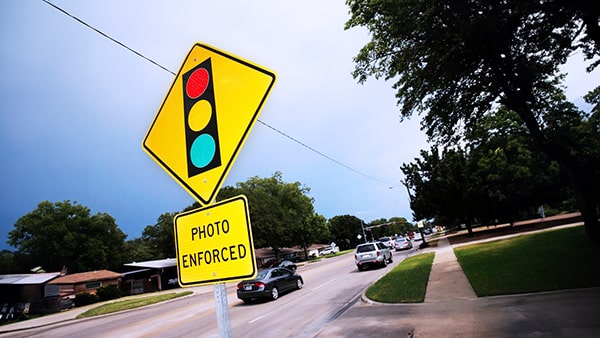
A yellow diamond sign displaying a vertical red-yellow-green signal warns of what ahead?

This sign indicates that the driver is ___________.
  1. A A yield sign
  2. B A stop sign
  3. C A traffic-control signal
  4. D A railroad crossing

Correct answer: C – A traffic-control signal

The Signal Ahead sign warns that a traffic-control signal is ahead. It gives drivers advance notice when the signal may not be visible far enough away for an appropriate response or when added emphasis is needed. Alabama commercial drivers should be prepared to slow or stop according to the signal indication and traffic conditions.

Source: MUTCD, 11th ed. with Revision 1 — § 2C.35, “Advance Traffic Control Signs (W3-1, W3-2, W3-3, and W3-4)”