


Alaska CDL Class B Practice Test (AK) 3

5 out of 5 (45 votes)
80% Passing score
20 Questions
4 Mistakes allowed
Dive into the heart of Alaskan driving with our third CDL practice test, specifically designed for Class B CDL applicants. This isn't just another test; it's a comprehensive tool that immerses you in the realities of commercial driving in Alaska. With 20 questions that mirror the diversity and complexity of the actual exam, this Alaska CDL class B practice test is your key to mastering the skills needed for the rugged Alaskan terrain. Imagine navigating the challenging roads of Alaska - it's all here in this general knowledge practice test. From mastering pre-trip vehicle inspections to perfecting gear shifting, including the crucial skill of downshifting, this CDL practice test covers it all. We also delve into handling steep hills and downgrades, a common scenario in our scenic state. Plus, it addresses the vital aspects of communication with other road users, controlling your vehicle's speed, and being aware of the importance of drug and alcohol regulations. The uniqueness of our practice test lies in its adherence to the most current driving laws and regulations, updated for 2026. This means you're not just practicing; you're staying ahead with the latest information. Every question is sourced from the official Alaska CDL driver's manual - the same resource used for the real CDL permit test. This alignment ensures that your preparation is not just thorough but also relevant. Our Alaska CDL Class B Practice Test is more than a learning tool; it's your gateway to understanding and conquering the specific challenges of Alaskan driving. It's about ensuring that when you're behind the wheel, you're not just driving; you're equipped with the knowledge and skills to safely and confidently navigate the unique Alaskan landscapes. Prepare to conquer the roads of the Last Frontier with precision and know-how!
FREE CDL Practice Test App
Pass your Alaska CDL General Knowledge test with the NextDoorDriving app. Real questions and answers—100% free and ad-free.
Download on the App Store

Sample Alaska CDL Test Questions - General Knowledge

Question 1

When should a driver downshift for a curve?

  1. A Before entering the curve
  2. B After beginning a downgrade beyond the curve
  3. C While traveling through the curve
  4. D Immediately after leaving the curve

Correct answer: A – Before entering the curve

Slow to a safe speed and select the proper gear before entering the curve. This allows some engine power to be used through the curve, helping the vehicle remain stable while turning. Attempting to change gears in the curve adds another task when the driver's attention should be on steering and vehicle control.

Source: Alaska Commercial Driver License Manual — § 2.3.1, “Before Entering a Curve”
Question 2

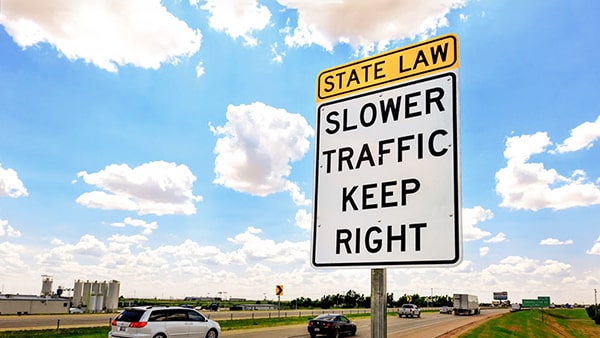
What does a SLOWER TRAFFIC KEEP RIGHT sign direct a driver to do?

This sign indicates that drivers ___________.
  1. A Use the right-hand lane when traveling slower than the normal traffic flow
  2. B Remain in the indicated lane regardless of speed
  3. C Pass slower vehicles only on the right
  4. D Increase speed to avoid using the right lane

Correct answer: A – Use the right-hand lane when traveling slower than the normal traffic flow

The sign directs slower-moving traffic toward the right-hand lane on a multilane roadway. It is used to improve roadway capacity and reduce unnecessary lane changes caused by slower vehicles impeding the normal traffic flow. It does not direct drivers to exceed a safe or lawful speed.

Source: Alaska Traffic Manual — MUTCD § 2B.38, “KEEP RIGHT EXCEPT TO PASS, SLOWER TRAFFIC KEEP RIGHT, and TRUCKS USE RIGHT LANE Signs”

Question 3

If oncoming headlights create glare at night, where should you direct your vision?

  1. A Slightly right, toward the right lane or edge marking
  2. B Toward the left shoulder
  3. C Directly at the centerline only
  4. D Into the oncoming headlights

Correct answer: A – Slightly right, toward the right lane or edge marking

Do not look directly into the headlights of an approaching vehicle. The CDL manual recommends looking slightly to the right at the right lane or edge marking, if one is available. This provides a roadway reference while reducing the blinding effect of the oncoming lights.

Source: Alaska Commercial Driver License Manual — § 2.11.5, “Avoid Glare from Oncoming Vehicles”

Question 4

Why should you keep the starter-switch key with you during an exterior vehicle inspection?

  1. A Only to prevent the key from being misplaced
  2. B To prevent someone from starting or moving the vehicle while you inspect it
  3. C Because the key opens components in the braking system
  4. D For both reasons A and C

Correct answer: B – To prevent someone from starting or moving the vehicle while you inspect it

The vehicle must remain secured throughout the exterior inspection. Keeping the starter key with you prevents another person from starting or moving the vehicle while you are beside or underneath it. This is particularly important when inspecting components that cannot be checked safely if the vehicle moves.

Source: Alaska Commercial Driver License Manual — § 2.1, “Vehicle Inspection”

Question 5

Which statement about loading a commercial vehicle in Alaska is correct?

  1. A The maximum legal weight is safe under every road and weather condition
  2. B The driver is not responsible for an overload when the shipper loaded the cargo
  3. C Vehicle and axle weights must remain within applicable legal limits
  4. D A thorough pre-trip inspection eliminates the need to recheck cargo during the trip

Correct answer: C – Vehicle and axle weights must remain within applicable legal limits

State regulations establish vehicle and load limits for operation on the state highway system, unless an applicable permit allows otherwise. The CDL manual requires the driver to recognize overloads and keep the vehicle within legal weight limits. A legal maximum is not a guarantee that the weight is safe for every road, weather, or operating condition.

Source: 17 AAC 25.011 — Prohibited Vehicles and Loads, Alaska Commercial Driver License Manual — § 3.2.2, “Legal Weight Limits”

Question 6

Which techniques are part of making a quick evasive turn safely?

  1. A Avoid braking while the vehicle is turning
  2. B Turn only as much as needed to clear the hazard
  3. C Be prepared to counter-steer after clearing the hazard
  4. D All of these techniques

Correct answer: D – All of these techniques

During a quick evasive turn, braking can lock the wheels and cause a skid. Turning farther than necessary increases the risk of skidding or rolling over. After clearing the hazard, the driver must be ready to counter-steer promptly to regain the intended path, making all three actions important parts of the maneuver.

Source: Alaska Commercial Driver License Manual — § 2.17.1, “How to Turn Quickly and Safely”