


Alaska CDL Practice Test: General Knowledge (AK) 6

5 out of 5 (43 votes)
80% Passing score
50 Questions
10 Mistakes allowed
Welcome to your sixth Alaska CDL practice test - a crucial step in your journey to mastering the essentials of commercial driving in Alaska. This general knowledge practice test, featuring a set of 50 well-rounded questions, is tailored to enhance your understanding of various aspects of commercial driving. Each question is carefully chosen to test your knowledge on critical topics such as vehicle equipment, handling road emergencies, accident procedures, pre-trip inspections, and even a touch on hazardous materials. This is vital knowledge, not just for those eyeing a HazMat endorsement, but for every aspiring commercial driver out there. What sets this CDL practice test apart is its consistency and focus on reinforcement. Regardless of the number of times you attempt it, the same set of questions will greet you. This repetition is not just a test of memory, but a deliberate strategy to deepen your understanding and ensure you are well-prepared for real-life scenarios on Alaskan roads. After each attempt, don't rush off. Take a moment to review the end-of-test summary. This summary isn't just a scorecard; it's a learning tool. It highlights the areas where you need improvement, offering correct answers for the questions you missed. This feedback loop is designed to solidify your knowledge and build confidence. Remember, there's no limit to how many times you can take this Alaska CDL practice test. Use it to your advantage. Practice until you're confident enough to move on to the next level. This isn't just about passing a test; it's about becoming a safe, knowledgeable, and responsible driver on the challenging and diverse terrains of Alaska.
FREE CDL Practice Test App
Pass your Alaska CDL General Knowledge test with the NextDoorDriving app. Real questions and answers—100% free and ad-free.
Download on the App Store

Sample Alaska CDL Test Questions - General Knowledge

Question 1

What causes most serious vehicle skids?

  1. A Driving too fast for roadway and weather conditions
  2. B Minor brake-adjustment differences
  3. C Placing extra weight over the steering axle
  4. D Normal wear on properly maintained tires

Correct answer: A – Driving too fast for roadway and weather conditions

Most serious skids result from traveling too fast for road conditions. Excessive speed may force a driver to brake, steer, or accelerate beyond the available tire traction. Adjusting speed to traffic, weather, and roadway conditions reduces the need for those abrupt control inputs.

Source: Alaska Commercial Driver License Manual — § 2.19, “Skid Control and Recovery”
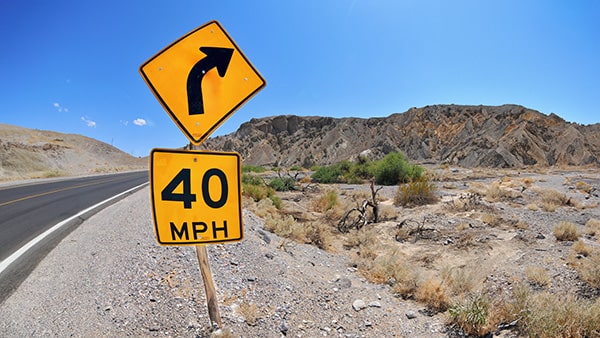
Question 2

A right-curve warning sign has a yellow 40 MPH advisory plaque beneath it. What does the plaque indicate?

This sign warns drivers to _______________.
  1. A Vehicles below 40 mph must remain in the right lane
  2. B Drivers are legally required to maintain at least 40 mph
  3. C The recommended operating speed for the curve is 40 mph
  4. D Drivers should exceed 40 mph while traveling through the curve

Correct answer: C – The recommended operating speed for the curve is 40 mph

An Advisory Speed plaque supplements a warning sign and displays the recommended operating speed for the condition ahead. A 40 MPH plaque beneath a curve sign advises drivers to approach and negotiate that curve at an appropriate speed near or below 40 mph. It is different from a regulatory speed-limit sign.

Source: Manual on Uniform Traffic Control Devices for Streets and Highways, 11th ed. — § 2C.59, “Advisory Speed Plaque (W13-1P) and Confirmation Advisory Speed Plaque (W13-1aP)”

Question 3

What is a likely result when too little vehicle weight rests on the front axle?

  1. A Steering can become unsafe because the steering axle is too lightly loaded
  2. B The drive-axle tires will automatically be damaged
  3. C The vehicle will handle better during turns
  4. D All of these results will occur

Correct answer: A – Steering can become unsafe because the steering axle is too lightly loaded

Shifting too much cargo weight toward the rear may leave the front axle underloaded. The steering axle can then become too lightly loaded for the vehicle to steer safely. Cargo should be distributed to maintain safe axle loading and handling while remaining within applicable weight limits.

Source: Alaska Commercial Driver License Manual — § 3.2.4, “Balance the Weight”

Question 4

What does the abbreviation GVW stand for?

  1. A Government vehicle weight
  2. B Gross variable weight
  3. C General vehicle width
  4. D Gross vehicle weight

Correct answer: D – Gross vehicle weight

GVW stands for gross vehicle weight. The Alaska CDL manual uses the term for the total weight of a single vehicle, including its load. GVW should not be confused with GVWR, which is the manufacturer’s loaded-weight rating for the vehicle.

Source: Alaska Commercial Driver License Manual — § 3.2.1, “Definitions You Should Know”

Question 5

What are the two functions of a combination vehicle’s emergency air line?

  1. A It supplies air to the trailer air tanks
  2. B It controls the trailer emergency brakes
  3. C It performs both functions
  4. D It carries only the service-brake signal

Correct answer: C – It performs both functions

The emergency or supply line carries air to the trailer’s air tanks. It also controls the emergency brakes on a combination vehicle. If pressure is lost in this line, the trailer emergency brakes apply; the loss may occur if a trailer separates or the line develops a major leak.

Source: Alaska Commercial Driver License Manual — § 6.2.4, “Trailer Air-lines”

Question 6

What is a possible effect of wet brakes?

  1. A A shorter stopping distance
  2. B Hydroplaning caused directly by the brake linings
  3. C Stronger and more even brake application
  4. D Reduced or uneven braking power

Correct answer: D – Reduced or uneven braking power

Water in the brakes may make them weak, uneven, or likely to grab. These conditions can reduce braking power and may cause wheel lockup or pulling to one side. On a combination vehicle, uneven brake action can also contribute to a jackknife.

Source: Alaska Commercial Driver License Manual — § 2.13.2, “Wet Brakes”