Alaska DMV Practice Test 7

4.3 out of 5 (101 votes)
80% Passing score
20 Questions
4 Mistakes allowed
The Alaska DMV practice test is a good place to get serious before the real General Knowledge Test starts asking questions with a clock running in the background. The official test gives you 20 questions and 25 minutes, and you need 16 correct answers to pass. That is 80%, which sounds friendly enough until you remember it means you can miss only 4. Not 5. Four. So yes, it is worth knowing the material before you sit down for the actual Alaska DMV test. This practice test follows that 20-question structure and keeps the focus where it belongs: road signs, traffic laws, safe driving judgment, proof of insurance, and the everyday rules that decide whether you are actually ready to drive in Alaska. And Alaska is not exactly a flat little loop around the block. Driving from Anchorage to a smaller rural community, or dealing with dark roads, weather shifts, and long stretches between services, has a way of making “general knowledge” feel a lot less general. The real knowledge test may be taken online through KnowTo Drive, provided you use a desktop or laptop with internet access and a front-facing camera or webcam. Touch devices are not supported, because apparently even testing platforms have their limits. You can also test through Alaska DMV offices or approved proctor locations, including DMV business partners, schools, police departments, Troopers, Village Public Safety Officers, and some government offices. That setup matters, especially for rural drivers who do not have a DMV office conveniently sitting ten minutes away. The same general knowledge test structure applies to first-time Class D permit and license applicants. Alaska applicants can apply for an instruction permit at age 14, with parental consent and the required documents, vision test, fee, and written test. Teens moving toward a provisional license need more than a lucky test score; they must hold a permit for at least 6 months, avoid recent violations or suspensions, complete 40 hours of driving practice, including 10 in progressively challenging circumstances, and pass the road test. Adults still need the required documents, knowledge test, vision test, road test unless exempt, and applicable fees. Use this Alaska practice permit test to slow down, make mistakes here instead of at the DMV, and build the kind of rule knowledge that holds up when the road gets messy, which, in Alaska, is not exactly rare.

FREE DMV Practice Test App
Study for your Alaska permit test or driver’s license with the NextDoorDriving app. 700+ DMV questions and answers, 100% free!
Download on the App Store

Sample Alaska Permit Test Questions

Question 1

A yellow diamond sign showing an arrow that bends sharply to the right warns that:

When you see this black and yellow sign, it means:
  1. A The roadway to the right carries one-way traffic
  2. B Construction traffic must detour right
  3. C The road changes direction sharply ahead
  4. D A side road enters from the right

Correct answer: C – The road changes direction sharply ahead

The sharp-turn sign warns that the roadway changes direction at a pronounced angle. Yellow diamond signs identify actual or potential hazards ahead and generally call for reduced speed and additional caution. Adjust your driving before reaching the turn rather than waiting until you are in it.

Source: Alaska Driver Manual — “Signs,” “Warning Sign”

Question 2

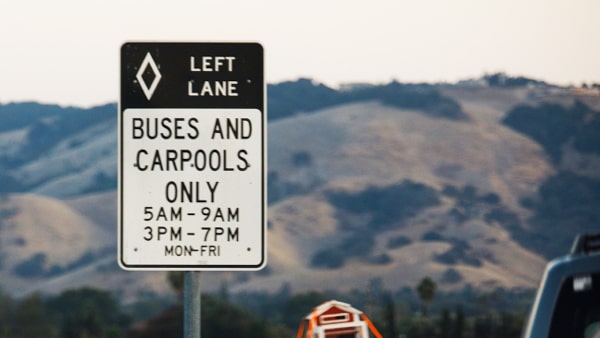
You approach a diamond-marked lane reserved for carpools and buses. When may you use it?

You can drive in a carpool lane if:
  1. A When your vehicle and trip meet the conditions shown on the posted signs
  2. B Whenever you are driving an otherwise empty passenger van
  3. C Whenever you want to pass slower traffic
  4. D Whenever you are running late

Correct answer: A – When your vehicle and trip meet the conditions shown on the posted signs

The Alaska driver manual identifies diamond-marked restricted lanes as preferential lanes assigned to vehicles such as buses and carpools. Special signs state the applicable restrictions. Drivers must obey those traffic-control devices and may use the lane only when they satisfy the posted conditions.

Source: 13 AAC 02.005(a) – Obedience to and Required Traffic-Control Devices, Alaska Driver Manual — “Pavement Markings,” “Restricted Lane”

Question 3

Compared with a lap-only restraint, a lap-and-shoulder belt generally:

  1. A Is ineffective during low-speed travel
  2. B Provides more complete occupant restraint
  3. C Prevents the vehicle from becoming involved in a crash
  4. D Is useful only in congested traffic

Correct answer: B – Provides more complete occupant restraint

A combined lap-and-shoulder belt provides more complete restraint than a lap belt alone. The driver manual recommends lap-and-shoulder belts for optimal protection when an occupant is large enough to use the vehicle’s belt. Both portions should be positioned and worn correctly.

Source: Alaska Driver Manual — “Child Restraints,” “Best Practice Recommendations”

Question 4

You are waiting to turn left at a green signal, but oncoming traffic is too close for a safe turn. What should you do?

  1. A Drive to the next intersection
  2. B Stop on the crosswalk
  3. C Wait before entering until a safe gap is available
  4. D Turn because the green signal gives you priority

Correct answer: C – Wait before entering until a safe gap is available

Alaska requires a left-turning driver to yield to an oncoming vehicle that is within the intersection or close enough to be an immediate hazard. The driver manual instructs motorists to wait for oncoming traffic before entering and not proceed past the intersection’s center while waiting. Turn only when an adequate gap is available.

Source: 13 AAC 02.125 – Vehicle Turning Left, Alaska Driver Manual — “Left Turn”

Question 5

Which action is a safe driving practice?

  1. A Checking your mirrors regularly to monitor surrounding traffic
  2. B Keeping your eyes fixed only on the road directly ahead
  3. C Using high beams in fog
  4. D Following another vehicle closely

Correct answer: A – Checking your mirrors regularly to monitor surrounding traffic

Mirrors help you remain aware of vehicles approaching from behind and beside you. The driver manual directs motorists to know what is happening behind them and to use mirrors when changing lanes. Mirror checks should be combined with direct blind-spot checks when preparing to move laterally.

Source: Alaska Driver Manual — “Control of Vehicle,” “How to Keep From Being Struck”, Alaska Driver Manual — “Highways,” “Changing Lanes”

Question 6

While driving through a residential area with parked vehicles, which child-related hazard requires special attention?

When you drive through an area where children are playing, you should expect them:
  1. A Children will always recognize when it is safe to cross
  2. B Children will remain at the curb until you stop
  3. C Children may be present behind or between parked vehicles
  4. D Children will enter the roadway only with an adult

Correct answer: C – Children may be present behind or between parked vehicles

The Alaska driver manual calls for extraordinary caution around parked vehicles in residential areas because children may be behind or between them. Maintain careful observation and be prepared to respond to a child’s presence. Do not treat the absence of a visible child as proof that the area is clear.

Source: 13 AAC 02.545(b) – Drivers to Exercise Care, Alaska Driver Manual — “Leaving Parking Space”