Alaska Road Signs Test 2

5 out of 5 (39 votes)
80% Passing score
20 Questions
4 Mistakes allowed
Use this Alaska DMV signs practice test to review the road signs, signals, and markings you may see on the state knowledge test. It is a practical way to make sure those familiar-looking signs still mean what you think they mean, because “I’ve seen that one before” is not always the same as knowing the rule. Alaska has a funny way of making signs feel a little more urgent when it is dark at 3:30 in the afternoon, the shoulder is packed with snow, and the next clear stretch of road is not exactly around the corner. This road signs drivers test gives you 20 multiple-choice questions, which lines up nicely with Alaska’s General Knowledge Test format. And here is the bit people sometimes miss: Alaska does not have a separate road-sign-only test for a standard Class D instruction permit or driver license. Road signs are folded into the regular knowledge test, along with traffic signals, pavement markings, and the usual rules-of-the-road material. You need 16 correct answers to pass, so yes, you can miss up to 4 total questions. No special sign-question loophole. No secret “but I only missed signs” exception. The DMV, inconveniently, counts the whole test. The questions cover the signs you are expected to recognize without squinting at them like they are ancient runes: red signs that shut down bad ideas, green signs that point you where to go, yellow signs that politely warn you before the road gets weird, and signals and markings that keep everyone from improvising too much. In Alaska, that matters. Fog on the coast, ice in the Interior, long rural drives, wildlife crossings, low light, sudden weather — it all adds up, and not in a cute way. After the DMV practice test, you can review what you missed with hints and explanations, because guessing correctly once is not the same as knowing the rule. Slightly annoying, but true. This Alaska DMV permit practice test is meant to help you build the kind of sign recognition that carries over into the road test too, where stop signs, traffic signals, lane changes, speed control, intersections, following distance, and general driving judgment are all fair game. When you get to the road test, you may also deal with backing, quick stops, parallel parking, freeway entry and exit, three-point turns, and the whole “bring a properly insured, registered, working vehicle” situation. So, yes, start with the signs. They are not the whole licensing process, but they are a very good place to stop pretending you will just remember everything on test day.

FREE DMV Practice Test App
Study for your Alaska permit test or driver’s license with the NextDoorDriving app. 700+ DMV questions and answers, 100% free!
Download on the App Store

Sample Alaska Permit Test Questions

Question 1

A highway’s right edge line gradually angles toward the center of the roadway. What condition does this indicate?

  1. A An intersection is immediately ahead
  2. B A work zone begins at the taper
  3. C All traffic must turn left
  4. D The available roadway width is decreasing

Correct answer: D – The available roadway width is decreasing

A solid white edge line identifies the outside edge of the pavement or shoulder. When that line tapers inward, the usable roadway becomes narrower. Alaska’s marking standards use transition markings to guide traffic through reductions in available roadway or lane width.

Source: Alaska Traffic Manual — § 3B.12, “Lane-Reduction Transitions”, Alaska Driver Manual — “Marking”

Question 2

Which yellow warning sign indicates that a median is ending and opposing traffic will soon share an undivided roadway?

  1. A Two same-direction lanes joining into one
  2. B Two separated arrows joining beyond the end of a divider
  3. C One upward arrow beside one downward arrow
  4. D A horizontal double-headed arrow

Correct answer: B – Two separated arrows joining beyond the end of a divider

The Divided Highway Ends sign shows that the median or physical separation between opposing roadways will terminate ahead. After the transition, vehicles traveling in opposite directions will use the same undivided roadway. Drivers should remain to the right of approaching traffic.

Source: Alaska Traffic Manual — § 2C.21, “Divided Highway (Road) Signs (W6-1 and W6-2)”, Alaska Driver Manual — Signs, “Warning Sign”

Question 3

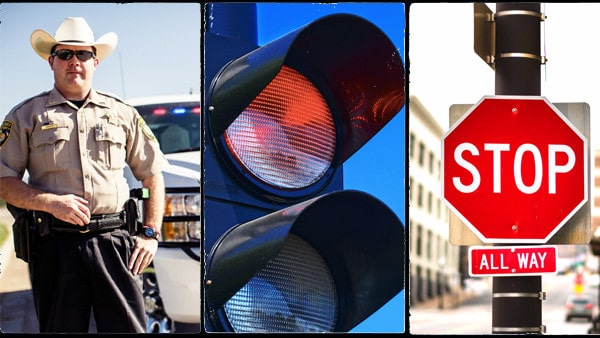
In Alaska, whose directions take priority over a traffic light or STOP sign?

Which of the following must you obey over the other three?
  1. A A driver facing a steady red light
  2. B A police officer directing traffic
  3. C A driver who reached the STOP sign first
  4. D A driver facing a flashing red light

Correct answer: B – A police officer directing traffic

Drivers must obey official traffic-control devices unless a police officer or another authorized person directs otherwise. An officer may order traffic to stop at a green signal or proceed despite a normally controlling sign or signal. Follow the officer’s directions carefully and promptly.

Source: 13 AAC 02.005(a) – Obedience to and required traffic-control devices, Alaska Driver Manual — “Traffic Signals”

Question 4

Red reflectors on the reverse side of roadway delineators are facing you. What does this indicate?

  1. A A busy intersection is ahead
  2. B A STOP sign is nearby
  3. C You are traveling in the wrong direction
  4. D You have entered a no-passing zone

Correct answer: C – You are traveling in the wrong direction

Red reflectors may be installed on the reverse side of delineators where they would be visible to a driver traveling the wrong way. Alaska’s traffic-control standards also call for red reflectors on the backs of delineators along one-way roads. Correct your direction only when you can do so safely.

Source: Alaska Traffic Manual — § 3G.03, “Delineator Application”

Question 5

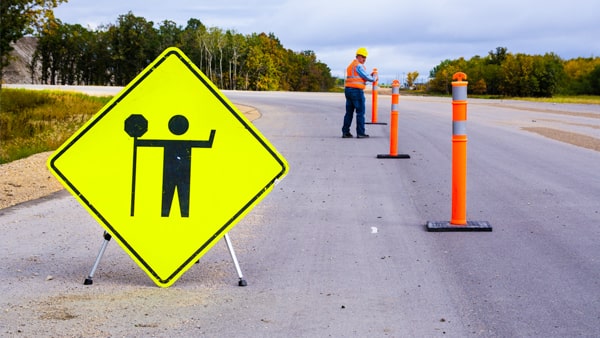
An orange diamond sign showing a person holding a flag warns that:

This sign means:
  1. A Pedestrians are crossing ahead
  2. B The work zone has ended
  3. C A school crossing is ahead
  4. D A flagger is directing traffic ahead

Correct answer: D – A flagger is directing traffic ahead

This work-zone sign warns that a flagger is controlling traffic ahead. The flagger may use a STOP/SLOW paddle or another authorized signal to stop or release vehicles. Reduce speed, watch for instructions, and be prepared to stop before reaching the flagger.

Source: Alaska Driver Manual — Signs, “Construction & Maintenance Sign”, Alaska Driver Manual — Signs, “Flagger Ahead”

Question 6

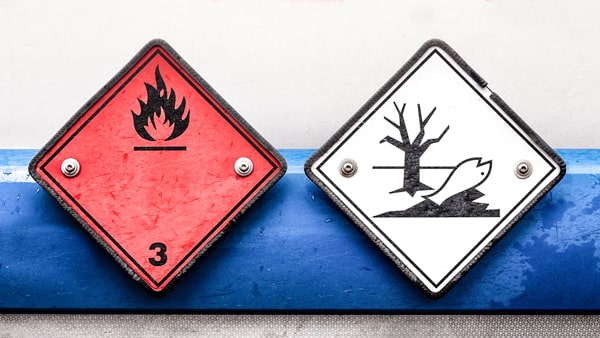
Under Alaska rules, what must the driver of a vehicle carrying an explosive substance or flammable liquid do at a railroad grade crossing?

Which of the following is true about vehicles displaying a diamond-shaped sign (indicating a hazardous load)?
  1. A Avoid all crossings located on major highways
  2. B Cross without stopping if traveling below 35 mph
  3. C Stop, look and listen before crossing unless a listed exception applies
  4. D Proceed first because the cargo is hazardous

Correct answer: C – Stop, look and listen before crossing unless a listed exception applies

The driver must stop between 15 and 50 feet from the nearest rail, look and listen in both directions, and proceed only when safe. The vehicle must cross in a gear that does not require shifting on the tracks. The rule does not require this stop when traffic is directed to proceed by a police officer, authorized flagger, or official traffic-control device.

Source: 13 AAC 02.240(a) – Obedience to signal indicating approach of train, 13 AAC 02.250(a)–(b) – Mandatory vehicle stops at railroad crossings