Alaska DMV Sign Test 3

5 out of 5 (35 votes)
80% Passing score
20 Questions
4 Mistakes allowed
If you’re studying for the Alaska road signs test, start with the part that tends to trip people up more than it should: signs are not just little roadside decorations with instructions slapped on them. Their shapes, colors, and symbols are doing work before you even get close enough to read the words. This Alaska DMV permit practice test zeroes in on that skill, while still keeping you tied to the bigger picture of the state’s General Knowledge Test. For a standard Class D instruction permit or driver license in Alaska, road signs and signals are included in the regular 20-question knowledge test. There is no separate road-sign-only score to survive, no hidden second tally, no special little trap door just for signs. You need 16 correct answers overall, which is an 80% passing score, and you can miss up to 4 questions total. The real test gives you 25 minutes, so yes, the clock matters a bit — not in a panic-inducing way, but enough that you should be comfortable recognizing signs without staring at them like they are abstract art. This Alaska DMV practice test includes 20 questions and gives you a sharper look at road sign shapes, meanings, and signals. An octagon means stop. A triangle means yield. Rectangles usually carry regulatory, directional, or general information, which sounds tidy on paper and gets a little less tidy when you are actually driving, checking traffic, watching lane markings, and trying not to miss your turn. That is where practice earns its keep. Many questions use visual aids, so you are not just memorizing lines from the Alaska Driver Manual; you are training your eyes to recognize what those signs look like in real road conditions. The official Alaska permit knowledge test also covers traffic laws, right-of-way rules, speed limits, pavement markings, safe driving practices, impaired driving, driver responsibility, and sharing the road with pedestrians, bicyclists, motorcycles, school buses, emergency vehicles, and large vehicles. This practice permit test does not replace drivers ed or the manual, and it should not pretend to. It works best as a solid review instead of moving straight to taking the real test.
FREE DMV Practice Test App
Study for your Alaska permit test or driver’s license with the NextDoorDriving app. 700+ DMV questions and answers, 100% free!
Download on the App Store

Sample Alaska Permit Test Questions

Question 1

What signal normally follows a steady yellow traffic light?

  1. A A flashing yellow light
  2. B A steady green light
  3. C A steady red light
  4. D A flashing red light

Correct answer: C – A steady red light

A steady yellow signal warns that the permitted movement is ending and a red signal will appear immediately afterward. Under Alaska regulation, stop if you can do so safely. If you are already in the intersection or too close to stop safely, proceed cautiously.

Source: 13 AAC 02.010(a)(2) – Traffic-control signal legend, Alaska Driver Manual — “Traffic Signals”
Question 2

A steady yellow arrow appears while you approach a left turn. What should you do?

  1. A Stop immediately, even if you are already in the intersection
  2. B Accelerate before the signal changes
  3. C Prepare to stop because a red indication is about to follow
  4. D Turn without yielding because the movement remains protected

Correct answer: C – Prepare to stop because a red indication is about to follow

A steady yellow arrow warns that a red indication is about to appear for the movement shown by the arrow. The Alaska Driver Manual directs drivers to stop unless they are already in the intersection or too close to stop safely. In that situation, complete the indicated turn cautiously.

Source: 13 AAC 02.010(a)(2) – Traffic-control signal legend, Alaska Driver Manual — “Traffic Signals,” “Yellow Arrow”

Question 3

On an Alaska road, a curb is painted yellow near a parking restriction. What should determine whether you may stop there?

  1. A The posted sign or wording marked on the curb
  2. B Whether a bus is using the area
  3. C Whether emergency vehicles are nearby
  4. D Whether you have a disability placard

Correct answer: A – The posted sign or wording marked on the curb

The traffic-control standards direct agencies to establish parking restrictions with standard signs. If curb markings are used without signs, wording such as “No Parking” or “No Standing” should identify the restriction. Local agencies may prescribe special curb colors, making the posted sign or curb wording the information a driver should follow.

Source: Alaska Traffic Manual — § 3B.18, “Curb Markings for Parking Regulations”

Question 4

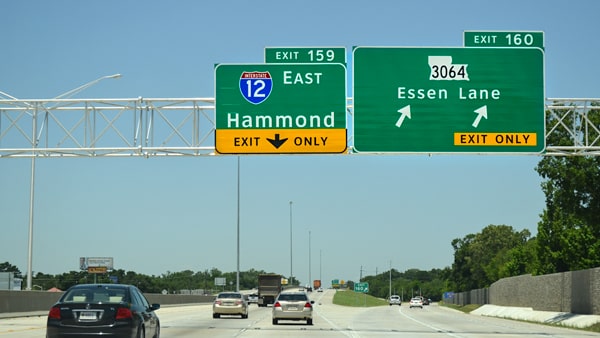
A freeway sign above your lane has a yellow EXIT ONLY panel and a downward arrow. If you remain in that lane, you must:

If you see this sign above your lane, you:
  1. A Continue past the exit without changing lanes
  2. B Choose either the exit or the through roadway at the last moment
  3. C Stop before entering the exit ramp
  4. D Leave the freeway on the exit ramp

Correct answer: D – Leave the freeway on the exit ramp

An EXIT ONLY panel identifies a lane that leaves the main roadway at the interchange. The Alaska Traffic Manual requires this panel for interchange lane drops where the through route continues on the main roadway. Change lanes safely before the exit if you intend to remain on the freeway.

Source: Alaska Traffic Manual — § 2E.28, “Signing for Interchange Lane Drops without an Optional Exit Lane”

Question 5

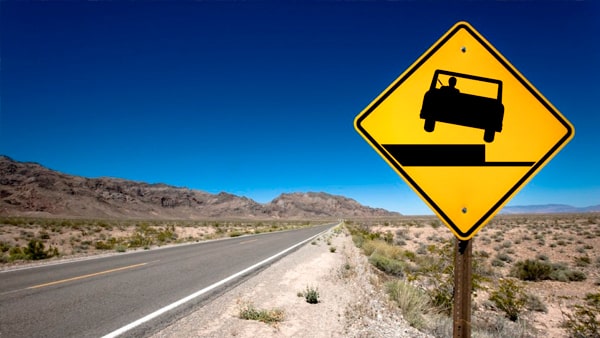
On an Alaska highway, a shoulder drop-off warning sign alerts you primarily to the danger of:

What should you be most concerned about when you see this sign?
  1. A Misaligned headlights caused by the roadway slope
  2. B Immediate tire damage from touching the shoulder
  3. C Hydroplaning whenever water is beside the roadway
  4. D Losing control if your wheels leave the pavement

Correct answer: D – Losing control if your wheels leave the pavement

The Shoulder Drop-Off sign warns of an unprotected shoulder more than three inches below the travel lane. A vehicle can become difficult to control if its wheels leave the pavement at that location. If this happens, ease off the accelerator, maintain a firm grip, brake lightly, and return at a slow speed when the way is clear.

Source: Alaska Traffic Manual — § 2C.29, “Shoulder Signs (W5-100, W8-4, W8-9, W8-17, W8-23, and W8-25)”, Alaska Driver Manual — Safety Tips, “Wheel(s) Off Roadway”

Question 6

A black-and-yellow chevron pointing right marks:

When you see this sign, it means:
  1. A An obstruction in the travel lane
  2. B Traffic entering from the right
  3. C A sharp change in roadway direction to the right
  4. D A merging lane ahead

Correct answer: C – A sharp change in roadway direction to the right

Chevron alignment signs emphasize a sharp or abrupt change in the roadway’s direction. Each chevron points in the direction drivers must follow through the alignment. They are commonly installed in a series along the outside of a curve, where drivers should adjust their speed and path accordingly.

Source: Alaska Traffic Manual — § 2C.08, “Chevron Alignment Sign (W1-8)”, Alaska Driver Manual — Signs, “Warning Sign”