Alaska Road Signs Test Simulator

5 out of 5 (36 votes)
80% Passing score
25 Questions
5 Mistakes allowed
This Alaska DMV permit practice test is built to feel close to the real thing, not like some throwaway quiz you click through once and forget. The official Alaska General Knowledge Test for a non-commercial Class D instruction permit or driver license has 20 questions, a 25-minute time limit, and an 80% passing score. In plain English, that means you need 16 correct answers, and you can miss 4. Our Alaska DMV practice test follows that same 20-question format, because practicing with the right shape of the test is half the battle (well, maybe not half, but it matters more than people think).  The questions are based on the Alaska Driver Manual and cover the material you are actually expected to know: road signs, traffic signals, pavement markings, lane markings, right-of-way rules, speed limits, safe driving habits, impaired driving laws, and the everyday judgment calls that come up when sharing the road with pedestrians, bicyclists, motorcycles, emergency vehicles, school buses, and large vehicles. Road signs are a big part of that, yes, but Alaska does not use a separate road-sign-only test for a standard Class D permit or license. Sign questions are mixed into the full knowledge test, right alongside the rest of the rules-of-the-road material, which is exactly why this Alaska permit practice test does not treat signs like they exist in a neat little bubble. Each session gives you 20 multiple-choice questions pulled from a broader question bank, so taking it again is not just busywork dressed up as studying. You will see new angles, new wording, and occasionally the kind of question that makes you slow down and think, which is annoying in the moment but useful later. That is the point. This DMV permit test simulator works for first-time permit applicants, license applicants, renewing drivers, seniors who want a refresher, and anyone who would rather find their weak spots here than during the official test through KnowTo Drive or an approved in-person or proctored option. And after the knowledge test, depending on your situation, the road test may still be waiting with its own demands: backing, lane changes, three-point turns, traffic signals, Stop signs, speed control, following distance, and yes, parallel parking in a 10-by-30-foot space. Start with the written material, get steady with it, and do not leave easy points sitting on the table.

FREE DMV Practice Test App
Study for your Alaska permit test or driver’s license with the NextDoorDriving app. 700+ DMV questions and answers, 100% free!
Download on the App Store

Sample Alaska Permit Test Questions

Question 1

What must you do when approaching a red-and-white triangular YIELD sign?

  1. A Slow only when an emergency vehicle is nearby
  2. B Continue through after looking in both directions
  3. C Come to a complete stop every time
  4. D Slow to a reasonable speed and stop if safety requires

Correct answer: D – Slow to a reasonable speed and stop if safety requires

A driver approaching a yield sign must slow to a speed reasonable for existing conditions. Stop if necessary, then yield to traffic in or approaching the intersection closely enough to be an immediate hazard. You may proceed without stopping when the way is clear and the movement can be made safely.

Source: 13 AAC 02.130(c) – Stop signs and yield signs, Alaska Driver Manual (Rev. 10/2025) — “Signs,” “Yield Sign”

Question 2

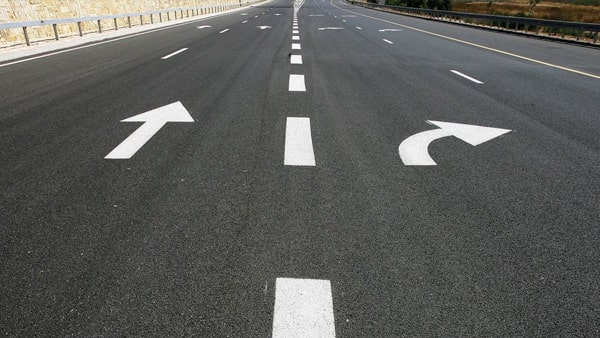
What does a dashed white line between two traffic lanes indicate?

A broken white center line on the roadway means:
  1. A Turning is prohibited from both lanes
  2. B A reduced-speed area begins ahead
  3. C Passing is prohibited in both directions
  4. D You may change lanes when the movement is safe

Correct answer: D – You may change lanes when the movement is safe

Dashed white lines separate lanes carrying traffic in the same direction where lane changing is not restricted. Before crossing the line, determine that the lane change can be made safely. Signal appropriately and account for nearby vehicles and blind spots before moving from your lane.

Source: 13 AAC 02.085(a) – Driving on roadways laned for traffic, Alaska Driver Manual (Rev. 10/2025) — “Marking”

Question 3

How should you respond to a steady yellow traffic light?

  1. A Accelerate before the signal changes
  2. B Continue after yielding to vehicles on the right
  3. C Stop if you can do so safely; otherwise continue cautiously
  4. D Stop immediately, even if hard braking is required

Correct answer: C – Stop if you can do so safely; otherwise continue cautiously

In Alaska, a steady yellow signal warns that the current movement is ending and a red indication will immediately follow. Stop unless you are already in the intersection or are too close to stop safely. If a safe stop is not possible, continue through the intersection cautiously rather than braking abruptly.

Source: 13 AAC 02.010(a)(2)(A) – Traffic-control signal legend, Alaska Driver Manual (Rev. 10/2025) — “Traffic Signals,” “Yellow Ball”

Question 4

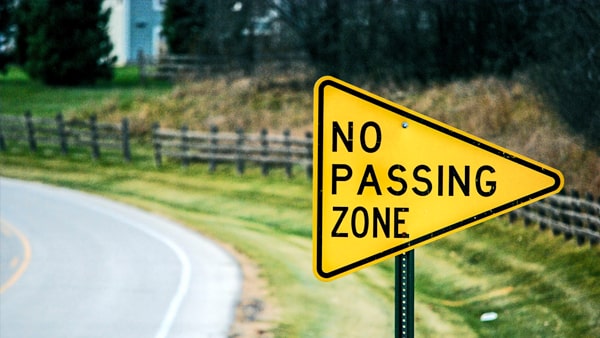
A yellow pennant-shaped sign posted on the left side of the roadway marks:

The sign with this shape and color is a _____________ sign.
  1. A The beginning of a no-passing zone
  2. B A wrong-way entrance
  3. C A railroad crossing
  4. D A required stop

Correct answer: A – The beginning of a no-passing zone

The yellow pennant warns that a no-passing zone begins ahead. It is normally placed on the left side of the roadway so drivers see it before entering the restricted area. Do not begin a pass when the restriction applies, and complete any lawful pass before reaching the zone.

Source: Alaska Driver Manual (Rev. 10/2025) — “Signs,” no-passing-zone warning sign, Alaska Driver Manual (Rev. 10/2025) — “Passing Safely”

Question 5

What colors are normally used for warning signs showing roadway hazards such as curves or narrow bridges?

  1. A Black symbols on a white background
  2. B Black symbols on a yellow background
  3. C White symbols on a blue background
  4. D White symbols on a green background

Correct answer: B – Black symbols on a yellow background

Standard warning signs for roadway conditions generally display black lettering or symbols on a yellow background. They alert drivers to actual or potential hazards ahead and call for increased attention. An advisory-speed plaque may accompany a warning sign to recommend a suitable speed for the condition.

Source: Alaska Driver Manual (Rev. 10/2025) — “Signs,” “Warning Sign”

Question 6

Your light turns green, but vehicles are still blocking the intersection. What should you do?

  1. A Enter the intersection and wait there
  2. B Drive around the vehicles if space appears available
  3. C Remain outside until the intersection clears
  4. D Enter because the green signal gives you priority

Correct answer: C – Remain outside until the intersection clears

A green signal permits movement when the intersection is clear, but drivers must yield to vehicles and pedestrians lawfully within it. Alaska’s manual also directs drivers to remain outside an intersection until they can enter safely. Wait for the blockage to clear, then proceed while checking that the signal still permits your movement.

Source: 13 AAC 02.010(a)(1)(A) – Traffic-control signal legend, Alaska Driver Manual (Rev. 10/2025) — “Traffic Signals,” “Green Ball”