


Arizona Permit Practice Test 3

4.9 out of 5 (416 votes)
80% Passing score
20 Questions
4 Mistakes allowed
The AZ permit test seems simple until you are sitting there trying to remember whether a rule applies to every driver or only ones over 21. Annoying? Maybe. Important? Very! This Arizona permit practice test gives you a cleaner way to sort all of that out before the real written test, without treating the whole process like a dry legal checklist. You will work through 20 questions covering Arizona traffic laws, safe driving habits, permit rules, and the kind of everyday driving knowledge the MVD expects you to actually understand. To pass this AZ permit practice test, you need at least 16 correct answers. That number matters because it gives you a useful benchmark, not just a nice little score at the end that makes you feel busy. For teen drivers, Arizona’s licensing process starts with the graduated instruction permit, available at age 15 years and 6 months after passing the written test and vision screening. Once you have that permit, it is valid for 12 months, and you cannot just cruise around solo because you feel ready. A licensed driver who is at least 21 must be seated beside you. Wireless communication devices are also off-limits while driving, except in a genuine emergency where stopping would be impossible or would make things even worse. And then, because Arizona likes its steps, there is the Class G license. Teens may apply at age 16 after holding the permit for at least 6 months and meeting the required driver education or supervised driving option. That could mean an approved driver education program, a qualifying defensive driving or traffic survival school program with supervised hours, or 30 supervised driving hours certified by a parent or guardian, including 10 at night. Adult first-time drivers have their own path. They still need the application, documents, fee, written test, vision screening, permit when required, and road test. They do not have to deal with the teen Class G holding period or supervised-hour rules, which is one small mercy, honestly. Use this Arizona DMV practice test with the Arizona Driver License Manual, a road sign review, and whatever drivers ed materials you have. The hints and explanations are there for the moments when guessing feels tempting, but learning the rule would save you trouble later.
FREE DMV Practice Test App
Study for your Arizona permit test or driver’s license with the NextDoorDriving app. 700+ DMV questions and answers, 100% free!
Download on the App Store

Sample Arizona Permit Test Questions

Question 1

A protected left-turn arrow changes to a circular green signal while you are waiting. What may you do?

  1. A Turn left after yielding to hazardous oncoming traffic and pedestrians
  2. B Proceed only straight through the intersection
  3. C Turn left with the same protected right-of-way as before
  4. D Remain stopped until another green arrow appears

Correct answer: A – Turn left after yielding to hazardous oncoming traffic and pedestrians

When the arrow changes to a circular green, a left turn remains permitted unless a sign prohibits it. The driver must yield to pedestrians and vehicles lawfully within the intersection. The driver must also yield to opposing vehicles that are in the intersection or close enough to present an immediate hazard.

Source: A.R.S. § 28-645(A)(1)(a) – Traffic control signal legend, A.R.S. § 28-772 – Vehicle turning left at intersection

Question 2

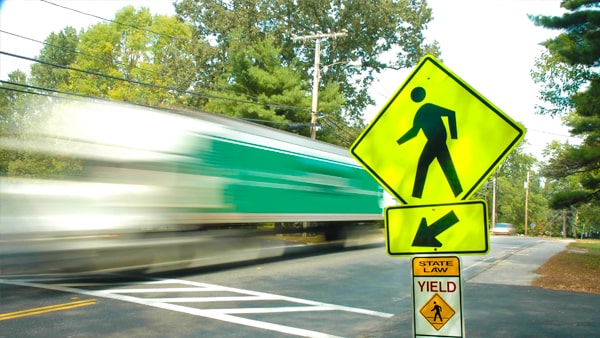
At an unsignalized marked midblock crosswalk, a pedestrian is crossing on your half of the roadway. What must you do?

If a pedestrian is in a crosswalk in the middle of a block:
  1. A Yield, slowing or stopping as necessary
  2. B Continue because pedestrians must yield at midblock locations
  3. C Continue because vehicles have priority in all midblock crosswalks
  4. D Sound the horn so the pedestrian crosses faster

Correct answer: A – Yield, slowing or stopping as necessary

Arizona requires a driver to yield at an unsignalized crosswalk when the pedestrian is on the driver's half of the roadway or is approaching that half closely enough to be in danger. The driver must slow or stop when needed to yield. A pedestrian may not suddenly enter the path of a vehicle that is too close for its driver to yield.

Source: A.R.S. § 28-792(A) – Right-of-way at crosswalk

Question 3

Before passing at 55 mph on a two-lane highway, what must you verify?

  1. A You can increase your speed to exactly 65 mph
  2. B The oncoming lane is clear far enough to complete the pass safely
  3. C Double solid yellow lines separate the lanes

Correct answer: B – The oncoming lane is clear far enough to complete the pass safely

Arizona law requires the left side to be clearly visible and free of oncoming traffic for enough distance to complete the pass safely. You must also return to the right before coming within 100 feet of an approaching vehicle. A particular speed increase does not establish that these conditions are met.

Source: A.R.S. § 28-725 – Limitations on overtaking on the left, Arizona Driver License Manual and Customer Service Guide — § 2, “Passing”

Question 4

After overtaking another vehicle, when should you move back into the right lane?

  1. A After its entire front is visible in your rearview mirror and the lane is clear
  2. B As soon as you activate your turn signal
  3. C Immediately after your vehicle moves ahead of it
  4. D When the other driver flashes the vehicle's headlights

Correct answer: A – After its entire front is visible in your rearview mirror and the lane is clear

The passed vehicle's entire front or both headlights should be visible in your rearview mirror before you prepare to return. Check over your shoulder to confirm that the lane is clear and signal before moving right. The law requires you to remain left until safely clear of the overtaken vehicle.

Source: A.R.S. § 28-723(1) – Overtaking a vehicle on the left, Arizona Driver License Manual and Customer Service Guide — § 2, “Passing”

Question 5

What should you do when another driver is following too closely behind you?

  1. A Apply the brakes abruptly
  2. B Speed up until the other driver falls behind
  3. C Increase the space between your vehicle and the vehicle ahead
  4. D Sound the horn and activate the emergency flashers

Correct answer: C – Increase the space between your vehicle and the vehicle ahead

Increase the cushion ahead so that you can brake more gradually if traffic slows. This gives the following driver additional time to react and stop. When it is safe, moving to another lane can also allow the tailgater to pass.

Source: Arizona Driver License Manual and Customer Service Guide — § 2, “Positioning Vehicle—Cushion of Space Around Your Vehicle”

Question 6

Which observation indicates that you have enough clearance to prepare to return after passing?

After passing a car, it is safe to return to your driving lane when:
  1. A Your turn signal has operated for four seconds
  2. B The passed driver gestures for you to move over
  3. C Both headlights of the passed vehicle are visible in your rearview mirror
  4. D One headlight is visible in your side mirror

Correct answer: C – Both headlights of the passed vehicle are visible in your rearview mirror

Seeing both headlights in the rearview mirror is the manual's visual reference for establishing clearance. Before returning, look over your shoulder to verify that the lane is clear and signal the lane change. The passing driver remains responsible for returning only when safely clear of the overtaken vehicle.

Source: A.R.S. § 28-723(1) – Overtaking a vehicle on the left, Arizona Driver License Manual and Customer Service Guide — § 2, “Passing”