


Arizona Practice Permit Test 4

4.9 out of 5 (356 votes)
80% Passing score
20 Questions
4 Mistakes allowed
Taking the Arizona permit test is not the place to wing it, even if someone’s cousin swears they passed after skimming a cheat sheet in the parking lot. Arizona’s test is straightforward, sure, but it still expects you to know the rules cold enough to answer under pressure. The official knowledge test has 30 questions, and you need 24 correct to pass. If you’re taking the Permit Test @ Home, you’ll have 30 minutes, which sounds generous until one question about right-of-way or child safety seats makes you reread everything twice. That’s where this Arizona permit practice test earns its keep. It gives you a focused way to review the driving knowledge that actually shows up in the licensing process, including traffic laws, safe driving habits, vehicle safety, and those easy-to-misjudge child restraint rules. Not glamorous material, no. But important, and very much the kind of thing Arizona expects new drivers to understand before they’re turned loose from Phoenix traffic to the colder, slicker roads around Flagstaff. For teen drivers, the timeline matters too. You can apply for a graduated instruction permit at 15 years and 6 months, but that permit is not a quick shortcut to a Class G license. You’ll need to hold it for 6 months and complete supervised practice with a licensed driver over 21. The standard route calls for 30 hours behind the wheel, including 10 at night. There is a reduced option after an approved defensive driving or traffic survival school, but even then, Arizona still wants 20 supervised hours, with 6 at night. So, yes, there are a lot of numbers to remember. Better to figure them out now than discover them later at the counter. Use this AZ DMV practice test like a rehearsal, not a one-and-done checkbox. Score 80% or better here, then take it again and clean up the weak spots. The real advantage is not memorizing answers; it’s getting comfortable with how Arizona asks about safety, judgment, and the small legal details that suddenly feel a lot less small when they are on the actual AZ permit test.
FREE DMV Practice Test App
Study for your Arizona permit test or driver’s license with the NextDoorDriving app. 700+ DMV questions and answers, 100% free!
Download on the App Store

Sample Arizona Permit Test Questions

Question 1

When using an acceleration lane to enter a freeway, what speed should you aim for before merging?

  1. A The slowest speed that allows careful steering
  2. B Exactly the posted maximum, regardless of traffic conditions
  3. C A speed well below traffic in the right lane
  4. D A speed that matches right-lane traffic as closely as lawful and safe

Correct answer: D – A speed that matches right-lane traffic as closely as lawful and safe

A vehicle entering from a ramp or acceleration lane must yield to traffic on the main freeway roadway. The driver manual instructs entering drivers to match the speed of traffic in the right lane, signal, check surrounding traffic, and merge when clear. Speed must still remain lawful and reasonable for existing conditions.

Source: A.R.S. § 28-771(C) — Vehicle at intersection; exception; entering freeway., A.R.S. § 28-701(A) — Reasonable and prudent speed; prima facie evidence; exceptions., Arizona Driver License Manual and Customer Service Guide — Section 2, “Freeway Driving—Entering a Freeway”.
Question 2

Alcohol can diminish which decision-making ability needed for safe driving?

  1. A Steering ability
  2. B Good judgment
  3. C Muscle control
  4. D Quick reflex movements

Correct answer: B – Good judgment

Safe driving requires judgment, and alcohol can diminish that judgment even when a driver does not feel impaired. Alcohol can also reduce reflexes, physical control, and the ability to recognize dangerous situations. A false sense of confidence may prevent an impaired person from accurately evaluating driving ability.

Source: Arizona Driver License Manual and Customer Service Guide — “Use of Alcohol, Marijuana and Other Drugs—Impaired Driving”.

Question 3

On an Arizona road posted at 65 mph, what does the speed limit sign establish?

  1. A Drivers may exceed 65 mph to keep pace with traffic
  2. B 65 mph is the maximum under favorable conditions, and a lower speed may be required
  3. C Drivers may exceed 65 mph in rural areas without heavy traffic

Correct answer: B – 65 mph is the maximum under favorable conditions, and a lower speed may be required

A properly posted maximum speed limit is effective as indicated by the sign. Drivers may not exceed that maximum merely to follow the traffic flow. They must also reduce speed below the posted limit when weather, visibility, curves, traffic, or other actual or potential hazards make a lower speed reasonable and prudent.

Source: A.R.S. § 28-702(B), (C) — State highway speed limits., A.R.S. § 28-701(A), (D) — Reasonable and prudent speed; prima facie evidence; exceptions.

Question 4

For an ordinary passenger vehicle turning right from a two-way road onto another two-way road, where should the turn finish unless signs or markings direct otherwise?

  1. A In the far-left lane
  2. B In the lane farthest from the right curb
  3. C In the lane closest to the right curb or roadway edge
  4. D In any open lane

Correct answer: C – In the lane closest to the right curb or roadway edge

Both the approach and the right turn must be made as close as practicable to the right-hand curb or roadway edge. The driver should enter the right lane rather than swing wide into another lane. Official signs or pavement markings may direct a different turning path at a particular intersection.

Source: A.R.S. § 28-751(1), (3) — Required position and method of turning., Arizona Driver License Manual and Customer Service Guide — Section 3, “Turning—Right Turns”.

Question 5

If you must suddenly slow or stop and a vehicle is immediately behind you, what should you do when there is time?

  1. A Apply the parking brake
  2. B Look over your shoulder
  3. C Give the proper stop or decrease-speed signal
  4. D Sound the horn continuously

Correct answer: C – Give the proper stop or decrease-speed signal

Arizona law requires an appropriate signal before stopping or suddenly reducing speed when there is an opportunity to warn the driver immediately behind. The signal may be given with the vehicle’s signal lamps or an authorized hand-and-arm signal. The hand signal for stopping or slowing is the left arm extended downward.

Source: A.R.S. § 28-754(C) – Turning Movements and Required Signals, A.R.S. § 28-755 – Hand or Arm Signals or Mechanical Signal, A.R.S. § 28-756(A)(3) – Method of Giving Hand and Arm Signals

Question 6

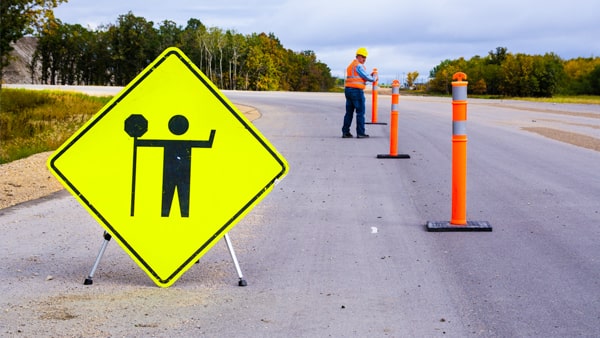
An orange diamond sign showing a person holding a flag warns of:

This sign means:
  1. A A pedestrian crossing
  2. B The end of road work
  3. C A school crossing
  4. D A flagger directing traffic ahead

Correct answer: D – A flagger directing traffic ahead

This sign warns that a flagger may be stopping, slowing or guiding traffic through a work zone. Flaggers may use red flags or STOP/SLOW panels to direct drivers. Reduce speed, remain alert and follow the flagger’s instructions while traveling through the area.

Source: Arizona Driver License Manual and Customer Service Guide — § 3, “Flaggers”