


Arizona Drivers Ed Practice Test 8

4.8 out of 5 (190 votes)
80% Passing score
20 Questions
4 Mistakes allowed
Intersections are where Arizona driving rules get real, fast. A four-way stop can look simple until two cars roll up together, someone waves when they should not, and suddenly everyone is doing that little hesitation dance through the windshield. This AZ drivers ed practice test, the eighth test in the series, focuses on those exact moments: right-of-way, yielding, turning through traffic, reading signs and signals, and knowing when “I think I can go” is not quite good enough. The test gives you 20 multiple-choice questions built around Arizona intersection rules and the kind of situations that show up both on the written exam and, more importantly, in actual traffic. It is not trying to bury you in trivia. It is trying to make the rules feel familiar before the DMV asks about them in its very DMV-ish way. While you work through the questions, you can use hints when you need a small nudge, and if you miss an answer, the explanation walks you back through the rule so it has a better chance of sticking. Not glamorous, no. Useful, yes. For teen drivers, this Arizona practice permit test fits into the larger graduated licensing process. Arizona allows teens to apply for a graduated instruction permit at 15 years and 6 months, and a Class G graduated driver license can be issued at age 16 for drivers who are under 18. Before that Class G license happens, though, Arizona expects real preparation: an approved driver education program, an approved defensive driving or traffic survival school route with certified supervised driving hours, or parent-certified supervised practice that includes required nighttime driving. Also, because the paperwork matters, minors need a parent or guardian signature on the permit or license application, witnessed by an MVD agent or notarized. Adults have a different path. At 18 or older, a first-time driver may apply for an Arizona operator instruction permit and work toward a Class D license by completing the application, bringing the required identity, residency, Social Security, and authorized-presence documents, paying the fee, passing the written permit test and vision screening, and then passing the road test in a properly registered and insured vehicle. This AZ DMV practice test is updated for current laws and can be retaken as often as needed. That repetition matters. Intersection rules are not the part you want to “sort of” understand on test day, or on a Tuesday afternoon in real traffic.
FREE DMV Practice Test App
Study for your Arizona permit test or driver’s license with the NextDoorDriving app. 700+ DMV questions and answers, 100% free!
Download on the App Store

Sample Arizona Permit Test Questions

Question 1

The signal is green, but there is not enough space beyond the intersection for your vehicle. What should you do?

  1. A Enter because the green signal gives you priority
  2. B Wait before the intersection until you can clear it
  3. C Enter if some cross traffic can pass around you
  4. D Enter if no vehicle is immediately behind you

Correct answer: B – Wait before the intersection until you can clear it

Do not enter when backed-up traffic would leave your vehicle stopped in the intersection. The Arizona manual describes a green signal as permission to proceed if the roadway is clear. State law also generally prohibits stopping, standing or parking within an intersection, except in specified circumstances such as avoiding a conflict or obeying an officer or traffic-control device.

Source: A.R.S. § 28-873(A)(4) – Stopping, standing or parking prohibitions; exceptions; definition, Arizona Driver License Manual and Customer Service Guide — Section 3, “Green — Green Means Go, if Clear!”
Question 2

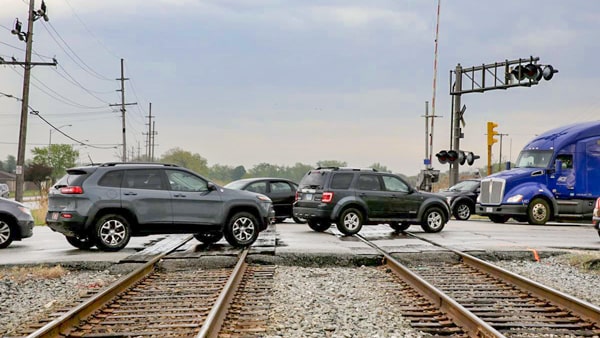
Heavy traffic is stopped beyond a railroad crossing. When should you begin crossing the tracks?

When traffic is slow and heavy and you must cross railroad tracks before reaching the upcoming intersection, you should:
  1. A When there is room to stop between the gates
  2. B As soon as the vehicle ahead begins moving
  3. C Only when enough space is available to clear the entire crossing
  4. D After sounding the horn several times

Correct answer: C – Only when enough space is available to clear the entire crossing

Wait until traffic beyond the tracks has moved far enough for your vehicle to clear the crossing completely. Beginning too soon could leave the vehicle trapped on the tracks if traffic stops again. The driver manual also warns that a train or other on-track equipment may use any track at any time.

Source: Arizona Driver License Manual and Customer Service Guide — Section 3, “Railroad Crossing Sign”

Question 3

When a steady traffic signal changes to yellow, which driver should continue through the intersection?

  1. A A driver who can safely stop before entering
  2. B A driver who sees no pedestrians
  3. C A driver preparing to turn right
  4. D A driver who is already within the intersection

Correct answer: D – A driver who is already within the intersection

A steady yellow signal warns that the related green movement is ending and a red indication will follow. A driver who has not entered should make a safe stop rather than accelerate to beat the light. A driver already within the intersection should continue moving and clear it safely.

Source: A.R.S. § 28-645(A)(2) – Traffic control signal legend, Arizona Driver License Manual and Customer Service Guide — Section 3, “Yellow — Yellow Means Caution!”

Question 4

When passing on the left of a two-way roadway, you must return to the right before coming within what distance of an approaching vehicle?

  1. A 100 feet
  2. B 200 feet
  3. C 300 feet
  4. D 500 feet

Correct answer: A – 100 feet

Arizona requires the passing vehicle to return to the right-hand side before coming within 100 feet of an approaching vehicle. The passing driver must also have enough visible, clear roadway to complete the maneuver without interfering with approaching or overtaken traffic. Although the overtaken driver must not increase speed while being passed, the passing driver remains responsible for completing the maneuver safely.

Source: A.R.S. § 28-725 – Limitations on overtaking on the left, A.R.S. § 28-723 – Overtaking a vehicle on the left

Question 5

What does a double solid white line separating lanes indicate?

  1. A The lines may be crossed to make a left turn
  2. B Crossing the lines is prohibited
  3. C The area is a two-way left-turn lane
  4. D Passing is allowed when traffic is clear

Correct answer: B – Crossing the lines is prohibited

The Arizona driver manual states that a double solid white line separates two lanes of traffic moving in the same direction. Drivers are prohibited from crossing this marking. It differs from a broken white line, which may be crossed cautiously for a lane change after signaling and checking that the movement is safe.

Source: Arizona Driver License Manual and Customer Service Guide — Section 3, “Double Solid White Line”

Question 6

A driver's left hand and arm are extended upward. What maneuver is being signaled?

  1. A A left turn
  2. B A right turn
  3. C A stop or decrease in speed
  4. D Continuing straight

Correct answer: B – A right turn

An upward left hand and arm signal indicates a right turn. A horizontal left arm indicates a left turn, while a downward left arm indicates stopping or decreasing speed. A bicycle rider may alternatively signal a right turn by extending the right hand and arm horizontally.

Source: A.R.S. § 28-756 – Method of giving hand and arm signals