Arkansas Road Signs Test

4.8 out of 5 (51 votes)
80% Passing score
10 Questions
2 Mistakes allowed
The Arkansas knowledge test does not treat road signs like background scenery, and neither should you. They may look simple from behind the wheel, especially the obvious ones, but the test has a way of leaning into the details: shapes, colors, symbols, pavement markings, signal meanings, and those railroad crossing rules that people often skim because, well, they seem straightforward until they are not. This Arkansas drivers practice test gives you 20 multiple-choice questions focused on the sign and roadway information Arkansas drivers are expected to know. You will see material tied to regulatory signs, warning signs, work zones, school zones, lane markings, traffic signals, pavement markings, and railroad crossings. Some questions will feel like a quick check of common sense. Others ask you to slow down and actually read the road, which is the whole point. A do-not-enter sign, a yield sign, flashing railroad lights, crossing gates, multiple-track warnings, and painted lane markings all carry instructions, not suggestions dressed up in reflective paint. Now, one licensing detail that is worth getting right: Arkansas does not have a separate road-sign-only test for the standard Class D instruction permit. Road sign questions are mixed into the regular Arkansas knowledge test. The official exam has 25 total questions, and you need 20 correct answers to pass. That gives you room to miss 5 overall, but there is no special separate allowance for sign questions. So yes, signs matter, but not because they sit in their own little testing category. They matter because they are part of the score you need. This Arkansas DMV practice test is untimed and available on mobile or desktop, which makes it easier to use the way people actually study, like in small chunks, between things, sometimes with a little too much confidence at first. Take your time with each question. Look at the shape, the color, the wording, the marking, the signal. For first-time permit applicants or anyone refreshing old knowledge, this Arkansas road signs practice test is a solid way to turn “I recognize that” into “I know what that means,” which is the version that helps on the exam and on the road.

FREE DMV Practice Test App
Study for your Arkansas permit test or driver’s license with the NextDoorDriving app. 700+ DMV questions and answers, 100% free!
Download on the App Store

Sample Arkansas Permit Test Questions

Question 1

Which centerline prohibits passing by traffic traveling in either direction?

  1. A One solid yellow line beside one broken yellow line
  2. B A single broken yellow line
  3. C Two solid yellow lines
  4. D A single broken white line

Correct answer: C – Two solid yellow lines

Two solid yellow lines separate opposing traffic and prohibit passing in both directions. The Arkansas guide permits crossing a solid yellow line to turn into a driveway when no opposing traffic is approaching, but that exception does not authorize passing. A broken yellow line permits passing only when conditions are clear.

Source: Arkansas Driver License Study Guide — Ch. 3, “Lanes of Traffic—Yellow Lane Markings”

Question 2

How should you respond to a flashing yellow traffic signal?

  1. A Continue at the same speed while watching for traffic
  2. B Come to a complete stop before entering
  3. C Slow down and proceed with caution
  4. D Wait until the signal displays steady green

Correct answer: C – Slow down and proceed with caution

A flashing yellow signal is a caution indication. Arkansas requires drivers to proceed through the intersection or past the signal only with caution, and the official guide instructs drivers to slow down. A complete stop is required for a flashing red signal, not a flashing yellow signal.

Source: A.C.A. § 27-52-108 — Flashing Signals, Arkansas Driver License Study Guide — Ch. 2, “Traffic Control Signals, Signs, and Pavement Markings—Flashing Lights”

Question 3

A traffic signal is dark, and no officer or temporary control is present. Which uncontrolled-intersection rule should you apply if two vehicles arrive together?

When a traffic signal light is not working, you should:
  1. A The driver on the left yields to the vehicle on the right
  2. B The driver on the right yields to the vehicle on the left
  3. C The vehicle traveling faster goes first
  4. D The larger vehicle goes first

Correct answer: A – The driver on the left yields to the vehicle on the right

The Arkansas guide states that at an intersection without a stop sign or traffic signal, drivers must yield to vehicles approaching from the right. Approach a dark signal cautiously and watch for traffic from every direction. Follow any directions given by law enforcement or temporary traffic controls.

Source: Arkansas Driver License Study Guide — Ch. 3, “Right of Way at Stop Signs”, Arkansas Driver License Study Guide — Ch. 2, “Traffic Control Signals, Signs, and Pavement Markings”

Question 4

A broken yellow line is next to your lane, with a solid yellow line beside it. When may you pass?

When the road is marked with a solid yellow line and a broken yellow line on your side you may pass:
  1. A Only during an emergency
  2. B Only on an expressway
  3. C When the road ahead is clear of opposing traffic
  4. D Only while traveling through an intersection

Correct answer: C – When the road ahead is clear of opposing traffic

When the broken yellow line is on your side, passing is permitted if there is no opposing traffic and the maneuver can be completed safely. Drivers on the side with the solid yellow line may not pass. The broken line does not remove other passing restrictions or guarantee sufficient clearance.

Source: Arkansas Driver License Study Guide — Ch. 3, “Lanes of Traffic—Yellow Lane Markings”

Question 5

On a two-way roadway, when may a driver use the left half of the road?

On a two-way highway, you are allowed to drive on the left half of the roadway when:
  1. A Whenever a double solid yellow centerline is present
  2. B Whenever a solid yellow line is next to the driver’s lane
  3. C While legally and safely overtaking another vehicle
  4. D Whenever approaching a curve before a left turn

Correct answer: C – While legally and safely overtaking another vehicle

Arkansas law generally requires vehicles to remain on the right half of the roadway but allows the left half to be used when overtaking under the rules governing that movement. Passing must also be permitted by the pavement markings and roadway conditions. A driver should not cross a no-passing centerline merely because the opposing lane appears empty.

Source: A.C.A. § 27-51-301(a)(1) — Vehicles to Be Driven on Right Side of Roadway—Exceptions, Arkansas Driver License Study Guide — Ch. 3, “Lanes of Traffic—Yellow Lane Markings”

Question 6

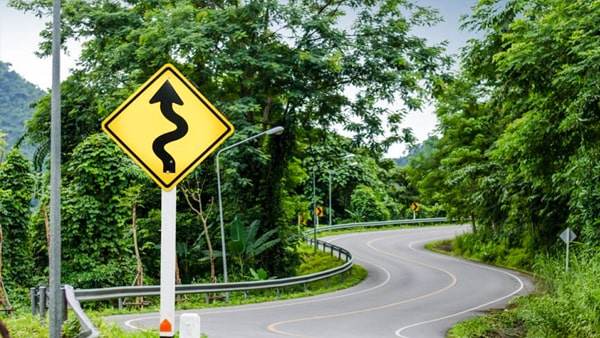
A yellow diamond sign displays a long, winding arrow. What condition does it warn about?

This sign tells you that:
  1. A Turns are prohibited ahead
  2. B The roadway becomes narrower
  3. C A series of curves is ahead
  4. D The pavement is slippery when wet

Correct answer: C – A series of curves is ahead

The Winding Road sign warns of three or more changes in the roadway’s alignment. Drivers should be ready for a series of curves rather than a single turn. An advisory speed plaque may accompany the sign to identify a recommended speed for the winding section.

Source: Manual on Uniform Traffic Control Devices for Streets and Highways, 11th ed., Rev. 1 — Ch. 2C, “Horizontal Alignment Signs”