California CDL General Knowledge Practice Test (CA) 2

4.9 out of 5 (467 votes)
80% Passing score
20 Questions
4 Mistakes allowed
Gearing up for your California CDL is a crucial step, and our second practice test is here to ensure your success on the General Knowledge test. Tailored to be an essential tool, this California CDL practice test encompasses a wide array of topics critical for every aspiring commercial driver. With 20 well-crafted questions, the California general knowledge practice test requires you to correctly answer at least 16, honing your knowledge and readiness for the actual exam. Our CDL practice test is unique in its approach. It's not just a set of questions; it's a learning journey. Each question is crafted and reviewed by seasoned driving instructors, professionals who've dedicated their careers to helping thousands obtain their licenses. Their expertise translates into questions that are not only relevant but also practical, covering everything from pre-trip vehicle inspections to effective communication on the road. But we don't just stop at questions. We know that learning is multi-faceted. That's why our California CDL general knowledge test includes visual aids, ideal for those who learn best through images. These aids cover a range of scenarios, from road signs to traffic situations, ensuring you're not just memorizing, but understanding and applying knowledge. Whether you're aiming for a Class A or Class B license, or looking to add endorsements, this CA CDL practice test is your starting point. It covers the general knowledge needed across all license classes, ensuring a solid foundation. From handling emergencies to cargo safety, this DMV practice test is a comprehensive preparation tool. And remember, the set of questions remains consistent each time you take it, allowing you to measure your progress effectively. Prepare to ace your California CDL General Knowledge test with us - your path to safe and confident driving starts here.
FREE CDL Practice Test App
Pass your California CDL General Knowledge test with the NextDoorDriving app. Real questions and answers—100% free and ad-free.
Download on the App Store

Sample California CDL Test Questions - General Knowledge

Question 1

What does a red triangular emblem with an orange center on the rear of a vehicle identify?

  1. A A vehicle carrying hazardous materials
  2. B A slow-moving vehicle
  3. C A vehicle carrying an oversize load
  4. D A vehicle exempt from road-use taxes

Correct answer: B – A slow-moving vehicle

The emblem warns that the vehicle is a slow-moving vehicle, such as certain farm or construction equipment. In California, vehicles displaying it are not designed to attain speeds greater than 25 mph. Recognizing the emblem early gives a commercial driver time to respond to the slower traffic ahead.

Source: California Commercial Driver Handbook — § 2.8.3, “Slow Drivers”
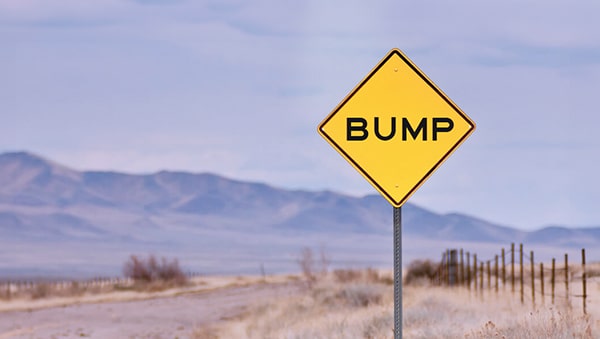
Question 2

What roadway condition does a BUMP warning sign indicate?

This sign warns drivers to _____________.
  1. A A depression in the roadway
  2. B A sharp rise in the roadway profile
  3. C The beginning of a higher speed zone
  4. D The end of the paved roadway

Correct answer: B – A sharp rise in the roadway profile

California’s traffic-control standard uses the BUMP sign in advance of a sharp rise in the roadway profile. A DIP sign warns of a depression instead. An advisory-speed plaque may accompany either sign when additional speed information is appropriate.

Source: California MUTCD 2026 — § 2C.26, “BUMP and DIP Signs (W8-1 and W8-2)”

Question 3

How should you plan your parking position whenever practical?

  1. A Park where the next inspection can be skipped
  2. B Park so you can pull forward when leaving
  3. C Limit any later backing to exactly 10 feet
  4. D Park as close as possible to an entrance ramp

Correct answer: B – Park so you can pull forward when leaving

Backing is dangerous because the driver cannot see everything behind a commercial vehicle. When parking, try to position the vehicle so you can leave by pulling forward. If backing is unavoidable, inspect the path, move slowly, use both mirrors, and use a helper when possible.

Source: California Commercial Driver Handbook — § 2.2.4, “Backing Safely”

Question 4

Under the standard time-interval rule, how much following distance should a 40-foot vehicle maintain at 50 mph?

  1. A 3 seconds
  2. B 4 seconds
  3. C 7 seconds
  4. D 5 seconds

Correct answer: D – 5 seconds

A 40-foot vehicle requires four seconds under the one-second-per-10-feet rule. Because the speed is above 40 mph, another second must be added, producing a five-second interval. Slippery roads and other hazards require still more following distance.

Source: California Commercial Driver Handbook — § 2.7.1, “Space Ahead”

Question 5

What does a NARROW BRIDGE warning sign tell you?

This sign warns drivers that _____________.
  1. A The bridge ahead is narrower than the approach roadway
  2. B The bridge has been declared structurally unstable
  3. C You must stop and wait for all oncoming traffic
  4. D You should accelerate before entering the bridge

Correct answer: A – The bridge ahead is narrower than the approach roadway

Under California’s traffic-control standard, the sign warns that the bridge or culvert has restricted horizontal clearance or is narrower than the approaching travel lanes. It does not by itself identify an unstable bridge or impose a stop requirement. A separate ONE LANE BRIDGE sign is used for more severely restricted width.

Source: California MUTCD 2026 — § 2C.18, “NARROW BRIDGE and NARROW UNDERPASS Signs (W5-2 and W5-2a)”, California MUTCD 2026 — § 2C.19, “ONE LANE BRIDGE and ONE LANE UNDERPASS Signs (W5-3 and W5-3a)”

Question 6

When fighting an engine-compartment fire, you should fully open the hood to reach the base of the flames.

  1. A True
  2. B False

Correct answer: B – False

Turn off the engine as soon as possible, but avoid opening the hood if you can. Direct extinguishing foam through the louvers, radiator, or from beneath the vehicle. When using the extinguisher, aim at the source or base of the fire rather than at the flames.

Source: California Commercial Driver Handbook — § 2.21.3, “Fire Fighting”