


California CDL Class B Practice Test (CA) 3

4.8 out of 5 (677 votes)
80% Passing score
20 Questions
4 Mistakes allowed
Gearing up for your California Class B CDL can be a smooth ride with the right preparation. Our third California CDL practice test is designed to reflect the real DMV exam, with 20 questions that challenge your knowledge on a wide range of subjects. From pre-trip vehicle inspection to mastering gear shifts and handling steep downgrades, this CDL practice test covers it all. It's crucial to not only memorize facts but to understand the concepts behind safe and responsible driving. By taking our California CDL general knowledge practice test, you're simulating the experience of the actual DMV written test. Each question is formatted as multiple choice or true/false, just like the real thing, honing your skills in recognizing the correct answer quickly and efficiently. Whether it's your first attempt or you're trying to perfect your knowledge, the California DMV practice test offers consistent questions, allowing you to track your progress effectively. Staying current is key, which is why our practice content is regularly updated to align with the latest 2026 driving laws and regulations in California. This means you're studying the most relevant and up-to-date information, giving you an accurate taste of what to expect. Sharpen your skills, boost your confidence, and prepare to ace your California Class B CDL test with our comprehensive practice test. Your journey to becoming a certified commercial driver is well within reach.
FREE CDL Practice Test App
Pass your California CDL General Knowledge test with the NextDoorDriving app. Real questions and answers—100% free and ad-free.
Download on the App Store

Sample California CDL Test Questions - General Knowledge

Question 1

During a vehicle inspection, what condition should you check wheel bearing seals for?

  1. A Excessive tightening
  2. B Leakage
  3. C Low tire pressure
  4. D Uneven tread depth

Correct answer: B – Leakage

Wheel bearing seals should be checked for leaks during the walk-around inspection. The handbook also directs drivers to verify that the hub oil level is adequate. Leakage can indicate a seal or lubrication problem that requires attention before the vehicle is operated.

Source: California Commercial Driver Handbook — § 2.1.5, “Step 5: Do a Walk Around Inspection”
Question 2

Drinking coffee and getting fresh air will quickly sober up a person who has consumed alcohol.

  1. A True
  2. B False

Correct answer: B – False

The statement is false. The California commercial driver guidance explains that the liver processes alcohol at a limited, fixed rate; coffee, fresh air, or a cold shower does not speed that process. Only the passage of time allows the body to eliminate the alcohol.

Source: California Commercial Driver Handbook — § 2.22.1, “How Alcohol Works”

Question 3

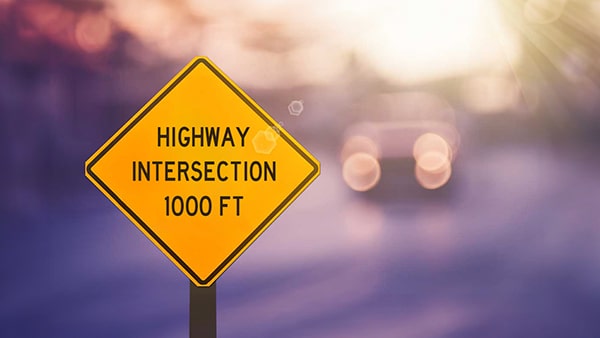
What does a crossroad warning sign indicate?

This sign indicates _________________.
  1. A A pedestrian crosswalk is ahead
  2. B A railroad crossing is ahead
  3. C A rest area is ahead
  4. D An intersection is ahead

Correct answer: D – An intersection is ahead

California’s Cross Road warning sign may be placed in advance of an intersection. It alerts drivers to the presence of the intersection and the possibility of traffic turning onto or entering the roadway. Other intersection-warning symbols are used for side roads, T-intersections, and Y-intersections.

Source: California MUTCD 2026 — § 2C.41, “Intersection Warning Signs (W2-1 through W2-8)”

Question 4

What should you do before entering a curve in a commercial vehicle?

  1. A Reduce to a safe speed and select the proper lower gear
  2. B Shift to a higher gear and accelerate
  3. C Stop before every curve

Correct answer: A – Reduce to a safe speed and select the proper lower gear

Slow to a safe speed and downshift to the proper gear before entering the curve. Selecting the gear in advance allows some power to be used through the turn, helping vehicle stability. Entering too fast or attempting an unnecessary shift in the curve can reduce control.

Source: California Commercial Driver Handbook — § 2.3.1, “Before Entering a Curve”

Question 5

Which conditions are examples of tire problems found during a commercial-vehicle inspection?

  1. A Too much or too little air pressure
  2. B Abnormal wear or tread separation
  3. C Cuts or other visible damage
  4. D All of the above

Correct answer: D – All of the above

All three conditions are tire problems that must be checked. Improper pressure, excessive wear, tread separation, and cuts can affect traction or lead to tire failure. Drivers should also inspect valve stems, dual-tire clearance, tire sizes, and whether fabric is visible through the tread or sidewall.

Source: California Commercial Driver Handbook — § 2.1.3, “Tire Problems”

Question 6

Using the standard time-interval rule, how much following distance should a 30-foot vehicle maintain at 55 mph?

  1. A 3 seconds
  2. B 4 seconds
  3. C 5 seconds
  4. D 6 seconds

Correct answer: B – 4 seconds

A 30-foot vehicle requires a three-second interval under the one-second-per-10-feet rule. Because 55 mph is above 40 mph, the driver adds one more second. The resulting minimum interval is four seconds under favorable conditions, with additional space needed on slippery roads.

Source: California Commercial Driver Handbook — § 2.7.1, “Space Ahead”