California CDL General Knowledge Test (CA) 5

5 out of 5 (257 votes)
80% Passing score
50 Questions
10 Mistakes allowed
Navigating the path to obtaining a California CDL (Commercial Driver's License) is a crucial step for aspiring commercial drivers. Our fifth California CDL General Knowledge Practice Test is designed to support you in this journey. This test, specifically tailored for California, reflects the unique driving laws, regulations, and road signs of the state, ensuring that you are well-prepared for the nuances of driving in California. Our California general knowledge CDL practice test comprises 50 carefully crafted questions, mirroring the style and content of the official CDL exam. To pass, you need to answer at least 40 questions correctly. Each attempt at this DMV practice test presents the same set of questions, offering a consistent measure of your knowledge and readiness. One of the key features of our learner's permit practice test is its foundation in the official California CDL driver's manual. This means every question you encounter is grounded in the same source material as the actual CDL written test. If it's in the manual, it could be on your test, and if it's not in the manual, you won't find it on your test. This alignment with the official manual ensures that your study sessions are as relevant and effective as possible. Moreover, our California CDL practice test offers customizable sessions. This flexibility allows you to focus on areas where you need more practice, retake the DMV test multiple times to improve your score, and engage with the material at your own pace and convenience. Whether you're brushing up on specific topics or getting a comprehensive overview, our California CDL practice test adapts to your study needs, making it a vital tool in your CDL test preparation.
FREE CDL Practice Test App
Pass your California CDL General Knowledge test with the NextDoorDriving app. Real questions and answers—100% free and ad-free.
Download on the App Store

Sample California CDL Test Questions - General Knowledge

Question 1

During a backing exercise, what is a pull-up?

  1. A Stopping and moving forward to improve the vehicle's position
  2. B Completing the exercise without backing
  3. C Moving forward to test the service brakes
  4. D Stopping without changing direction

Correct answer: A – Stopping and moving forward to improve the vehicle's position

In California's basic control skills test, a pull-up occurs when the driver stops and moves forward to clear an encroachment or obtain a better position. Merely stopping without changing direction is not a pull-up. Excessive pull-ups may be counted as errors during the exercise.

Source: California Commercial Driver Handbook — § 12.1, “Skills Test Scoring”

Question 2

What does a Merge warning sign tell you?

This sign warns drivers to  _____________.
  1. A Emergency vehicles regularly enter the roadway
  2. B Traffic from another roadway may join your lane ahead
  3. C All traffic must stop at an intersection ahead
  4. D The roadway ends ahead

Correct answer: B – Traffic from another roadway may join your lane ahead

California's Merge sign warns that merging movements may occur where lanes from separate roadways converge. It alerts drivers on the major roadway or entering roadway to the merge condition ahead. Unlike a Lane Ends sign, it does not indicate that a lane on the same roadway is ending.

Source: California MUTCD 2026 — § 2C.45, “Merge Signs and Plaque (W4-1, W4-5, and W4-5aP)”

Question 3

What happens when a vehicle hydroplanes?

  1. A The tires ride on water and lose contact and traction with the road
  2. B The steering system mechanically locks
  3. C The brakes fade because they are overheated
  4. D The trailer swings outward during braking

Correct answer: A – The tires ride on water and lose contact and traction with the road

During hydroplaning, the tires lose contact with the roadway and have little or no traction. Steering and braking may become ineffective. Hydroplaning can occur at speeds as low as 30 mph when enough water is present, especially when tire pressure is low or tread is worn.

Source: California Commercial Driver Handbook — § 2.6.2, “Matching Speed to the Road Surface”

Question 4

How can excessive weight on a vehicle's steering axle affect handling?

  1. A It can make steering difficult
  2. B It can make steering unusually easy
  3. C It can make the brakes difficult to apply
  4. D It can reduce brake-pedal resistance

Correct answer: A – It can make steering difficult

Poor weight distribution can make a commercial vehicle unsafe to handle. Excessive weight on the steering axle can cause hard steering and may damage the steering axle and tires. The load must be properly balanced rather than concentrated too heavily over the front axle.

Source: California Commercial Driver Handbook — § 3.2.4, “Balance the Weight”

Question 5

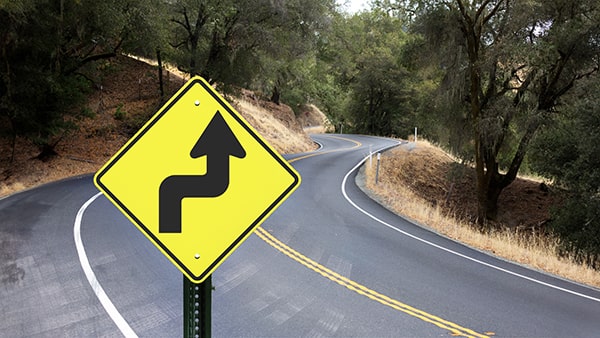
A Reverse Turn sign showing the first movement to the right warns of:

This sign warns drivers to  _____________.
  1. A A gradual right curve followed by a gradual left curve
  2. B One sharp right turn
  3. C One sharp left turn
  4. D A sharp right turn followed by a sharp left turn

Correct answer: D – A sharp right turn followed by a sharp left turn

A Reverse Turn sign warns of two turns in opposite directions that are close together. The direction at the top of the symbol identifies the first turn encountered. When that part points right, expect a sharp right turn followed by a sharp left turn.

Source: California MUTCD 2026 — § 2C.07, “Horizontal Alignment Signs (W1-1 through W1-5, W1-11, and W1-15)”

Question 6

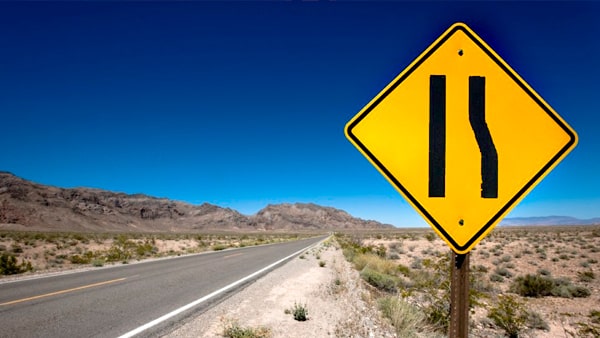
What condition is shown by a ROAD NARROWS warning sign?

This sign warns drivers that _____________.
  1. A A traffic signal is ahead
  2. B The available roadway width decreases ahead
  3. C The pavement becomes slippery ahead
  4. D An entrance to a highway is ahead

Correct answer: B – The available roadway width decreases ahead

Under California's sign standard, the ROAD NARROWS sign warns of an abrupt reduction in pavement width. On a two-lane road, the narrow section may not provide enough width for vehicles traveling in opposite directions to pass simultaneously without reducing speed.

Source: California MUTCD 2026 — § 2C.17, “ROAD NARROWS Sign (W5-1)”