California DMV Permit Test Simulator

4.7 out of 5 (13838 votes)
83% Passing score
46 Questions
8 Mistakes allowed
Let’s be honest: nobody wakes up excited to study the California driver handbook. You open it with good intentions, read three pages about right-of-way rules, and somehow end up scrolling your phone. It happens. That’s exactly why this California permit practice test exists — not as a lecture, but as a slightly more tolerable way to survive the California DMV written test. Here’s the deal. Every attempt throws 46 questions at you. Not 20. Not a polite little sampler. The full 46 questions, just like the real California DMV permit test. And yes, you need 39 correct answers to pass — that’s an 85% passing score, which sounds friendly until you miss question eight and start doing mental math in a mild panic. The DMV permit practice test here mirrors the actual exam structure, but without the awkward plastic chair and the person coughing behind you. Questions shuffle every time, so memorizing A-B-C patterns won’t save you. The California permit test questions pull from the same core material you’ll see on test day — traffic signs, DUI laws, rules of the road, insurance requirements, all of it. The serious stuff. The surprisingly specific stuff. Some questions even include images, because road signs aren’t theoretical blobs in real life. They’re bright, confusing shapes you’re expected to understand instantly. When you finish — assuming you didn’t dramatically close the tab halfway through — you can review correct answers, explanations, even hints. There’s a performance summary too, which is either validating or humbling. Sometimes both. It’s an online permit test that feels less like punishment and more like preparation. Slightly chaotic, updated for 2026, and far more useful than rereading the handbook again while pretending it’s sticking. This is DMV written test practice that actually sticks. Probably.
FREE DMV Practice Test App
Study for your California permit test or driver’s license with the NextDoorDriving app. 700+ DMV questions and answers, 100% free!
Download on the App Store

Sample California Permit Test Questions

Question 1

Traffic is backed up beyond railroad tracks near an intersection. When may you begin crossing the tracks?
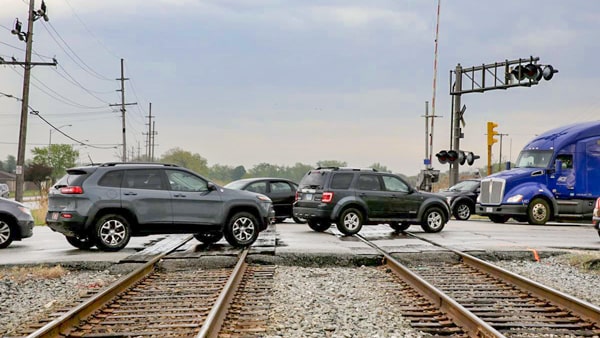
When traffic is slow and heavy and you must cross railroad tracks before reaching the upcoming intersection, you should:
  1. A When there is room to wait between the gates
  2. B When you can stop on the tracks until traffic moves
  3. C Only when there is enough room to clear the tracks completely
  4. D After sounding your horn several times

Correct answer: C – Only when there is enough room to clear the tracks completely

Never begin crossing railroad tracks when traffic ahead could leave your vehicle stopped on them. Wait before the crossing until there is enough room on the far side for your entire vehicle. Once you begin, cross all tracks and clear them completely before stopping.

Source: California Driver’s Handbook — § 7, “Near Railroad or Light Rail Tracks”

Question 2

Which driving-related ability is affected earliest by even a small amount of alcohol?

  1. A Steering ability
  2. B Good judgment
  3. C Muscle control
  4. D Quick reflex movements

Correct answer: B – Good judgment

The California commercial driving manual explains that the first part of the brain affected by alcohol controls judgment and self-control. Those abilities are essential for recognizing hazards and making safe choices. Muscle control, vision, coordination, and reaction time become increasingly affected as alcohol concentration rises.

Source: California Commercial Driver’s Handbook — § 2.22.1, “Alcohol and Driving”, California Driver’s Handbook — § 9, “Blood Alcohol Concentration (BAC) Limits”

Question 3

Under the general rule, on which side should you pass a vehicle traveling in the same direction?

  1. A On the right
  2. B On the left
  3. C Only on the side selected by the other driver
  4. D On either side whenever an opening appears

Correct answer: B – On the left

California law generally requires a driver overtaking another vehicle traveling in the same direction to pass on the left at a safe distance. Passing on the right is permitted only under specified conditions, such as when the other vehicle is turning left or when the roadway has sufficient lanes or width for the maneuver.

Source: CVC § 21750(a), CVC § 21754

Question 4

What condition does this yellow diamond warning sign indicate?

This sign means:
  1. A A church is ahead
  2. B A first-aid station is ahead
  3. C Another roadway crosses ahead
  4. D A railroad crossing is ahead

Correct answer: C – Another roadway crosses ahead

This is the Cross Road warning sign, designated W2-1. It may be installed in advance of an intersection to notify drivers that another road crosses ahead and that traffic may turn or enter there. Under the California MUTCD, it is a warning sign rather than a regulatory sign.

Source: California MUTCD 2026 — § 2C.41, “Intersection Warning Signs (W2-1 through W2-8)”

Question 5

On an icy or snow-packed road, which action helps prevent a skid before descending a steep hill?

  1. A Follow the vehicle ahead closely
  2. B Pump the brakes continuously
  3. C Shift into a low gear before starting downhill
  4. D Accelerate quickly to increase traction

Correct answer: C – Shift into a low gear before starting downhill

Ice and packed snow reduce tire traction, especially when a vehicle is traveling too fast or downhill. The handbook recommends shifting into a low gear before descending a steep hill. Drivers should also slow down, increase following distance, and avoid quick stops or fast turns on slippery surfaces.

Source: California Driver’s Handbook — § 8, “Slippery Surface Skids”

Question 6

Before and while backing in a straight line, what should you do?

When backing up your car, you should:
  1. A Watch only the side mirrors
  2. B Check traffic and blind spots, look over your shoulder, and back at a smooth, safe speed
  3. C Look only over your left shoulder
  4. D Rely entirely on the backup camera

Correct answer: B – Check traffic and blind spots, look over your shoulder, and back at a smooth, safe speed

California’s handbook directs drivers to observe traffic and check appropriate blind spots before backing. Look in the rearview mirror and over your shoulder for vehicles and pedestrians, then remain aware of what is behind you. Back at a smooth, safe speed that allows you to maintain control.

Source: California Driver’s Handbook — § 6, “Straight Line Backing”