


California Permit Practice Test 5

4.8 out of 5 (4791 votes)
80% Passing score
20 Questions
4 Mistakes allowed
Driving in California is weirdly specific. Not hard, necessarily — although anyone who has merged onto a Los Angeles freeway at the wrong time may want to argue — but specific. You have coast roads, city traffic, wine-country curves, fog, tourists, distracted drivers, and, tucked underneath all of that, a pile of rules the DMV very much expects you to know. This California DMV practice test is built around those rules, especially the ones that show up in the official California permit test: traffic laws, road safety, substance abuse, DUI regulations, BAC limits, and the not-so-fun consequences of driving after drinking. This particular CA permit test practice gives you 20 practice questions, with a noticeable emphasis on alcohol-related driving laws. That is not random. DUI and substance abuse rules are part of the California DMV Driver’s Manual, and they are fair game on the real DMV written test. The DMV does not hand out the exact test questions — because of course it does not; that would make life too tidy — but these questions are written to feel close to the structure, phrasing, and topic mix you are likely to see on the actual DMV learners permit test. The real California knowledge test depends on your age, which is one of those details people forget until they are suddenly staring at appointment instructions. If you are under 18, the written knowledge test has 46 multiple-choice questions, and you need 38 correct to pass. That means you can miss 8. If you are 18 or older, the test has 36 questions, and you need 30 correct, so you can miss 6. The DMV describes the passing score as 80%, although the math works out slightly above that in practice — about 82.6% for minors and 83.3% for adults. There is no strict time limit, provided you finish before the DMV office closes, which is comforting in a very DMV-ish sort of way. This free California permit practice test is useful whether you are studying in Sacramento, San Francisco, Los Angeles, San Diego, or somewhere with fewer palm trees and more parking lots. The official test is offered in English, Spanish, Arabic, Chinese, French, German, Korean, Vietnamese, and more than 30 total languages. Audio/oral testing is available through touchscreen headsets, and ASL video testing is available too. Use this California drivers permit practice test to see what you know, what you sort of know, and what you absolutely do not want to discover for the first time at the DMV counter.
FREE DMV Practice Test App
Study for your California permit test or driver’s license with the NextDoorDriving app. 700+ DMV questions and answers, 100% free!
Download on the App Store

Sample California Permit Test Questions

Question 1

A white regulatory sign shows a black arrow passing to the right of an obstruction. What does it require?

This white sign means:
  1. A Pass to the right of the obstruction
  2. B Yield before making a right turn
  3. C Move slower traffic into the right lane
  4. D Turn right at the next intersection

Correct answer: A – Pass to the right of the obstruction

California’s R4-7 Keep Right sign is used where traffic must pass only to the right of a roadway feature or obstruction. It may be placed near the approach end of a median, island, or pier. The sign does not require a right turn at the next intersection or establish a slower-traffic lane.

Source: California MUTCD 2026 Edition — § 2B.39, “Keep Right and Keep Left Signs (R4-7 Series and R4-8 Series)”
Question 2

Before pulling away from the curb after parallel parking, which check is essential?

  1. A Sound your horn before moving
  2. B Turn on your hazard flashers
  3. C Turn your head and look over your shoulder for traffic in the blind spot
  4. D Check only the inside rearview mirror

Correct answer: C – Turn your head and look over your shoulder for traffic in the blind spot

Blind spots are areas that cannot be seen by looking straight ahead or using mirrors. Before leaving a parking space or pulling away from the curb, look over the appropriate shoulder through the side window. Check for vehicles, motorcycles, bicycles, and pedestrians before moving.

Source: California Driver’s Handbook — § 8, “Blind Spots”, California Driver’s Handbook — § 8, “Know What is Behind You”

Question 3

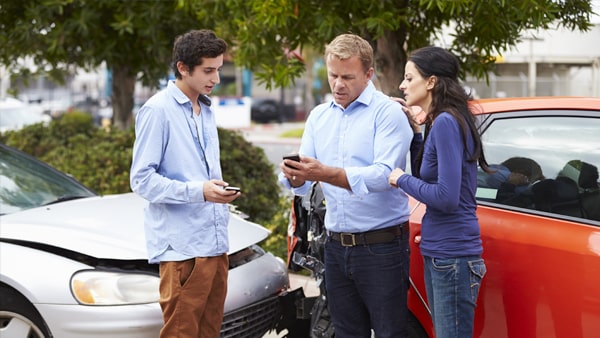
Unless unable because of injury, a California driver involved in a collision must exchange their driver’s license number with:

If you have a collision, the law requires you to exchange your driver's license information with:
  1. A Any witness at the scene
  2. B Another driver or property owner involved and present
  3. C A nearby security guard
  4. D Any person who asks for it

Correct answer: B – Another driver or property owner involved and present

CVC § 16025 requires each capable driver involved in a collision to exchange specified information with another involved driver or property owner who is present. This includes the driver’s name, current address, license number, vehicle identification number, registered owner’s address, and evidence of financial responsibility. Failure to provide all required information is an infraction punishable by a fine of up to $250.

Source: CVC § 16025(a)–(b)

Question 4

Orange diamond-shaped warning signs generally alert drivers to:

  1. A Temporary road work, workers, equipment, or changed roadway conditions
  2. B Motorist services such as fuel and food
  3. C Permanent recreational areas
  4. D A required stop at every sign

Correct answer: A – Temporary road work, workers, equipment, or changed roadway conditions

The California MUTCD assigns orange to temporary traffic control and generally requires work-zone warning signs to have black markings on orange or fluorescent orange backgrounds. These signs warn of temporary conditions that may not otherwise be apparent. Drivers should watch for workers, slow-moving equipment, closed lanes, barriers, and instructions from flaggers.

Source: California MUTCD 2026 Edition — § 1D.05, “Color Code”, California MUTCD 2026 Edition — § 6H.01, “Warning Sign Function, Design, and Application”, California Driver’s Handbook — § 7, “Road Workers and Work Zones”

Question 5

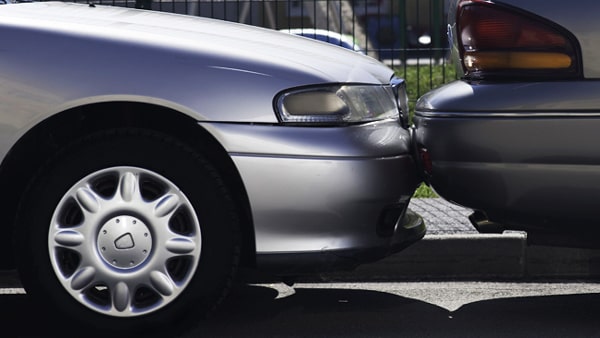
If you damage an unattended parked vehicle in California and cannot locate its owner, you must:

If you hit a parked car and cannot find the owner, you:
  1. A Report the damage only to your insurance company
  2. B Leave without taking further action
  3. C Leave a conspicuous written notice and promptly notify the appropriate police agency or CHP office
  4. D Wait at the scene until the owner returns

Correct answer: C – Leave a conspicuous written notice and promptly notify the appropriate police agency or CHP office

The written notice must be placed conspicuously on the damaged vehicle or property and provide the names and addresses of the driver and vehicle owner, along with the circumstances. The driver must also notify city police or the local CHP office without unnecessary delay, depending on where the collision occurred. A violation is a misdemeanor punishable by up to six months in county jail, a fine of up to $1,000, or both.

Source: CVC § 20002(a)(2), (c)

Question 6

Before driving after taking an over-the-counter medicine, what should you do?

  1. A Read the label and determine how the medicine may affect you
  2. B Drink alcohol to offset its effects
  3. C Assume nonprescription medicine is safe for driving
  4. D Drive only during daylight hours

Correct answer: A – Read the label and determine how the medicine may affect you

California’s DUI rules apply to drugs that impair safe driving, including prescription and over-the-counter medications. Read the medication label and know its possible effects before driving. If the medicine affects your alertness, judgment, coordination, or ability to drive safely, do not drive while affected.

Source: CVC § 23152(f), California Driver’s Handbook — § 9, “Alcohol and Drugs”