


California Drivers Ed Practice Test 8

4.8 out of 5 (3209 votes)
80% Passing score
20 Questions
4 Mistakes allowed
The California drivers ed practice test is basically your low-stakes dress rehearsal for the DMV written test, minus the fluorescent lighting, the ticket number, and that very specific DMV silence where everyone is pretending not to be nervous. This practice drivers ed test gives you 20 multiple-choice questions pulled around the same kinds of topics you will see in the California DMV Driver’s Manual: traffic laws, road safety, road signs, DUI and substance abuse rules, and those tiny wording details that look harmless until you pick the almost-right answer. Rude, but educational. The real California permit exam is a written knowledge test, and for drivers under 18, it has 46 multiple-choice questions. You need 38 correct answers to pass, which means you can miss 8. Applicants 18 and over may miss 6 total questions. Not 6 road sign questions, not 6 “oops, I forgot what yellow means” questions — 6 total. California does not run a separate standalone road signs test, either. Road sign identification gets folded into the main knowledge test, where questions may ask about a sign’s color, shape, or meaning. So the signs still count. They just do not get their own little stage. This CA driver ed practice test is untimed, which is honestly how practice should be. You can read the question, reread it because the DMV loves phrasing things in a way that feels just slightly sideways, and then work through the answer choices without panic-clicking your way into regret. The official DMV knowledge test is also not timed, as long as you finish before the DMV office closes for the day. Still, practicing slowly now makes the real thing feel less like walking into a room where the rules were explained to everyone except you. After you finish this California driving test practice, you will see a summary of what you missed along with the correct answers, which is the part that quietly does the heavy lifting. Annoying? Sometimes. Useful? Very. The official test is offered in English, Spanish, Arabic, Chinese, French, German, Korean, Vietnamese, and more than 30 total languages. Audio/oral testing is available through touchscreen headsets, and ASL video testing is available on touchscreen terminals. All applicants also need to pass a vision test before getting an instruction permit or driver’s license. So, yes, there are a few hoops. This California permit test practice just helps you stop tripping over the written one.
FREE DMV Practice Test App
Study for your California permit test or driver’s license with the NextDoorDriving app. 700+ DMV questions and answers, 100% free!
Download on the App Store

Sample California Permit Test Questions

Question 1

Why should you maintain open space around your vehicle whenever possible?
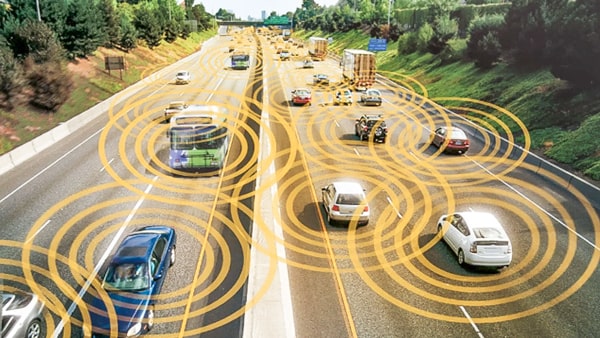
Should you try to keep a "space cushion" around your vehicle whenever possible?
  1. A It gives you more time and room to react to hazards
  2. B It prevents other vehicles from using the roadway
  3. C It allows you to drive without checking your mirrors
  4. D It is useful only when driving on city streets

Correct answer: A – It gives you more time and room to react to hazards

Adequate space gives you time to recognize a problem and respond safely. A proper following distance helps if the vehicle ahead brakes suddenly or another driver makes a mistake. Space at the sides also gives you room to maneuver, so avoid remaining directly beside another vehicle or in another driver's blind spot.

Source: California Driver’s Handbook — § 8, “Tailgating (Following Too Closely)” and “Know What Is at Your Side”

Question 2

On an undivided road, a school bus ahead displays flashing red lights while loading or unloading children. What must you do?

  1. A Stop and remain stopped until the red lights cease operating
  2. B Change lanes and pass at a reduced speed
  3. C Proceed after the last visible child enters or leaves the bus
  4. D Slow down but continue unless the bus driver waves you to stop

Correct answer: A – Stop and remain stopped until the red lights cease operating

California drivers meeting or overtaking a stopped school bus with flashing red lights must stop before passing and remain stopped until the signals cease operating. The opposite-direction exception applies when the bus is on the other roadway of a divided or qualifying multilane highway. Failure to stop may result in a fine of up to $1,000 and suspension of the driving privilege for one year.

Source: CVC § 22454(a)–(b), California Driver’s Handbook — § 7, “Around Children”

Question 3

No parent or legal guardian is present, and your 15-year-old passenger is not properly restrained. Who may be cited?

  1. A Only the passenger
  2. B No one because the passenger is older than eight
  3. C The driver
  4. D Only the vehicle's registered owner

Correct answer: C – The driver

In California, a driver may not transport a child from age eight through 15 unless the child is secured by an appropriate restraint system or safety belt. The driver is exempt when the child's parent or legal guardian is present as a passenger, but that exception does not apply here. A first conviction is punishable by a $100 fine, and a later conviction by a $250 fine, subject to specified education-program provisions.

Source: CVC § 27360.5(a)–(b), CVC § 27360.6(a)–(b), California Driver’s Handbook — § 8, “Seat Belts”

Question 4

Lighting or smoking a cigarette while driving is considered:

Preparing to smoke and smoking while driving:
  1. A A way to improve concentration
  2. B An activity that does not affect vehicle control
  3. C A driving distraction
  4. D A recommended method of remaining alert

Correct answer: C – A driving distraction

A distraction is anything that takes attention away from the driving task. Smoking is listed among activities inside a vehicle that can distract a driver, along with eating, drinking, adjusting controls, and reaching for objects. Drivers should eliminate or reduce such activities and keep their full attention on operating the vehicle safely.

Source: California Commercial Driver Handbook — § 2.9, “Distracted Driving”

Question 5

Which behavior leaves a driver with too little time to respond when the vehicle ahead brakes suddenly?

  1. A Checking the rearview mirror periodically
  2. B Following the vehicle ahead too closely
  3. C Watching traffic several vehicles ahead
  4. D Leaving additional space in poor weather

Correct answer: B – Following the vehicle ahead too closely

Following too closely limits your view of the roadway and reduces the time available to respond if the lead vehicle stops suddenly. Use the three-second rule to estimate a safe following distance under ordinary conditions. Increase that distance when road, weather, traffic, or visibility conditions require additional stopping time.

Source: California Driver’s Handbook — § 8, “Tailgating (Following Too Closely)”, California Driver’s Handbook — § 14, “Three-second rule”

Question 6

Which speed-related condition is listed as a common factor in traffic collisions?

  1. A Driving on a city street during rush hour
  2. B Using a multilane freeway
  3. C Crossing a bridge or overpass
  4. D Traveling faster or slower than the general flow of traffic

Correct answer: D – Traveling faster or slower than the general flow of traffic

The California Driver’s Handbook lists a vehicle traveling faster or slower than the flow of traffic among common collision causes. Large speed differences increase the number of interactions in which drivers must pass, merge, brake, or change lanes. Drivers must still obey speed limits and never drive faster than is safe for current conditions.

Source: California Driver’s Handbook — § 10, “Causes of Collisions”