California DMV Sign Test 4

4.8 out of 5 (1847 votes)
80% Passing score
20 Questions
4 Mistakes allowed
This California road signs test is here for the part of DMV prep that looks easy until, annoyingly, it is not. It gives you 20 multiple-choice questions focused on road sign recognition, including sign colors, shapes, meanings, and the little driving decisions that follow right after you recognize one. Because knowing that a sign is yellow is nice. Knowing whether it means “slow down,” “watch for merging traffic,” or “something weird is about to happen, please pay attention” is the more useful bit. This is the fourth CA road signs test in our series, so it is built for extra practice rather than a first awkward handshake with the material. You’ll run into regulatory signs, warning signs, guide signs, and other traffic control clues that show up on California roads: speed limits, lane merges, road changes, service signs, pavement markings, traffic lights, the whole crowded little cast. Some signs tell you what you must do. Some warn you before the road gets rude. Others just point you toward places and routes, which sounds simple until you’re actually driving and the sign has about three seconds to make sense. You can take this California DMV sign test online from a phone, tablet, or computer, so it fits into whatever sliver of study time you can realistically manage. To pass this practice test, you’ll need 16 correct answers out of 20, and your results appear right away. Helpful, yes. Mildly judgmental, sometimes. But useful. Now, about the official test — and this is the part people often mix up — California does not have a separate standalone road signs test. Road sign identification is folded into the main California DMV knowledge test, where signs may appear in regular multiple-choice questions about color, shape, meaning, and safe response. There is no separate road-sign missed-question allowance. Those questions count toward the overall knowledge test limit: applicants under 18 may miss 8 total questions, while adults 18 and over may miss 6. This CA DMV practice test also works well alongside a California drivers ed course, especially for teens working toward a provisional instruction permit at 15½. Applicants under 18 must complete driver education; adults 18 and older do not. The official California DMV test is offered in more than 30 languages, with audio/oral testing and ASL video testing available on touchscreen terminals. So the access options are there. This California driving test practice helps make sure the signs themselves are not what sneak up on you.

FREE DMV Practice Test App
Study for your California permit test or driver’s license with the NextDoorDriving app. 700+ DMV questions and answers, 100% free!
Download on the App Store

Sample California Permit Test Questions

Question 1

A steady yellow arrow appears as you approach a left turn. What does it tell you?

  1. A Accelerate before the arrow turns red
  2. B A left turn is prohibited for the rest of the signal cycle
  3. C The protected turn is ending, so watch for and obey the next signal
  4. D You have an unconditional right-of-way through the intersection

Correct answer: C – The protected turn is ending, so watch for and obey the next signal

A steady yellow arrow warns that the protected turning period is ending. Under California guidance, you should pay attention to and obey the signal that follows, which could be a red arrow or another signal indication. If you cannot stop safely or are already in the intersection, cautiously complete the turn.

Source: CVC § 21452(a), California Driver’s Handbook — § 7, “Yellow Arrow”

Question 2

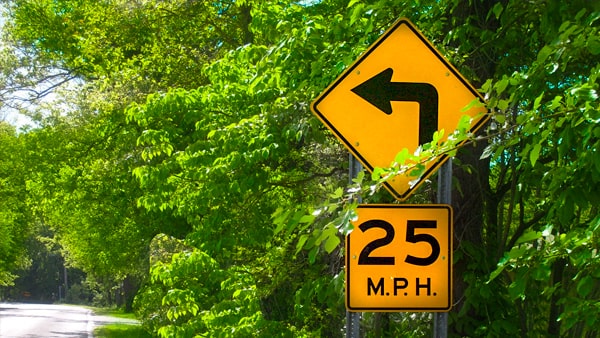
A left-curve warning sign is posted above a 25 MPH plaque. What does the combination mean?

This sign means:
  1. A The road curves right, and 25 mph is recommended
  2. B The road curves left, and 25 mph is the minimum speed
  3. C The road curves right, and 25 mph is the legal maximum
  4. D The road curves left, and 25 mph is the recommended speed

Correct answer: D – The road curves left, and 25 mph is the recommended speed

The curve symbol shows that the roadway changes direction to the left. The 25 MPH plaque displays an advisory speed recommended for that section of roadway; it is not a minimum-speed sign. Drivers must still choose a speed that is safe for current roadway, weather, and traffic conditions.

Source: California MUTCD 2026 Edition — § 2C.06, “Horizontal Alignment Warning Signs”, California MUTCD 2026 Edition — § 2C.59, “Advisory Speed Plaque (W13-1P) and Confirmation Advisory Speed Plaque (W13-1aP)”

Question 3

What do yellow center lines generally separate on a roadway?

  1. A Traffic traveling in opposite directions
  2. B Lanes traveling in the same direction on a one-way street
  3. C The stopping area before railroad tracks
  4. D Only center turn lanes and turnout areas

Correct answer: A – Traffic traveling in opposite directions

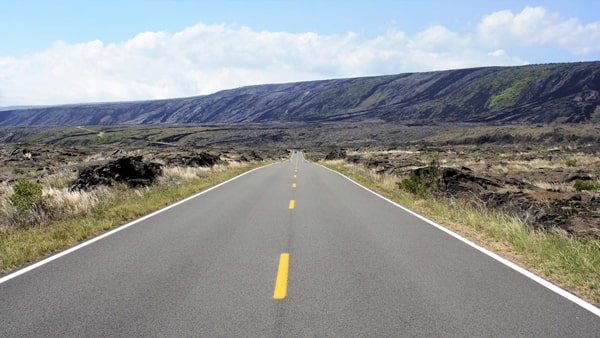
Yellow center lines divide traffic moving in opposite directions. The pattern of the lines—solid, broken, or double—determines whether crossing or passing is permitted. White lane lines, by contrast, generally separate lanes of traffic traveling in the same direction.

Source: California Driver’s Handbook — § 6, “Lane Markings”

Question 4

When a broken yellow center line is next to your lane, when may you cross it?

A broken yellow center line on the roadway means:
  1. A Never, because it marks a no-passing zone
  2. B To pass when the maneuver can be completed safely
  3. C Only after reducing your speed below 25 mph
  4. D Only to make a right turn

Correct answer: B – To pass when the maneuver can be completed safely

A broken yellow line separates opposing traffic but permits a driver on the broken-line side to cross for passing. California’s handbook emphasizes that passing is allowed only when it is safe. Check for oncoming traffic, roadway hazards, and enough space to return to your lane before beginning the maneuver.

Source: California Driver’s Handbook — § 6, “Broken Yellow Line”

Question 5

Which maneuver is prohibited across one set of double solid yellow center lines?

  1. A Turning left at an intersection when otherwise permitted
  2. B Turning left into or out of a driveway
  3. C Crossing the lines to pass another vehicle
  4. D All of these maneuvers

Correct answer: C – Crossing the lines to pass another vehicle

California law generally prohibits driving left of double solid yellow lines, so they may not be crossed to pass another vehicle. The law contains exceptions for a permitted left turn at an intersection or into or out of a driveway or private road. Certain lawful U-turns are also permitted across one set of double yellow lines.

Source: CVC § 21460(a), (d), California Driver’s Handbook — § 6, “Double Solid Yellow Lines”

Question 6

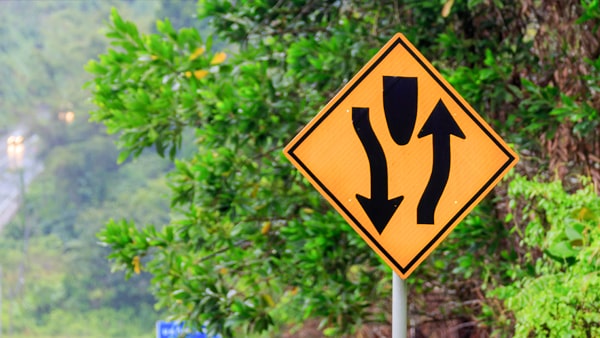
A warning sign shows two opposing traffic streams separating around a median. What is ahead?

This sign means:
  1. A The divided highway ends
  2. B A one-way street begins
  3. C A one-way street ends
  4. D A divided highway begins

Correct answer: D – A divided highway begins

The Divided Highway sign warns that opposing traffic flows will soon be separated by a median or another physical barrier. Drivers should remain on the right-hand roadway. A different sign, with the divider symbol narrowing toward the bottom, warns that a divided highway is ending.

Source: California MUTCD 2026 Edition — § 2C.20, “Divided Highway Sign (W6-1)”, California MUTCD 2026 Edition — § 2C.21, “Divided Highway Ends Sign (W6-2)”