


Colorado Practice Permit Test 3

5 out of 5 (87 votes)
80% Passing score
20 Questions
4 Mistakes allowed
Getting ready for the Colorado permit test is one of those things that sounds simple until you realize the official exam is not just asking whether you can recognize a Stop sign. It wants to know whether you actually understand Colorado traffic laws, road signs, signals, pavement markings, safe driving habits, impaired driving rules, and all the little “yes, this matters” details that tend to blur together when you are staring at the Colorado Driver Handbook for too long. That is where this third Colorado practice permit test earns its keep. It gives you 20 multiple-choice and true/false questions in a calmer, less DMV-ish setting, which is helpful because, frankly, nobody does their best thinking while imagining a clerk calling their number. You will review the same general territory covered on the official Class D knowledge test, including rules of the road, sharing the road, driver responsibility, crash prevention, and distracted driving. And yes, handheld mobile devices come up, because Colorado takes that seriously—and so should you, even if your phone is being very dramatic in the cup holder. The real Colorado knowledge test has 25 multiple-choice questions, and you need 20 correct answers to pass. That is an 80% score. This Colorado permit test practice keeps that same standard in a shorter format: answer 16 out of 20 correctly, and you are in good shape for this round. Not perfect, not magically licensed, but definitely moving in the right direction. Road signs are included here too, not because Colorado has a separate road-sign-only test, but because sign questions are part of the regular permit exam. The visual aids help with that, especially when a question is easier to understand by seeing the sign, marking, or driving situation instead of trying to decode a block of text like it is a riddle from a very safety-conscious wizard. A few licensing details are worth keeping in your head while you study. Colorado allows learner’s permits starting at age 15, though younger applicants have driver education or driver awareness requirements. Drivers under 18 must hold a permit for at least 12 full months and complete supervised driving time before licensing. Adults usually do not have that same waiting period after getting a permit. So while you are gathering documents, planning the vision screening, figuring out fees, or deciding whether to test online through Colorado @Home or in person, use this DMV practice test to keep the knowledge fresh. The handbook is important, yes. But practice is where the rules start feeling less like trivia and more like something you can actually use.
FREE DMV Practice Test App
Study for your Colorado permit test or driver’s license with the NextDoorDriving app. 700+ DMV questions and answers, 100% free!
Download on the App Store

Sample Colorado Permit Test Questions

Question 1

A five-sided fluorescent yellow-green sign showing two people, with a downward-pointing arrow plaque below it, marks:
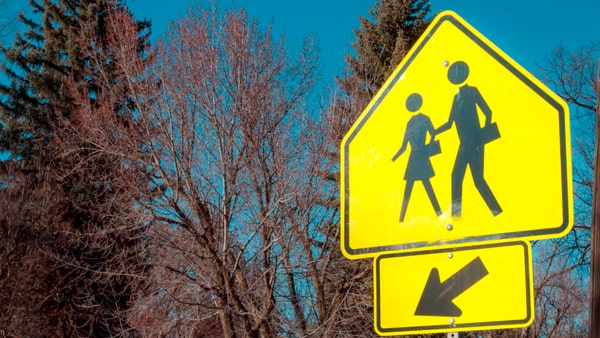
This road sign means:
  1. A A school crossing
  2. B A business district
  3. C A sidewalk-only area
  4. D A prohibited pedestrian crossing

Correct answer: A – A school crossing

This sign assembly identifies a school crossing. Reduce speed as conditions require and watch carefully for students entering the roadway. Drivers must also obey directions given by school crossing guards.

Source: Colorado Driver Handbook — “Traffic Signals & Road Sign Groups”
Question 2

When turning left from a two-way road onto a one-way road, where should you finish the turn unless signs or markings direct otherwise?

  1. A In the right-hand lane
  2. B Near the center of the roadway
  3. C In the extreme left-hand lane available
  4. D In whichever lane has the least traffic

Correct answer: C – In the extreme left-hand lane available

Colorado requires a driver approaching a left turn to use the extreme left-hand lane lawfully available. When practicable, the driver must leave the intersection in the extreme left-hand lane available on the roadway being entered. A traffic-control device may require a different turning path.

Source: C.R.S. § 42-4-901(1)(b), (2) – Required position and method of turning

Question 3

You are traveling uphill on a steep, one-lane mountain road when you meet a downhill vehicle. A wider place is available behind the other vehicle but not behind you. Who should back up?

  1. A You should back downhill
  2. B The downhill driver should back to the wider place
  3. C Neither driver should move
  4. D You should back only if the other vehicle is a truck

Correct answer: B – The downhill driver should back to the wider place

On a steep, narrow road, the Colorado handbook directs the downhill vehicle to yield by backing to a wider place or stopping where the uphill vehicle can pass. An exception applies when it is more practical for the uphill vehicle to return to a turnout. Here, the wider place is behind the downhill vehicle, making that vehicle responsible for backing.

Source: Colorado Driver Handbook — “Right-of-Way,” “Narrow Mountain Road”

Question 4

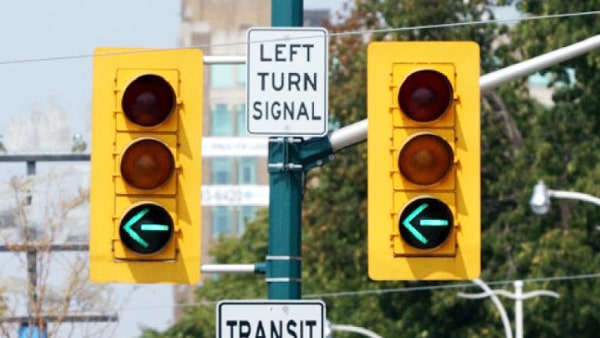
What movement does a steady green left arrow authorize?

On the intersection, if you see a green arrow pointing to the left, you can:
  1. A Travel in any direction
  2. B Turn left after yielding to lawful traffic and pedestrians still in the intersection
  3. C Turn left or continue straight regardless of other signals
  4. D Turn left only after all opposing traffic receives a green light

Correct answer: B – Turn left after yielding to lawful traffic and pedestrians still in the intersection

A green arrow allows a driver to cautiously enter the intersection for the movement shown by the arrow. The driver must still yield to pedestrians lawfully in an adjacent crosswalk and to other traffic lawfully using the intersection. The arrow does not authorize straight travel unless another signal permits it.

Source: C.R.S. § 42-4-604(1)(a)(II) – Traffic control signal legend

Question 5

Compared with a lap belt alone, what additional restraint does a lap-and-shoulder belt provide?

  1. A It restrains occupants only at high speeds
  2. B It restrains the upper torso as well as the pelvis
  3. C It prevents the vehicle from being involved in a crash
  4. D It works only in heavy traffic

Correct answer: B – It restrains the upper torso as well as the pelvis

A lap-and-shoulder assembly combines pelvic restraint with upper-torso restraint, while a lap belt provides pelvic restraint only. Colorado defines a safety belt system as a lap belt, shoulder belt, or combination of belts meeting federal safety standards. Covered drivers and passengers must wear the installed system fastened while the vehicle is operated.

Source: C.R.S. § 42-4-237(1)(b), (2) – Safety belt systems - mandatory use - exemptions - penalty - definitions, 49 C.F.R. § 571.209 – Standard No. 209; Seat belt assemblies

Question 6

When an approaching light rail vehicle could cross your intended path, you should:

  1. A Expect it to stop as quickly as a passenger car
  2. B Pass it slowly on the right in every situation
  3. C Wait rather than turn in front of it
  4. D Sound your horn before crossing its tracks

Correct answer: C – Wait rather than turn in front of it

The Colorado handbook instructs motorists never to turn in front of an approaching light rail vehicle. Check every direction before turning across tracks and obey all lights, gates, and warning devices. Buildings and foliage may also make an approaching rail vehicle difficult to see.

Source: Colorado Driver Handbook — “Light Rail,” “Driver Safety Tips”