Colorado Drivers Ed Practice Test 8

5 out of 5 (63 votes)
80% Passing score
20 Questions
4 Mistakes allowed
This eighth Colorado practice permit test gets into the part of driving where people suddenly forget how lines, signs, and basic turn-taking work: intersections. Four-way stops are the big attraction here, if “attraction” is the word we’re using for a place where everyone hesitates, creeps forward, waves someone else through, then regrets it immediately. You’ll work through right-of-way questions, lane control situations, traffic signals, pavement markings, and the kind of sign-related details that are easy to skim in the handbook until they show up on the Colorado permit test looking a little too familiar. And yes, road signs matter. Colorado does not give you some tidy little road-sign-only test off to the side. Road sign questions are a big part of the regular Class D knowledge test, along with traffic laws, safe driving, DUI topics, signals, markings, and all the other official “please know this before driving a car” material. So when this Colorado DMV practice test brings in regulatory signs, warning signs, guide signs, sign colors, shapes, lane controls, and pavement markings, it is not wandering off-topic. It is doing the annoying-but-useful thing. The test includes 20 questions, with visual aids for intersection setups and traffic-control situations, because sometimes reading “yield to the vehicle on your right” is fine, and sometimes you need to stare at a picture and mutter, “Oh, that guy goes first.” That is allowed. Learning is not always glamorous. After you finish, the review section lets you go back through the questions you missed, read the explanations, and pick up the hints you maybe should have noticed earlier. No judgment—well, a tiny bit, but helpful judgment. Also worth knowing: Colorado does not set a separate missed-question limit for road signs. They count inside the 25-question written test, where you can miss up to 5 total. Use this Colorado drivers ed practice test alongside the Colorado Driver Handbook, online drivers education, flashcards, road sign charts, or whatever keeps the rules from sliding out of your brain five minutes later. It is especially handy if you’ll be driving through Denver traffic, Colorado Springs intersections, Boulder’s “surprise, there’s a bike lane” moments, or mountain roads where confidence is nice but actual knowledge is better.

FREE DMV Practice Test App
Study for your Colorado permit test or driver’s license with the NextDoorDriving app. 700+ DMV questions and answers, 100% free!
Download on the App Store

Sample Colorado Permit Test Questions

Question 1

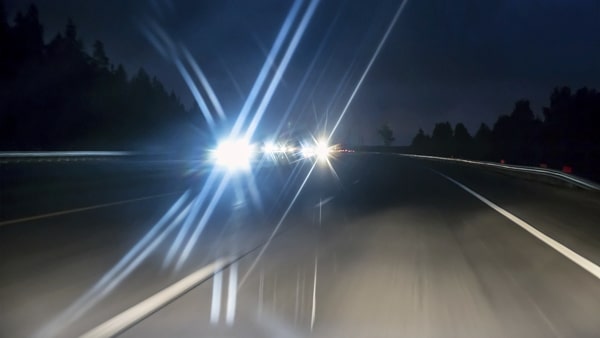
Bright headlights from an oncoming vehicle are causing glare. Where should you direct your vision?

  1. A Directly at the oncoming headlights
  2. B Below the glare, using the painted edge line as a guide
  3. C Toward the center of the oncoming lane
  4. D Continuously into the rearview mirror

Correct answer: B – Below the glare, using the painted edge line as a guide

Do not look directly into approaching headlights. As the vehicle comes closer, lower your sight below the glare and use the painted edge line to guide your position. Return your gaze farther ahead after the vehicle passes, while continuing to maintain control and monitor the roadway.

Source: Colorado Driver Handbook — “Night Driving”

Question 2

What is the primary safety benefit of properly adjusting a vehicle’s head restraint?

  1. A It makes long drives more relaxing
  2. B It helps reduce the risk or severity of neck injury in a crash
  3. C It keeps the occupant’s hairstyle in place
  4. D It allows a tired driver to rest while driving

Correct answer: B – It helps reduce the risk or severity of neck injury in a crash

A correctly positioned head restraint helps control the head’s movement, particularly during a rear-end collision. This can reduce the likelihood or severity of a neck injury. Adjust it high enough to support the back of the head and follow the vehicle manufacturer’s instructions for proper positioning.

Source: Colorado Driver Handbook — “Preparing to Drive: Occupant protection”

Question 3

If an approaching driver does not dim high beams at night, what is the safest response?

At night, if an oncoming vehicle fails to dim its high-beams, look:
  1. A Focus on the approaching headlights
  2. B Look below the glare and use the painted edge line for guidance
  3. C Steer toward the centerline to improve your view
  4. D Close one eye and continue at the same speed

Correct answer: B – Look below the glare and use the painted edge line for guidance

Looking directly into high beams can temporarily reduce your ability to see. Lower your gaze below the glare and use a painted edge line to maintain your path until the vehicle passes. Continue controlling your speed and lane position rather than focusing on the other driver’s headlights.

Source: Colorado Driver Handbook — “Night Driving”

Question 4

In Colorado, when may a driver traveling 55 mph in a 65-mph zone be cited for driving too slowly?

  1. A When road or weather conditions make the reduced speed necessary
  2. B When the speed impedes normal and reasonable traffic movement without a safety or legal reason
  3. C Never, because traveling below the speed limit is always lawful

Correct answer: B – When the speed impedes normal and reasonable traffic movement without a safety or legal reason

The minimum-speed rule prohibits driving slowly enough to impede or block the normal and reasonable forward movement of traffic. Reduced speed is permitted when necessary for safe vehicle operation or to comply with the law. Conditions such as snow, poor visibility, or congestion may justify traveling below the posted limit.

Source: C.R.S. § 42-4-1103(1) — Minimum speed regulation

Question 5

Which pavement marking normally identifies the right edge of a roadway?

  1. A A broken white line
  2. B A solid yellow line
  3. C A solid white line
  4. D A broken yellow line

Correct answer: C – A solid white line

A solid white line is used to mark the right edge or shoulder of the roadway. White lines also separate traffic lanes moving in the same direction. Yellow markings generally separate traffic moving in opposite directions or identify the left edge of a divided roadway.

Source: Colorado Driver Handbook — “Pavement Markings: White lines”

Question 6

If a vehicle is equipped with airbags, when should its occupants wear seat belts?

  1. A Only while traveling on a freeway
  2. B On every trip
  3. C Only outside city limits
  4. D Only at speeds above 35 mph

Correct answer: B – On every trip

The Colorado handbook directs everyone in a vehicle to fasten a seat belt for protection in a crash. Airbags do not change that recommendation because they are designed to work as part of the vehicle’s occupant-protection system. Wear the lap and shoulder portions correctly and keep the belt properly adjusted throughout every trip.

Source: Colorado Driver Handbook — Safe Driving Tips, “Buckle up”