Colorado Road Signs Test 2

5 out of 5 (59 votes)
80% Passing score
20 Questions
4 Mistakes allowed
Colorado road sign questions seem easy enough until the test starts asking what a shape means without any other info. That is the whole point of this Colorado DMV road sign practice test: it gives you a tighter, more practical way to review the signs, signals, pavement markings, and lane-control rules that can appear on the Colorado Class D knowledge test. The regular Class D knowledge test has 25 multiple-choice questions. You need 20 correct answers to pass, so, yes, there is some room to miss a few (five, specifically) but not enough room to casually guess your way through sign meanings, winter driving rules, traffic laws, and all the other small-but-important details from the Colorado Driver Handbook. This practice test gives you 20 multiple-choice questions focused on traffic signs and the driving situations around them. You will work through regulatory signs, warning signs, guide signs, traffic signals, pavement markings, sign colors, shapes, and those Colorado-specific reminders that feel obvious only after someone points them out: wildlife crossings, steep grades, snowy mountain conditions, rural-road hazards, and seasonal warnings that matter a lot more once you are actually driving through them. Each answer comes with immediate feedback, which is useful for seeing how ready you are. You can see what you missed, why the correct answer is correct, and where your understanding got a little fuzzy. That matters because the official knowledge test reaches beyond signs into safe driving practices, sharing the road, impaired driving, freeway and night driving, mountain and winter driving, and general driver responsibility. The signs are part of the bigger picture, not a decorative side topic. Colorado lets eligible applicants take the Class D knowledge test online through the official @Home testing platform or in person at a driver license office. The online version has a 60-minute limit and is offered in English and Spanish. And while you are practicing, it is worth getting the boring-but-necessary licensing pieces together too: proof of identity, date of birth, lawful status when applicable, Social Security number when applicable, two Colorado address documents, payment, and your online test confirmation if you tested at home. Use this Colorado permit practice test as a sharp, focused check before the real thing. It helps you spot weak areas now, not at the DMV counter, which is generally the better place to avoid surprises.

FREE DMV Practice Test App
Study for your Colorado permit test or driver’s license with the NextDoorDriving app. 700+ DMV questions and answers, 100% free!
Download on the App Store

Sample Colorado Permit Test Questions

Question 1

What information does a diamond-shaped traffic sign usually provide?

  1. A A warning about roadway conditions or hazards ahead
  2. B An interstate route number
  3. C A posted speed limit
  4. D A mandatory stop requirement

Correct answer: A – A warning about roadway conditions or hazards ahead

Diamond-shaped traffic signs are generally warning signs. They alert drivers to roadway conditions or hazards ahead, such as curves, merging traffic, changes in road width, or intersections. The symbol displayed inside the diamond identifies the particular condition.

Source: Colorado Driver Handbook — “Traffic Signs”

Question 2

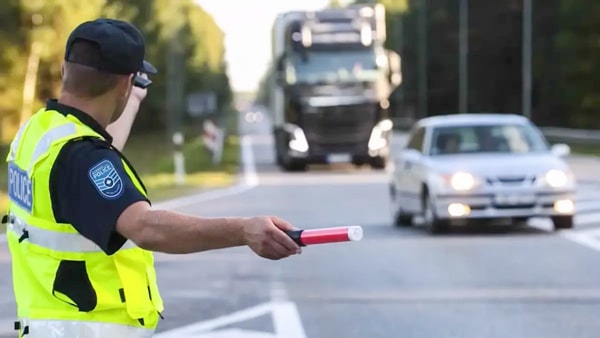
A traffic signal is red, but a police officer lawfully directs you through the intersection. What should you do?

A traffic light is red, but a police officer is telling you to go ahead anyway. What should you do?
  1. A Remain stopped until the signal turns green
  2. B Proceed only after another vehicle moves
  3. C Follow the officer’s direction
  4. D Wait for the officer to approach your vehicle

Correct answer: C – Follow the officer’s direction

Colorado drivers must comply with a lawful order from a police officer authorized to direct traffic. The officer’s instruction controls even when it differs from the displayed traffic signal. Proceed as directed while continuing to watch for traffic and pedestrians in your path.

Source: C.R.S. § 42-4-107 – Obedience to police officers, Colorado Driver Handbook — “Traffic Controls”

Question 3

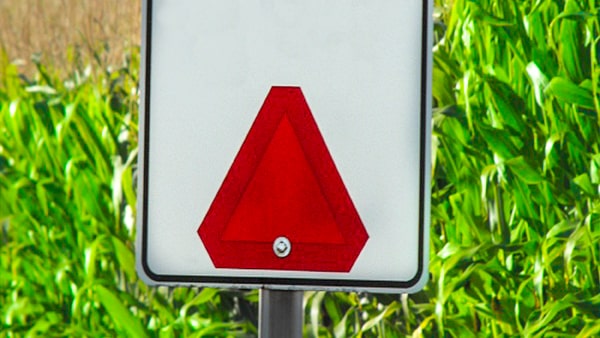
A reflective orange triangular emblem on the rear of a vehicle identifies:

An orange and red sign of this shape always means:
  1. A A vehicle carrying hazardous material
  2. B A vehicle with priority over other traffic
  3. C A slow-moving vehicle
  4. D An emergency-response vehicle

Correct answer: C – A slow-moving vehicle

In Colorado, machinery, equipment, and vehicles designed or normally operated below 25 mph generally must display a triangular slow-moving-vehicle emblem on the rear. The handbook describes this as a reflective orange triangle. Drivers who see it should recognize that the vehicle travels substantially slower than ordinary traffic.

Source: C.R.S. § 42-4-234(1)(a) – Slow-moving vehicles - display of emblem, Colorado Driver Handbook — “Traffic Signs,” “Slow moving vehicle marker”

Question 4

On a two-way roadway marked with double solid yellow centerlines, which maneuver may be permitted?

  1. A Turning left into a private driveway when the movement is safe
  2. B Using the opposing lane to pass a slow-moving car
  3. C Driving left of the lines to avoid congestion
  4. D Treating both sides of the roadway as one-way lanes

Correct answer: A – Turning left into a private driveway when the movement is safe

Double solid yellow lines generally prohibit passing by traffic on either side. Colorado’s handbook permits crossing a solid yellow line to turn left into an alley, private road, or driveway when the movement can be made safely. It also recognizes a limited exception for safely passing a bicyclist with the required clearance when the oncoming lane is clear.

Source: C.R.S. § 42-4-1001(3) – Drive on right side - exceptions, Colorado Driver Handbook — “Pavement Markings”

Question 5

Yellow centerlines normally separate:

  1. A A center turn lane from through traffic
  2. B A bicycle lane from a motor-vehicle lane
  3. C Lanes traveling in the same direction
  4. D Traffic traveling in opposite directions

Correct answer: D – Traffic traveling in opposite directions

Yellow pavement lines divide traffic moving in opposite directions. A solid yellow line restricts passing across that line, subject to limited lawful exceptions such as certain left turns and passing a bicyclist safely. White lines ordinarily separate lanes moving in the same direction.

Source: Colorado Driver Handbook — “Pavement Markings”

Question 6

A five-sided warning sign showing people walking indicates:

This road sign means:
  1. A A stop sign ahead
  2. B A school area or school crossing
  3. C A shopping district
  4. D Pedestrians are prohibited

Correct answer: B – A school area or school crossing

A five-sided school warning sign alerts drivers to a school area or school crossing. The people shown on the sign represent students or pedestrians who may be crossing. Drivers should recognize the sign and be prepared for school-related pedestrian activity.

Source: Colorado Driver Handbook — “Traffic Signs”