Colorado DMV Sign Test 4

5 out of 5 (53 votes)
80% Passing score
20 Questions
4 Mistakes allowed
Colorado does not exactly let drivers coast on vague road sign knowledge. Between Denver traffic, rural highways, sudden weather, mountain grades, and those charming little moments where a curve warning sign suddenly feels very personal, you need to know what signs mean before you are already reacting to them. That is where this Colorado road signs test earns its keep. This is the fourth practice test in our road sign series, built for drivers preparing for the Colorado Class D driver license knowledge test. That is the written test used for a standard passenger-vehicle instruction permit, and no, Colorado does not treat road signs as some separate little side exam. Road sign questions are folded into the full Class D knowledge test, along with traffic laws, rules of the road, safe driving habits, sharing the road, impaired driving, pavement markings, lane controls, and the kind of mountain, winter, freeway, rural, and night-driving topics that Colorado drivers really do need to understand. The focus here is sign color and shape, which sounds simple until you realize how much information the road is throwing at you in two seconds. Red means stop, restriction, or prohibition. Green points you toward permitted movement and direction. Yellow gives warning before conditions change, sometimes politely and sometimes with a bit of urgency. You will also work through regulatory signs, warning signs, guide signs, traffic signals, and pavement markings drawn from the same general areas covered in the Colorado Driver Handbook, the official study source for the DMV knowledge test. The real Colorado Class D knowledge test has 25 multiple-choice questions, and you need 20 correct answers to pass. That is an 80% score, with only 5 misses allowed. Colorado offers the test in person at a driver license office or online through the official @Home testing platform, where the Class D Knowledge Test has a 60-minute limit and is available in English and Spanish. Use this Colorado DMV practice test as a clean, lawful study tool, not one of those questionable “DMV test cheat sheets” floating around online with who-knows-when-it-was-updated information. When you finish, you will see a results summary with missed questions and correct answers, which is the part that actually helps. A score is useful, sure, but knowing exactly why you missed something is what turns a shaky guess into road sign knowledge you can trust.

FREE DMV Practice Test App
Study for your Colorado permit test or driver’s license with the NextDoorDriving app. 700+ DMV questions and answers, 100% free!
Download on the App Store

Sample Colorado Permit Test Questions

Question 1

Before turning right on a circular green signal, a driver must:

  1. A Maintain the same speed through the turn
  2. B Come to a complete stop in every case
  3. C Yield to pedestrians lawfully in the crosswalk
  4. D Accelerate before entering the intersection

Correct answer: C – Yield to pedestrians lawfully in the crosswalk

Colorado law permits traffic facing a circular green signal to proceed or turn unless a sign prohibits the turn. Turning traffic must yield to vehicles and pedestrians lawfully within the intersection and to pedestrians lawfully within an adjacent crosswalk. A green light does not provide an unconditional right to turn.

Source: C.R.S. § 42-4-604(1)(a)(I) – Traffic control signal legend, Colorado Driver Handbook — “Traffic Signals”

Question 2

What must a driver do when approaching a red-and-white triangular YIELD sign?

  1. A Stop only when an emergency vehicle is nearby
  2. B Continue at the same speed after looking both ways
  3. C Always make a complete stop
  4. D Slow down and stop if necessary to yield

Correct answer: D – Slow down and stop if necessary to yield

At a YIELD sign, a Colorado driver must slow to a speed reasonable for existing conditions and stop if safety requires it. After slowing or stopping, the driver must yield to traffic close enough to present an immediate hazard. The driver handbook also directs motorists to yield to pedestrians and vehicles that have the right-of-way.

Source: C.R.S. § 42-4-703(4) – Entering through highway - stop or yield intersection, Colorado Driver Handbook — “Traffic Signs,” “Yield signs”

Question 3

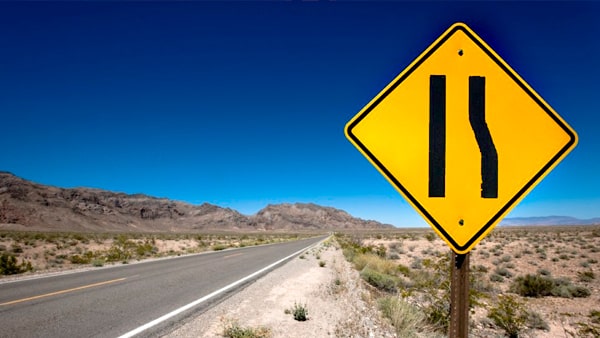
A yellow warning sign showing the right lane tapering into the left lane means:

This sign means:
  1. A The right lane ends ahead
  2. B A divided highway begins
  3. C A steep hill is ahead
  4. D Trucks will cross the roadway

Correct answer: A – The right lane ends ahead

This lane-reduction sign warns that the right lane ends ahead. A driver in the ending lane will need to move into the continuing lane. Before changing lanes, the driver must first determine that the movement can be completed safely.

Source: C.R.S. § 42-4-1007(1)(a) – Driving on roadways laned for traffic, Colorado Driver Handbook — “Traffic Signs”

Question 4

When may a driver cross a broken white or yellow pavement line?

  1. A Only when the maneuver can be completed safely without interfering with traffic
  2. B Whenever the driver intends to enter a driveway
  3. C Only when the vehicle ahead is disabled
  4. D Whenever traffic in the current lane is moving slowly

Correct answer: A – Only when the maneuver can be completed safely without interfering with traffic

Broken white lines permit lane changes when they can be made safely, while broken yellow lines permit passing when lawful and safe. Colorado law requires a driver to determine that movement from a marked lane can be completed safely before beginning it. A broken line does not authorize a driver to interfere with other traffic.

Source: C.R.S. § 42-4-1007(1)(a) – Driving on roadways laned for traffic, Colorado Driver Handbook — “Pavement Markings”

Question 5

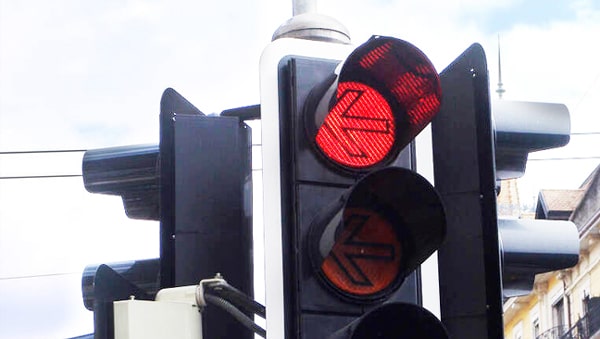
Which statement correctly distinguishes a red arrow from a circular red signal?

What is the difference between traffic lights with red arrows and those with solid red lights?
  1. A A driver may not make the movement shown by a red arrow, even after stopping
  2. B Red arrows apply only to protected left-turn lanes
  3. C Red arrows prohibit left turns but never right turns
  4. D Red arrows prohibit right turns but never left turns

Correct answer: A – A driver may not make the movement shown by a red arrow, even after stopping

In Colorado, a steady red arrow prohibits entering the intersection to make the movement shown by the arrow until an indication permitting that movement appears. A circular red signal may allow a right turn after stopping and yielding unless a sign prohibits it. It may also allow a left turn from a one-way street onto another one-way street under the stated conditions.

Source: C.R.S. § 42-4-604(1)(c)(I), (III) – Traffic control signal legend, Colorado Driver Handbook — “Traffic Signals”

Question 6

A signal displays a green arrow together with a circular red light. How may you proceed?

  1. A Drive straight through the intersection only
  2. B Proceed only in the direction shown by the green arrow
  3. C Wait until the circular signal turns green
  4. D Proceed in any direction after slowing

Correct answer: B – Proceed only in the direction shown by the green arrow

Colorado law allows traffic facing a green arrow to cautiously enter the intersection for the movement indicated by that arrow. The accompanying red signal continues to prohibit movements that it controls. Drivers following the arrow must yield to pedestrians in an adjacent crosswalk and to other traffic lawfully using the intersection.

Source: C.R.S. § 42-4-604(1)(a)(II) – Traffic control signal legend, Colorado Driver Handbook — “Traffic Signals”