Colorado Road Signs Test Simulator

5 out of 5 (55 votes)
80% Passing score
25 Questions
5 Mistakes allowed
Colorado road signs have a way of looking obvious until the permit test puts one in front of you with wording that feels just slightly sideways. That is where this Colorado DMV road signs test simulator earns its place. It gives you focused practice on the sign, signal, pavement marking, and lane-control topics that show up on the Colorado Class D knowledge test.   Each session includes 20 multiple-choice questions, which keeps the practice tight instead of turning it into a long, wandering study slog. The official Colorado knowledge test has 25 questions, and you need 20 correct answers to pass, so the target is clear enough: you need to know this material, not sort of recognize it. And yes, you can retake this practice test again and again, with fresh questions each time, which is helpful because memorizing the rhythm of one fixed quiz is not the same thing as understanding what a sign is telling you to do. Expect questions on regulatory signs, warning signs, guide signs, traffic signals, sign colors and shapes, pavement markings, and those lane-use controls that people swear they understand until the arrows and lines start stacking up. The wording is designed to feel close to the DMV style without pretending to be the real exam questions. Memorizing questions doesn't really help you learn, but practicing and getting useful feedback definitely will.   This Colorado permit test practice is built for new drivers, adult permit applicants, renewals, or anyone who wants to walk into the DMV process with fewer loose ends rattling around. While you are gathering documents, checking fees, preparing for the vision screening by getting new glasses, or sorting out the extra steps that apply to minors, this test gives you something useful to keep working on. Testing road sign knowledge is a big part of how the state checks whether you are ready to drive without guessing, hesitating, or hoping the other driver figures out a right-of-way standoff first.
FREE DMV Practice Test App
Study for your Colorado permit test or driver’s license with the NextDoorDriving app. 700+ DMV questions and answers, 100% free!
Download on the App Store

Sample Colorado Permit Test Questions

Question 1

A yellow diamond sign showing a short road joining from the right warns of:

This sign means:
  1. A A required right turn
  2. B A side road entering from the right
  3. C Traffic required to continue straight
  4. D A prohibited right turn

Correct answer: B – A side road entering from the right

The Side Road sign warns that another road enters the roadway from the direction shown by the symbol. A branch on the right indicates a side road entering from the right. Because it is a warning sign, it does not require or prohibit a turn.

Source: Colorado Driver Handbook — “Traffic Signs”

Question 2

A black-and-yellow chevron panel pointing to the right indicates:

When you see this sign, it means:
  1. A An object is blocking the roadway
  2. B Traffic will enter from the right
  3. C A sharp change in roadway direction to the right
  4. D A merging lane begins ahead

Correct answer: C – A sharp change in roadway direction to the right

Chevron panels emphasize a sharp change in the roadway’s direction. A chevron pointing right directs attention to a curve or turn toward the right. Several panels may be placed along the outside of the curve to show its alignment.

Source: Colorado Driver Handbook — “Traffic Signs”
Question 3

An orange sign with black lettering or symbols usually indicates:

  1. A Road construction or maintenance activity ahead
  2. B Services for drivers are available ahead
  3. C A reported collision at the next intersection
  4. D A mandatory stop is immediately ahead

Correct answer: A – Road construction or maintenance activity ahead

In Colorado, orange signs with black symbols or lettering identify roadway work areas. They guide traffic through construction or maintenance zones and help protect roadway workers. Stay alert for equipment, changing traffic patterns, flaggers, and posted instructions.

Source: Colorado Driver Handbook — “Traffic Controls,” “Work Zone Signs”

Question 4

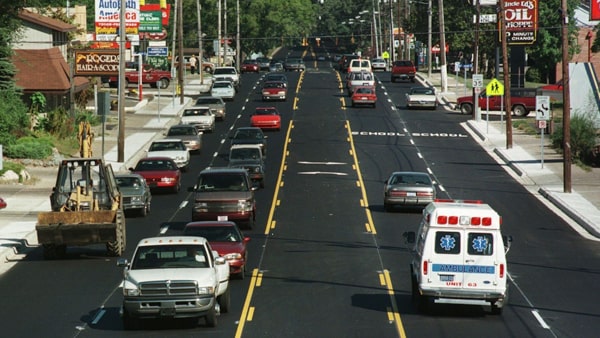
On a roadway marked with a center lane and left-turn arrows in both directions, the center lane is reserved for:

The center lane in the illustration is used for:
  1. A Normal through travel
  2. B Left turns from either direction
  3. C Passing slower traffic
  4. D Emergency vehicles

Correct answer: B – Left turns from either direction

On a Colorado road, a two-way left-turn lane is exclusively for vehicles preparing to turn left from either direction. A driver may wait there until the turn can be completed safely. The lane must not be used for passing or ordinary through travel.

Source: Colorado Driver Handbook — “Lane Controls,” “Two-Way Left-Turn Lane”

Question 5

Under Colorado law, what must the driver of a placarded hazardous-materials vehicle generally do at most railroad grade crossings?

Which of the following is true about vehicles displaying a diamond-shaped sign (indicating a hazardous load)?
  1. A Stop 15 to 50 feet from the nearest rail and proceed only when safe
  2. B Cross without stopping if traveling below 35 mph
  3. C Use the shoulder while approaching the tracks
  4. D Sound the horn and claim the right-of-way

Correct answer: A – Stop 15 to 50 feet from the nearest rail and proceed only when safe

A driver carrying hazardous materials that require placarding generally must stop between 15 and 50 feet from the nearest rail. While stopped, the driver must look and listen for approaching rail traffic and proceed only when safe. Exceptions include certain crossings controlled by a traffic signal, police officer or flagger, or officially marked as exempt.

Source: C.R.S. § 42-4-707(1)(a), (4) – Certain Vehicles Must Stop at Railroad Grade Crossings - Definitions

Question 6

The solid white line marking the right edge of your roadway gradually angles left. What should you expect?

  1. A An intersection immediately ahead
  2. B A required left turn
  3. C A new lane opening on the right
  4. D Less roadway width ahead

Correct answer: D – Less roadway width ahead

A solid white edge line identifies the roadway boundary and separates the travel area from the shoulder. When that boundary angles inward, less lateral roadway space remains ahead. Maintain your lane and be prepared for the narrower roadway.

Source: Colorado Driver Handbook — “Pavement Markings,” “White Lines”