


Connecticut CDL Class B Practice Test (CT) 3

5 out of 5 (59 votes)
80% Passing score
20 Questions
4 Mistakes allowed
As someone eager to obtain your Connecticut Class B CDL, our third CDL practice test is an invaluable resource for your preparation. This CT CDL Class B Practice Test is meticulously designed to enhance your understanding and skills crucial for passing the actual test. With 20 carefully selected permit test questions, this practice test offers a comprehensive review of essential topics. Every question on this CDL practice test is a stepping stone towards mastery in areas such as pre-trip vehicle inspection, basic vehicle control, and proficient gear shifting - including downshifting. It also delves into more challenging aspects like navigating hills and steep downgrades, effective communication with other road users, speed control, and important drug and alcohol awareness. These topics are vital for not only passing the Connecticut CDL test but also for ensuring safe and responsible driving on Connecticut roads. One of the key features of this CT class B CDL practice test is its end-of-test summaries. After completing the test, you'll receive detailed feedback, highlighting the questions you missed and providing the correct answers. This feedback is crucial for your learning process, allowing you to understand and rectify your mistakes. Our CT DMV practice test mirrors the actual DMV general knowledge test in both the approach to testing and content. This similarity is intentional, aimed at familiarizing you with the question styles and subjects you'll encounter on the real CDL test. It's a perfect blend of theoretical knowledge and practical application, ensuring you're not just memorizing answers but truly understanding the principles of safe driving. By repeatedly taking this CT CDL permit practice test, you solidify your knowledge base, enhance your test-taking skills, and boost your confidence. Remember, the same set of questions will appear each time, enabling you to track your progress and focus on areas where you need more practice. Prepare with us, and take a significant step towards achieving your Class B Connecticut CDL with confidence and competence.
FREE CDL Practice Test App
Pass your Connecticut CDL General Knowledge test with the NextDoorDriving app. Real questions and answers—100% free and ad-free.
Download on the App Store

Sample Connecticut CDL Test Questions - General Knowledge

Question 1

When preparing to back a vehicle with a trailer, how should you position the combination whenever possible?

  1. A To back in a straight line
  2. B To back toward the passenger’s side
  3. C To avoid using the outside mirrors
  4. D To make the sharpest possible turn

Correct answer: A – To back in a straight line

Position the combination so you can back in a straight line whenever possible. Straight-line backing reduces the steering corrections needed and makes the trailer easier to control. If a curved path is unavoidable, back toward the driver’s side so you have a better view of the trailer’s path.

Source: Connecticut Commercial Driver’s License Manual — § 6.1.7, “Backing with a Trailer”
Question 2

If an emergency forces your vehicle off the roadway, when should you begin braking if conditions allow?

  1. A Immediately and as hard as possible
  2. B Only after every wheel is off the pavement
  3. C After speed has fallen to about 20 mph, then very gently
  4. D Only after the vehicle has returned to the travel lane

Correct answer: C – After speed has fallen to about 20 mph, then very gently

The Connecticut CDL manual advises avoiding the brakes, if possible, until speed drops to about 20 mph. Then brake very gently to reduce the risk of skidding on a loose surface. Keep one set of wheels on the pavement when possible, and remain on a clear shoulder until the vehicle stops.

Source: Connecticut Commercial Driver’s License Manual — § 2.17.1, “Steering to Avoid a Crash,” “Leaving the Road”

Question 3

After a tire blowout, you should immediately apply the brakes as hard as possible.

  1. A True
  2. B False

Correct answer: B – False

Grip the steering wheel firmly and avoid braking while the vehicle begins to slow, unless you are about to strike something. Braking immediately after a tire failure can cause a loss of control. Once speed has decreased, brake gently, move off the roadway, stop, and inspect all the tires.

Source: Connecticut Commercial Driver’s License Manual — § 2.17.4, “Tire Failure”

Question 4

According to the CDL manual, what is the leading cause of injuries and deaths in roadway work zones?

  1. A Speeding traffic
  2. B Wet pavement
  3. C Defective vehicle brakes
  4. D Limited nighttime visibility

Correct answer: A – Speeding traffic

The Connecticut CDL manual identifies speeding traffic as the leading cause of injury and death in roadway work zones. Observe posted limits and monitor the speedometer because speed can gradually increase through a long construction area. Reduce speed further when weather, road conditions, or workers close to the roadway create additional hazards.

Source: Connecticut Commercial Driver’s License Manual — § 2.6.7, “Roadway Work Zones”

Question 5

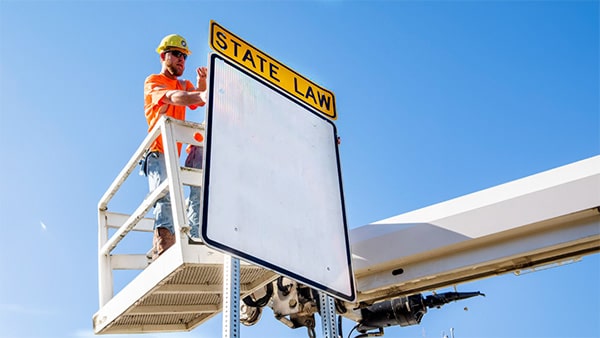
Which sign category commonly uses a vertical rectangular shape?

Many _____________ are this shape.
  1. A School-zone signs
  2. B Regulatory signs
  3. C General warning signs
  4. D Railroad advance-warning signs

Correct answer: B – Regulatory signs

Most regulatory signs are rectangular, commonly with the longer dimension positioned vertically. They communicate traffic laws or restrictions, such as speed limits and movement controls. Some regulatory signs use special shapes, including the octagonal STOP sign and triangular YIELD sign, but the general category is associated with rectangular designs.

Source: Manual on Uniform Traffic Control Devices, 11th Edition with Revision 1 — § 2B.02, “Design of Regulatory Signs”

Question 6

Which statement about alcohol and driving is correct?

  1. A Some drivers are completely unaffected by alcohol
  2. B Equivalent amounts of alcohol from beer and liquor can impair driving similarly
  3. C Coffee and fresh air quickly remove alcohol from the body
  4. D Drinking rapidly reduces alcohol’s effect on driving

Correct answer: B – Equivalent amounts of alcohol from beer and liquor can impair driving similarly

It is the amount of alcohol consumed—not whether it came from beer, wine, or liquor—that affects performance. Coffee, cold showers, and fresh air do not remove alcohol from the body; only time allows the body to process it. Drinking faster increases the amount of alcohol accumulating in the body and can increase impairment.

Source: Connecticut Commercial Driver’s License Manual — § 2.22.1, “Alcohol and Driving,” “What Is a Drink?”