


Connecticut General Knowledge CDL Prep Test (CT) 4

5 out of 5 (49 votes)
80% Passing score
20 Questions
4 Mistakes allowed
Are you preparing for your Connecticut Commercial Driver's License (CDL) test? Our fourth CDL general knowledge practice test is a vital tool in your preparation arsenal. This DMV practice test includes 20 carefully crafted questions, designed to mirror the format and content of the actual DMV written test. To pass, you need to correctly answer at least 16 questions, setting a high standard for your learning. What makes our CT CDL practice test stand out is its focus on customization and detailed feedback. You can tailor your study sessions according to your needs. If certain topics seem challenging, you can concentrate on them more intensively. The flexibility of taking the general knowledge practice test multiple times allows you to see consistent improvement in your performance. It's not just about practicing; it's about evolving your understanding and skills with each session. Another advantage of our drivers practice test is the comprehensive end-of-test summary. This feature provides you with insights into your performance, pinpointing the questions you missed and providing the correct answers. This feedback is invaluable for learning and retaining the correct information, ensuring that you're not just memorizing, but truly understanding the material. The resemblance of our Connecticut general knowledge CDL practice test to the actual DMV test cannot be overstated. We have diligently designed the questions to emulate the real permit test, both in the type of questions and the way they are presented. This similarity is crucial for you to become comfortable with the test format, reducing anxiety and increasing your confidence on the day of the actual test. In summary, our Connecticut General Knowledge CDL Practice Test offers an effective and comprehensive preparation tool, designed to enhance your knowledge, boost your confidence, and ultimately help you succeed in your CDL test in 2026.
FREE CDL Practice Test App
Pass your Connecticut CDL General Knowledge test with the NextDoorDriving app. Real questions and answers—100% free and ad-free.
Download on the App Store

Sample Connecticut CDL Test Questions - General Knowledge

Question 1

Which two measurements can tell a manual-transmission driver when to shift up?

  1. A Engine sound and coolant temperature
  2. B Engine speed and road speed
  3. C Time in the current gear and clutch resistance
  4. D Oil pressure and brake pressure

Correct answer: B – Engine speed and road speed

One method uses engine speed: learn the vehicle’s operating rpm range and shift as the engine reaches the appropriate point. The other uses road speed: learn which speeds are suitable for each gear and monitor the speedometer. Shift points can vary by vehicle, transmission, and manufacturer specifications.

Source: Connecticut Commercial Driver’s License Manual — § 2.3.1, “Manual Transmissions,” “Knowing When to Shift Up”
Question 2

On a two-lane, two-way road, a solid yellow center line is beside your lane and a broken yellow line is beside the opposing lane. What does this mean for you?

  1. A You may not cross the center marking to pass
  2. B You may cross the center marking to pass with care
  3. C Your traffic lane is about to end
  4. D The posted speed limit is 25 mph

Correct answer: A – You may not cross the center marking to pass

A solid yellow line adjacent to your lane marks a no-passing restriction for traffic traveling in your direction. Traffic beside the broken yellow line may cross the center marking to pass with care when otherwise lawful and safe. The marking regulates passing; it does not indicate that your lane is ending or establish a speed limit.

Source: Manual on Uniform Traffic Control Devices, 11th Edition with Revision 1 — § 3B.01, “Yellow Center Line Pavement Markings and Warrants”

Question 3

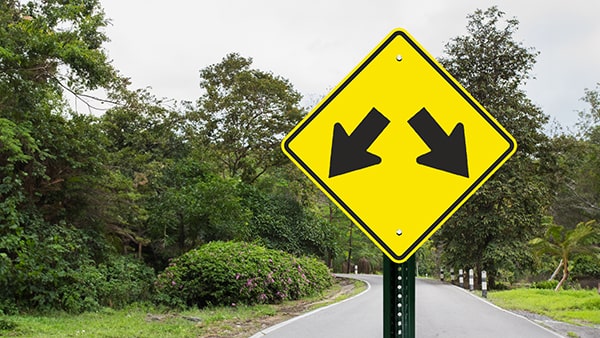
A yellow diamond sign showing black arrows passing on both sides of a center point means:

This sign indicates that _____________.
  1. A Traffic must turn left at the next intersection
  2. B Traffic must keep right of the obstruction
  3. C Traffic may pass on either side of an island or roadway obstruction
  4. D All turns are prohibited ahead

Correct answer: C – Traffic may pass on either side of an island or roadway obstruction

The Double Arrow warning sign advises that traffic may travel on either side of an island, obstruction, or gore in the roadway. It warns of the roadway feature ahead rather than establishing a turning restriction. Drivers should select the appropriate open path and maintain safe clearance.

Source: Manual on Uniform Traffic Control Devices for Streets and Highways, 11th ed. with Revision 1 — § 2C.23, “Double Arrow Sign (W12-1)”

Question 4

Under ideal conditions, what is the minimum total stopping distance at 55 mph?

  1. A 216 feet
  2. B 300 feet
  3. C 419 feet
  4. D 550 feet

Correct answer: C – 419 feet

The Connecticut CDL manual gives a minimum total stopping distance of 419 feet at 55 mph under ideal conditions. This includes about 142 feet of perception distance, 61 feet of reaction distance, and 216 feet of braking distance. Poor traction, worn brakes, excess speed, or delayed recognition can increase the distance substantially.

Source: Connecticut Commercial Driver’s License Manual — § 2.6.1, “Stopping Distance”

Question 5

On a vehicle without automatic air-tank drains, when should the tanks be drained?

  1. A At the end of each day of driving
  2. B Once each month
  3. C Every six months
  4. D Once each year

Correct answer: A – At the end of each day of driving

Manually drained air tanks must be drained completely at the end of each day of driving. Moisture and compressor oil can collect in the tanks, and water may freeze in cold weather and interfere with brake operation. Automatic drain valves normally expel these contaminants, although some automatic systems also permit manual draining.

Source: Connecticut Commercial Driver’s License Manual — § 5.1.4, “Air Tank Drains”

Question 6

Which action communicates the maneuver you intend to make to other road users?

  1. A Using a mobile phone
  2. B Applying the brakes repeatedly
  3. C Sounding the horn continuously
  4. D Using the proper turn signal

Correct answer: D – Using the proper turn signal

Proper signaling tells other road users what movement you plan to make. Signal early enough to provide useful warning before turning, changing lanes, or pulling away from the curb. A horn can communicate your presence when needed, but it does not replace the turn signal used to announce an intended maneuver.

Source: Connecticut Commercial Driver’s License Manual — § 2.5.1, “Signal Your Intentions”