


Connecticut CDL General Knowledge Test (CT) 5

5 out of 5 (57 votes)
80% Passing score
50 Questions
10 Mistakes allowed
As a new driver preparing for your Connecticut CDL (Commercial Driver's License), you understand the importance of thorough preparation. That's where our Connecticut CDL General Knowledge Practice Test comes in, designed to boost your confidence and knowledge as you approach your exam. This is your fifth CT CDL practice test, a pivotal step in your preparation journey, offering a comprehensive approach to mastering the essentials of commercial driving. Our DMV practice test includes 50 carefully curated questions, mirroring the real test's structure. To pass, you'll need to answer at least 40 questions correctly. The content of these questions is critical, covering vital areas such as pre-trip inspection, basic vehicle control, and safe cargo transportation. These topics are not just for passing the CDL written test; they are fundamental skills for every responsible commercial driver, ensuring you're equipped for any situation on the road. What makes our Connecticut CDL practice test stand out is its dynamic nature. Unlike static tests, where questions and their order remain unchanged, our test offers a randomized set of questions each time you take it. This approach ensures that you're not just memorizing sequences but actually understanding and internalizing the knowledge. It's a method proven to enhance learning and retention, preparing you for the unpredictability of real-world scenarios. Furthermore, the CT CDL practice test is tailored specifically for Connecticut, incorporating state-specific rules, regulations, and road signage. This specificity is crucial as driving laws vary significantly across states. By focusing on Connecticut's unique requirements, you're not just preparing for a test; you're preparing for real-life driving in your home state. Our general knowledge practice test is more than just a preparation tool; it's a crucial step towards becoming a safe, knowledgeable, and responsible commercial driver in Connecticut.
FREE CDL Practice Test App
Pass your Connecticut CDL General Knowledge test with the NextDoorDriving app. Real questions and answers—100% free and ad-free.
Download on the App Store

Sample Connecticut CDL Test Questions - General Knowledge

Question 1

Properly adjusted outside convex mirrors on a school bus should show:

  1. A The entire side of the bus up to the mirror mounts
  2. B The front of the rear tires where they touch the ground
  3. C At least one traffic lane on each side of the bus
  4. D All of these views

Correct answer: D – All of these views

The Connecticut CDL manual specifies all three views for outside left and right convex mirrors. They should show the entire side of the bus up to the mirror mounts, the front of the rear tires touching the ground, and at least one traffic lane on each side. Convex mirrors widen the field of view, but objects appear smaller and farther away than they are.

Source: Connecticut Commercial Driver’s License Manual — § 10.1.4, “Outside Left and Right Side Convex Mirrors”
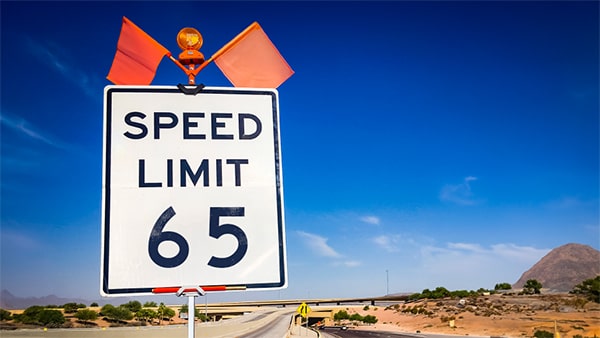

Question 2

A white rectangular sign reading “SPEED LIMIT 65” means you should:

This sign instructs drivers to _____________.
  1. A Drive 65 mph only during daylight hours
  2. B Maintain a speed of at least 65 mph
  3. C Not exceed 65 mph and drive slower when conditions require
  4. D Drive 65 mph only at night

Correct answer: C – Not exceed 65 mph and drive slower when conditions require

A posted 65 mph limit does not require a driver to maintain that speed. Connecticut law prohibits driving above 65 mph where that limit applies and still requires drivers to reduce speed when traffic, weather, visibility, pedestrians, or highway conditions create a special hazard. The same posted maximum applies during the day and at night unless another lawful limit is displayed.

Source: Conn. Gen. Stat. § 14-218a — Traveling unreasonably fast. Establishment of speed limits, Conn. Gen. Stat. § 14-219 — Speeding

Question 3

What must you do when approaching a YIELD sign?

When approaching this sign _______________.
  1. A Continue without reducing speed
  2. B Enter the intersection before approaching traffic
  3. C Slow to a reasonable speed and yield to traffic presenting an immediate hazard
  4. D Expect all other traffic to stop for you

Correct answer: C – Slow to a reasonable speed and yield to traffic presenting an immediate hazard

In Connecticut, a driver approaching a YIELD sign must slow to a speed reasonable for existing conditions. The driver must yield to a vehicle already in the intersection or approaching closely enough to constitute an immediate hazard while the driver crosses the intersection. Proceed only after the required right-of-way has been given.

Source: Conn. Gen. Stat. § 14-302 — “Yield” signs

Question 4

Which checks belong to the kingpin, apron, and gap portion of a fifth-wheel inspection?

  1. A Confirm that the kingpin is present and is not bent, damaged, or worn
  2. B Inspect the visible apron for bending, cracks, or breaks
  3. C Verify that the trailer lies flat on the fifth-wheel skid plate with no gap
  4. D All of these checks

Correct answer: D – All of these checks

All three conditions must be inspected. The kingpin must be present and free of bending, damage, or excessive wear, while the visible apron must not be bent, cracked, or broken. The trailer must also lie flat on the fifth-wheel skid plate without space between the apron and fifth wheel, indicating proper seating of the connection.

Source: Connecticut Commercial Driver’s License Manual — § 11.6.1, “Kingpin, Apron & Gap”

Question 5

Which practices should you use when backing a commercial vehicle?

  1. A Back toward the driver’s side whenever possible
  2. B Use a helper when one is available
  3. C Inspect the intended path before backing
  4. D All of these practices

Correct answer: D – All of these practices

Before backing, inspect the route and look for hazards beside, behind, and above the vehicle. Back slowly while checking both mirrors, and use driver-side backing whenever possible because it provides a better view through the side window. A properly positioned helper can warn about blind spots, but the driver remains responsible for controlling the vehicle safely.

Source: Connecticut Commercial Driver’s License Manual — § 2.2.4, “Backing Safely”

Question 6

How should you measure your following distance in seconds?

  1. A Allow one second for each passenger vehicle between you and the vehicle ahead
  2. B Begin counting when the vehicle ahead passes a clear landmark and stop when you reach it
  3. C Estimate the distance only in feet
  4. D Count from the moment the vehicle ahead applies its brakes

Correct answer: B – Begin counting when the vehicle ahead passes a clear landmark and stop when you reach it

Choose a fixed landmark and begin counting when the vehicle ahead passes it. Stop counting when the front of your vehicle reaches the same point; the result is your following interval in seconds. Compare that interval with the recommended rule of at least one second for every 10 feet of vehicle length, plus one additional second when traveling over 40 mph.

Source: Connecticut Commercial Driver’s License Manual — § 2.7.1, “Space Ahead”