


Connecticut DMV Test Evaluation

4.7 out of 5 (1168 votes)
80% Passing score
10 Questions
2 Mistakes allowed
Start with this Connecticut DMV practice test before you walk into the real thing thinking, well, how hard can 25 questions be? The answer is: not impossible, not scary, but definitely specific. Connecticut’s learner’s permit knowledge test is based on the Connecticut Driver’s Manual, and it expects you to know more than the obvious stuff. Road signs, traffic laws, safe driving habits, sharing the road, and driver responsibilities can all show up. The wording can be just slippery enough to catch people who only skimmed the info.   This CT DMV permit practice test gives you a clean first read on where you stand. It includes 10 questions, some with visual aids, covering the same general territory you will see on the official test. No timer is breathing down your neck, which is good, because the point here is not to rush through and hope for the best. Read the question, look at the details, catch yourself before you pick the answer that “sounds right” but is not quite right. That happens more often than people admit. For the official Connecticut DMV permit test, you will need to answer at least 20 out of 25 questions correctly to pass. That is an 80% score, with road sign questions included inside the main knowledge test rather than split off into some separate road-sign exam. Rules, judgment, safety, and knowing what Connecticut actually expects from a new driver? Practicing will keep you from drawing blanks on test day.   A score of 8 out of 10 is a solid sign that you are on track, but do not treat it like a victory lap. Treat it like a checkpoint. Take this CT permit practice test, review what you miss, and keep working through more DMV practice test questions until the signs, rules, and safe-driving decisions feel familiar instead of half-remembered.   Use this permit test practice while you are getting the other licensing pieces together, because there are pieces. You need to schedule your in-person DMV appointment, gather original identity documents, bring two proofs of Connecticut residency, complete the required Work Zone Safety Course, print the certificate, and remember glasses or contacts if you need them for the vision test. Not a ton of fun, but all important. Getting a license is a lot of work, but this test is here to help.
FREE DMV Practice Test App
Study for your Connecticut permit test or driver’s license with the NextDoorDriving app. 700+ DMV questions and answers, 100% free!
Download on the App Store

Sample Connecticut Permit Test Questions

Question 1

A school bus is stopped ahead in your lane with its red signal lights flashing. What must you do?

  1. A Stop and remain stopped until the red lights stop flashing
  2. B Change lanes and pass at a reduced speed
  3. C Proceed after the last visible child leaves the bus
  4. D Slow down unless the bus driver signals you to stop

Correct answer: A – Stop and remain stopped until the red lights stop flashing

Connecticut law requires a driver approaching, following, or overtaking a stopped school bus to stop at least 10 feet away while its red lights are flashing. A first violation carries a $450 fine; later violations carry a $500 to $1,000 fine, up to 30 days' imprisonment, or both. The opposite-direction exception applies when a median or physical barrier separates the roadways.

Source: CGS § 14-279(a), (b) – Vehicles to stop for school bus. Penalties. Written warning or summons., State of Connecticut Driver's Manual — “Right-of-Way”
Question 2

Which methods should drivers use to communicate their presence or intentions to others?

  1. A Turn signals and brake lights when changing direction or slowing
  2. B The horn when a warning is necessary for safety
  3. C Emergency flashers or warning devices during vehicle trouble
  4. D All of the above

Correct answer: D – All of the above

Turn signals alert others before a turn, lane change, merge, or parking maneuver, while brake lights communicate slowing or stopping. A horn may be used as a safety warning when it can help prevent a collision. Emergency flashers and warning devices help make a disabled vehicle visible to approaching road users.

Source: State of Connecticut Driver's Manual — “Turn Signals”, State of Connecticut Driver's Manual — “Horn”, State of Connecticut Driver's Manual — “Use Emergency Signals”

Question 3

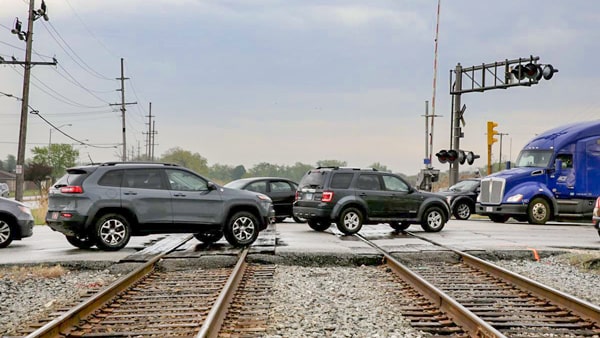
Traffic is backed up beyond a railroad crossing. When may you begin crossing the tracks?

Before you reach the intersection, when crossing railroad tracks in slow traffic, you should:
  1. A After sounding your horn
  2. B As soon as the vehicle ahead reaches the tracks
  3. C When there is enough room to stop between the rails
  4. D Only when enough space exists to clear the tracks completely

Correct answer: D – Only when enough space exists to clear the tracks completely

Do not begin crossing railroad tracks unless there is room for your entire vehicle on the far side. Waiting before the crossing prevents traffic congestion from trapping the vehicle on the rails. Never try to drive around a lowered gate or enter while crossing lights are flashing.

Source: State of Connecticut Driver's Manual — “Railroad Crossing Signs”

Question 4

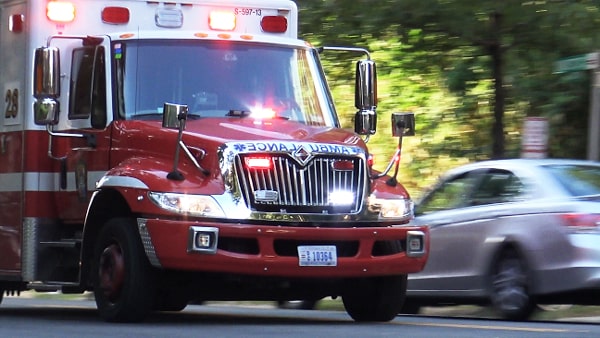
An emergency vehicle using a siren and flashing lights is approaching, and you are clear of an intersection. What must you do?

When you hear the siren or see the flashing red light of a closely approaching emergency vehicle, and you are not in the intersection, you should:
  1. A Continue slowly in the right lane
  2. B Accelerate to remain ahead of it
  3. C Move as close as possible to the right edge and stop
  4. D Stop immediately in your current lane

Correct answer: C – Move as close as possible to the right edge and stop

Connecticut law requires nearby drivers to move parallel to and as close as possible to the right edge or curb, clear of an intersection, and stop until the emergency vehicle passes. If already in an intersection, continue through before pulling over. Willfully or negligently obstructing or delaying a covered emergency vehicle can result in a fine of up to $250.

Source: CGS § 14-283(e), (h) – Rights and duties re emergency vehicles. Obstruction of emergency vehicle., State of Connecticut Driver's Manual — “Right-of-Way”
Question 5

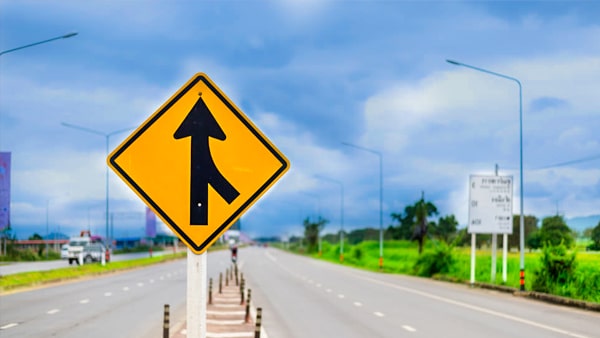
A yellow diamond-shaped MERGE sign warns that:

This sign means:
  1. A Opposing traffic begins ahead
  2. B The roadway becomes divided
  3. C Two streams of traffic are about to join
  4. D Your lane ends at a stop sign

Correct answer: C – Two streams of traffic are about to join

A merge sign warns that two lanes or streams of traffic are about to become one. Drivers in both lanes are responsible for merging smoothly. Check surrounding traffic, adjust your speed when necessary, and use an available safe gap rather than making an abrupt lane movement.

Source: State of Connecticut Driver's Manual — “Warning Signs,” “Merge”

Question 6

To identify hazards early and avoid last-minute braking or turning, how far ahead should you generally scan?

  1. A About two seconds
  2. B About five seconds
  3. C At least 12 seconds
  4. D Only as far as the vehicle directly ahead

Correct answer: C – At least 12 seconds

Connecticut's manual states that safer drivers tend to look at least 12 seconds ahead. This is about one city block in urban traffic and roughly four blocks or one-quarter mile on a highway. Continue checking nearby traffic, the sides, and mirrors while scanning well ahead for developing problems.

Source: State of Connecticut Driver's Manual — “Scanning,” “Look Ahead”