


Connecticut DMV Practice Test

4.7 out of 5 (877 votes)
80% Passing score
20 Questions
4 Mistakes allowed
Connecticut does not give out learner’s permits on vibes, optimism, or the fact that you have watched someone else parallel park a few times. You have to pass the knowledge test first, and that means dealing with 25 official questions, 20 of which need to go your way. So, yes, the bar is not impossible. It is also not something you want to casually wander into after skimming a road sign chart in the car. This CT permit test practice gives you 20 multiple-choice questions built around the material Connecticut actually cares about: road signs, traffic signals, right-of-way rules, safe driving, sharing the road, and all those little driver responsibilities that seem minor until they are sitting there on the screen at the DMV. The wording is meant to feel close to a real Connecticut DMV permit practice test, without drifting into fake “cheat sheet” territory, because those shortcuts have a nasty habit of being outdated, oversimplified, or just plain wrong. While you are practicing, you can also start getting the rest of the licensing puzzle together. Before the official knowledge test, Connecticut learner’s permit applicants must complete the free online Work Zone Safety Course, print the certificate, schedule an in-person DMV appointment, bring the right original documents, pay the testing fee, and pass the vision test before the written test even begins. It is not wildly complicated, but it is very much a “show up prepared or enjoy rescheduling” situation. For teen drivers, the process starts at age 16 and eventually involves driver training, 40 hours of practice driving, and the required permit-holding period before the road test. Adults getting a first Connecticut license usually need an adult learner’s permit and the 8-hour Safe Driving Practices Course. There are steps. There is paperwork. There may be a printer involved, which somehow makes everything feel more official. This CT DMV practice test helps make sure the knowledge-test part is the easy part.
FREE DMV Practice Test App
Study for your Connecticut permit test or driver’s license with the NextDoorDriving app. 700+ DMV questions and answers, 100% free!
Download on the App Store

Sample Connecticut Permit Test Questions

Question 1

Before turning across a bicycle lane or changing lanes near bicyclists, why should you check your blind spots?

  1. A Bicyclists always have the right-of-way
  2. B A bicyclist may be outside the area visible in your mirrors
  3. C Bicyclists are required to ride against traffic
  4. D Bicyclists are exempt from traffic rules

Correct answer: B – A bicyclist may be outside the area visible in your mirrors

Blind spots are areas near the rear corners of a vehicle that cannot be seen through its mirrors. Look over your shoulder in the direction you intend to move before changing lanes. Drivers should also identify the position of bicyclists before turning so they do not move across a bicyclist’s path.

Source: Connecticut Driver’s Manual — Road Safety, “Changing Lanes”; “Turning and Bicycles”
Question 2

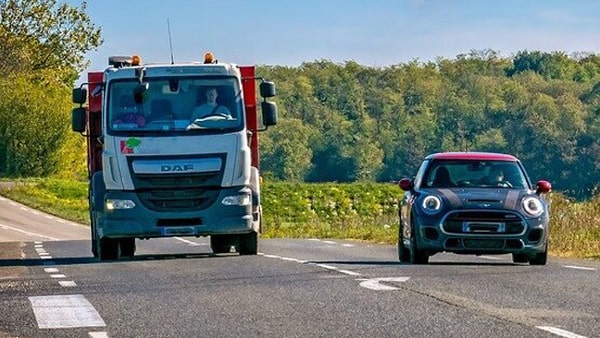
After passing another vehicle, which observation indicates that you have enough room to return to your lane?

After passing a car, it is safe to return to your driving lane when:
  1. A You have operated your turn signal for four seconds
  2. B The overtaken driver flashes the vehicle’s headlights
  3. C Both headlights of the overtaken vehicle appear in your inside rearview mirror
  4. D One headlight appears in your side mirror

Correct answer: C – Both headlights of the overtaken vehicle appear in your inside rearview mirror

The Connecticut manual advises waiting until both headlights of the overtaken vehicle are visible in your inside rearview mirror before returning. This provides a practical check that sufficient space has been left. The overtaken driver must give way and may not increase speed, but the passing driver remains responsible for staying left until safely clear.

Source: CGS § 14-232(a) – Passing, Connecticut Driver’s Manual — Road Safety, “Passing”

Question 3

What color combination is normally used for a highway sign showing the distance to an exit?

  1. A Yellow with black lettering
  2. B Black with white lettering
  3. C Red with white lettering
  4. D Green with white lettering

Correct answer: D – Green with white lettering

Green is used for guide signs that provide directions, destinations, and distances. Destination and distance signs direct drivers to specific exits and other locations. Their messages and symbols are generally displayed in white against the green background.

Source: Connecticut Driver’s Manual — Know the Road, “Colors”; “Destination and Distance Signs”

Question 4

What should you anticipate when orange signs and traffic cones appear ahead on a highway?

  1. A A mandatory lane change with no reduction in speed
  2. B Workers, equipment, or changing roadway conditions
  3. C Only a permanent reduction in the number of lanes
  4. D A need to accelerate through the area

Correct answer: B – Workers, equipment, or changing roadway conditions

Orange signs warn of construction, maintenance, or emergency work on or near the roadway. Drivers may encounter workers, flaggers, slow-moving equipment, detours, reduced speeds, or suddenly changing surfaces. Stay alert and obey signs and directions given by authorized traffic-control personnel.

Source: Connecticut Driver’s Manual — Know the Road, “Work Area Signs”

Question 5

Which color is used for centerlines separating traffic moving in opposite directions?

  1. A White
  2. B Red
  3. C Black
  4. D Yellow

Correct answer: D – Yellow

Yellow centerlines separate lanes carrying traffic in opposite directions. A broken yellow line may permit passing when conditions are safe, while solid yellow markings impose restrictions. White lines are generally used to separate lanes moving in the same direction or to mark the right roadway edge.

Source: Connecticut Driver’s Manual — Know the Road, “Pavement Markings—Center Lines”

Question 6

Before opening the driver’s door on the traffic side of a parked vehicle, what should you do?

  1. A Check behind you for vehicles, bicycles, and other traffic
  2. B Open the door far enough to make traffic stop
  3. C Give a left-turn hand signal
  4. D Sound the horn

Correct answer: A – Check behind you for vehicles, bicycles, and other traffic

The Connecticut manual instructs drivers to check traffic before opening a vehicle door and to exit on the curb side when possible. State law prohibits opening or leaving open a motor-vehicle door in a manner that causes contact with moving traffic. Moving traffic includes motor vehicles, bicycles, electric bicycles, electric scooters, and pedestrians.

Source: CGS § 14-300j – Opening or leaving open a motor vehicle door so as to cause physical contact with moving traffic, Connecticut Driver’s Manual — Road Safety, “Parking”