Connecticut Road Signs Test 2

5 out of 5 (219 votes)
80% Passing score
20 Questions
4 Mistakes allowed
Connecticut road signs are not exactly thrilling material, unless you are the kind of person who gets emotionally invested in merge arrows and yellow diamond warnings. Still, they matter, and the DMV has a habit of asking about the ones people think they already know. This CT DMV signs test gives you a cleaner way to review the signs that show up in the Connecticut Driver’s Manual, from stop and yield signs to construction warnings, highway markers, lane-use signs, railroad crossings, and all those color-coded clues that are supposed to make sense before you are halfway past them. The practice test includes 20 multiple-choice questions focused on Connecticut road signs, so it is a useful warm-up whether you are studying for your first learner’s permit, brushing up for renewal, or just trying to prove to yourself that you have not been driving on vibes alone. The real Connecticut knowledge test is a little bigger: 25 questions, with 20 correct needed to pass. That is an 80% score, which sounds manageable until one weird sign eats up your confidence for no good reason. And, because this is licensing, there are a few extra pieces hanging around the edges. Knowledge and vision tests are done in person by appointment, and Connecticut does not offer the standard learner’s permit knowledge test online at home. Starting in 2026, applicants also need to complete the free Work Zone Safety Course before taking the learner’s permit knowledge test. It takes less than an hour, which is merciful, but yes, it still has to be done. Fail the knowledge test and you will need to wait 7 days before trying again, with a $40 retake fee waiting there too, being exactly as welcome as it sounds. For teens, the learner’s permit starts at 16, followed by 40 hours of practice driving and a permit holding period of 120 days with commercial or secondary driver education, or 180 days with home training. Adults 18 and older have their own track: a 90-day permit holding period and the required 8-hour Safe Driving Practices Course. You will also need the paperwork side handled, including two identity documents, at least one primary identity document, two Connecticut residency proofs, and DMV-approved translations for non-English documents. Meanwhile, use this CT road signs test to stay sharp while you are pulling the rest of it together.
FREE DMV Practice Test App
Study for your Connecticut permit test or driver’s license with the NextDoorDriving app. 700+ DMV questions and answers, 100% free!
Download on the App Store

Sample Connecticut Permit Test Questions

Question 1

Your lane faces a green left-turn arrow while the circular traffic signal is red. What may you do?

  1. A Travel straight through the intersection only
  2. B Cautiously turn left in the arrow’s direction after yielding as required
  3. C Wait for a circular green signal in every case
  4. D Proceed in any direction after slowing

Correct answer: B – Cautiously turn left in the arrow’s direction after yielding as required

Connecticut law permits traffic facing a green arrow to cautiously enter the intersection for the movement shown by the arrow. A red circular indication still prohibits movements that are not authorized by another displayed signal. Drivers making the arrow-authorized movement must yield to pedestrians in a crosswalk and traffic lawfully within the intersection.

Source: C.G.S. § 14-299(b)(4) – Traffic control signals. Right turn on red
Question 2

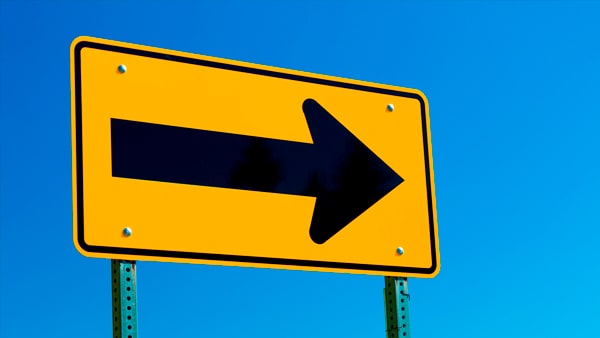
A black chevron on a yellow rectangular sign is placed along the outside of a bend. What does it indicate?

When you see this black and yellow sign, it means:
  1. A Traffic on the road to the right travels one way
  2. B A construction detour begins to the right
  3. C The roadway changes direction sharply
  4. D A side road enters from the right

Correct answer: C – The roadway changes direction sharply

Black-and-yellow direction signs placed along a bend warn drivers of a significant change in the roadway’s direction. Several may be installed along the outside of a sharp curve to show its path. Reduce speed as needed to negotiate the change safely.

Source: Connecticut Driver’s Manual — Traffic Signs—Warning Signs, “Change in Direction”

Question 3

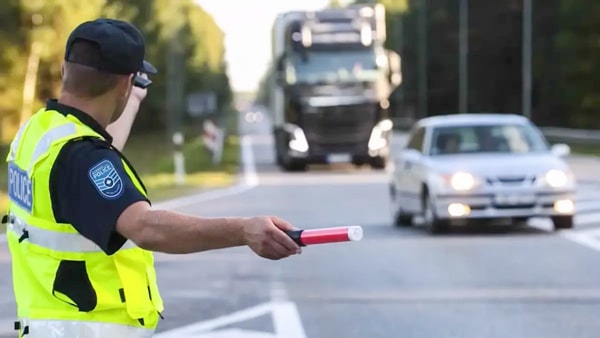
A police officer directs you through an intersection even though your traffic signal is red. What should you do?

A traffic light is red, but a police officer is telling you to go ahead anyway. What should you do?
  1. A Remain stopped until the signal turns green
  2. B Change lanes before entering the intersection
  3. C Follow the officer’s direction
  4. D Wait for the officer to approach your vehicle

Correct answer: C – Follow the officer’s direction

The Connecticut driver’s manual requires motorists to obey signals given by a law enforcement officer, even when those directions conflict with a traffic signal. The red light does not require you to remain stopped when the officer directs you to proceed. Follow the officer’s instructions.

Source: Connecticut Driver’s Manual — Road Safety, “Right-of-Way”

Question 4

Which pavement marking helps drivers select the lane required for a particular turn?

  1. A A flashing red signal
  2. B A flashing yellow signal
  3. C A solid edge line beside the roadway
  4. D Directional arrows painted in the travel lanes

Correct answer: D – Directional arrows painted in the travel lanes

Pavement lines and symbols provide lane control and identify which lanes drivers should use for turns. Directional arrows painted within a lane show the movement assigned to or permitted from that lane. Position your vehicle in the appropriate lane before reaching the intersection.

Source: Connecticut Driver’s Manual — Know the Road, “Pavement Markings”

Question 5

A yellow arrow appears while you are waiting in a dedicated left-turn lane. What should you do?

  1. A Accelerate to enter the intersection before the signal changes
  2. B Remain stopped regardless of your position or ability to stop safely
  3. C Prepare to stop and obey the signal indication that follows
  4. D Turn immediately because the arrow gives you priority

Correct answer: C – Prepare to stop and obey the signal indication that follows

A yellow arrow warns that the protection provided by the green arrow is ending. The driver’s manual directs a motorist turning in the arrow’s direction to prepare to stop. A steady yellow indication requires stopping before entering the intersection when the stop can be made safely.

Source: C.G.S. § 14-299(b)(2) – Traffic control signals. Right turn on red, Connecticut Driver’s Manual — Know the Road, “Traffic Signals—Arrows”

Question 6

Which action may be made across one set of double solid yellow centerlines when it can be completed safely?

  1. A Turning left into a private driveway
  2. B Using the opposing lane as an additional travel lane
  3. C Crossing the lines for any convenient reason
  4. D Passing an ordinary slower vehicle

Correct answer: A – Turning left into a private driveway

The Connecticut manual permits solid yellow centerlines to be crossed for a left turn to or from an alley, private road, driveway, or street. They do not permit an ordinary pass of a slower vehicle. Before turning, the driver must ensure the movement can be made with reasonable safety and yield to opposing traffic presenting an immediate hazard.

Source: C.G.S. § 14-242(a), (e) – Turns restricted. Signals to be given before turning or stopping. U-turns. Left turns. Right turns when passing person riding bicycle, electric bicycle or electric scooter, Connecticut Driver’s Manual — Know the Road, “Pavement Markings”