


Connecticut DMV Sign Test 4

4.9 out of 5 (210 votes)
80% Passing score
20 Questions
4 Mistakes allowed
This CT road sign practice test gives you 20 multiple-choice questions focused on Connecticut road signs, sign colors, shapes, and the everyday driving situations they point to. You will see the familiar stuff, of course: Stop signs, warning signs, highway guide signs, pedestrian crossings, service signs, and the regulatory signs people sometimes glance at too fast. To pass this practice test, you need 16 correct answers out of 20, which matches the 80% standard used on Connecticut’s official learner’s permit knowledge test. For the real DMV test, Connecticut does not use a separate road-sign-only exam for a standard Class D learner’s permit. Road sign questions are included in the main 25-question knowledge test, which is based on the Connecticut Driver’s Manual. Applicants need at least 20 correct answers to pass, so missing more than 5 questions means rescheduling, waiting 7 days, and paying the testing fee again. A bit unpleasant, and also very easy to avoid with the right kind of review. There are a few licensing details to keep in mind while you study. First-time learner’s permit applicants must pass a vision test before the written knowledge test. Connecticut also requires learner’s permit applicants to complete the free online Work Zone Safety Course before taking the knowledge test, and you need to bring the printed completion certificate with you to the DMV. So, while you are collecting documents, checking appointment details, and making sure you have glasses or contacts if you need them, this CT DMV practice test gives you something practical to do with that waiting-around energy. Take your time as you move through the questions. There is no timer here, and that matters. Look at each sign closely, think through what it tells a driver to do, and connect it to the kinds of roads you actually drive in Connecticut, from busier city streets to quieter rural stretches and highway exits that sneak up faster than they should.
FREE DMV Practice Test App
Study for your Connecticut permit test or driver’s license with the NextDoorDriving app. 700+ DMV questions and answers, 100% free!
Download on the App Store

Sample Connecticut Permit Test Questions

Question 1

At a steady green signal, you plan to turn left, but approaching vehicles are close enough to create a hazard. Before completing the turn, you must:

  1. A Continue straight and use the next intersection
  2. B Stop on the crosswalk until the signal changes
  3. C Yield until the approaching traffic no longer presents an immediate hazard
  4. D Turn immediately because the green signal gives you priority

Correct answer: C – Yield until the approaching traffic no longer presents an immediate hazard

A circular green signal permits a left turn unless a sign or marking prohibits it. In Connecticut, however, a driver turning left must yield to opposing traffic that is in the intersection or close enough to present an immediate hazard. Complete the turn only when it can be made with reasonable safety.

Source: C.G.S. § 14-299(b)(1) – Traffic control signals. Right turn on red, C.G.S. § 14-242(a), (e) – Turns restricted. Signals to be given before turning or stopping. U-turns. Left turns. Right turns when passing person riding bicycle, electric bicycle or electric scooter
Question 2

Which centerline ordinarily marks a no-passing zone for traffic traveling in both directions?

  1. A A broken white line
  2. B Two solid yellow lines
  3. C A broken yellow line
  4. D A solid white line

Correct answer: B – Two solid yellow lines

The Connecticut manual identifies double solid yellow lines as centerlines separating opposing traffic where ordinary vehicle-to-vehicle passing is prohibited. Drivers must obey clearly visible no-passing markings. State law contains limited exceptions for safely passing certain road users, slow vehicles, or obstructions listed in the statute.

Source: C.G.S. § 14-234(a), (b) – Determination of no-passing zones. Overtaking and passing in no-passing zones, Connecticut Driver’s Manual — Know the Road, “Pavement Markings”

Question 3

A yellow diamond warning sign shows one vertical arrow pointing up and another pointing down. Which sign is this?

  1. A Lane Ends
  2. B Divided Highway Ends
  3. C Two-Way Traffic
  4. D Turn Left or Right

Correct answer: C – Two-Way Traffic

The Two-Way Traffic sign warns that opposing vehicles use the roadway ahead. New Hampshire traffic-control standards provide for this sign where a divided or one-way roadway changes to a two-lane, two-way roadway. It may also appear along a two-way road as a reminder that traffic approaches from both directions.

Source: N.H. Admin. R. Tra 502.04(a)(3) – Highway Project Design Criteria, Manual on Uniform Traffic Control Devices, 2009 ed., Revs. 1–3 — § 2C.44, “Two-Way Traffic Sign (W6-3)”

Question 4

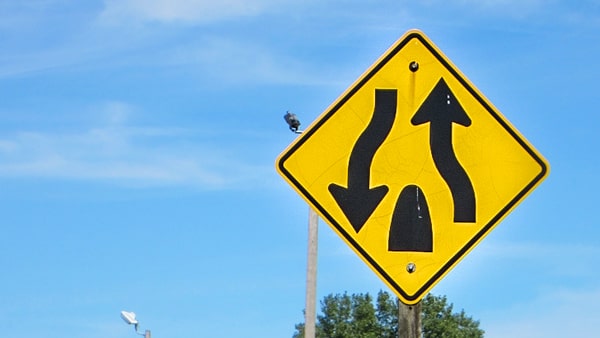
A yellow diamond sign shows two opposing arrows with the divider between them coming to an end. What does it warn of?

This sign means:
  1. A A required turn at the next intersection
  2. B The divided roadway is ending and two-way traffic begins
  3. C A one-way street begins ahead
  4. D The roadway is closed ahead

Correct answer: B – The divided roadway is ending and two-way traffic begins

This warning indicates that the divided portion of the highway is ending. Beyond the transition, opposing vehicles will travel on the same roadway rather than on roadways separated by a median or divider. Watch for oncoming traffic and remain on the proper side of the centerline.

Source: Connecticut Driver’s Manual — Traffic Signs—Warning Signs, “Two-Way Road Way”

Question 5

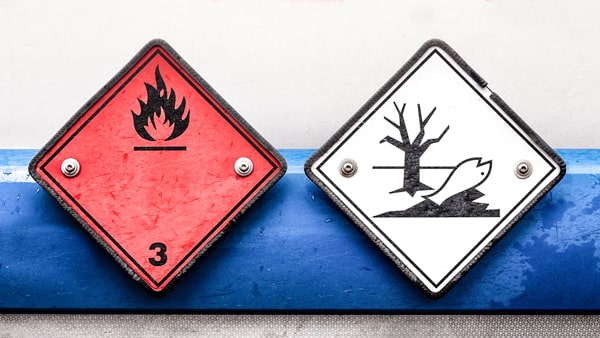
Under Connecticut law, what must a commercial motor vehicle carrying hazardous materials do before crossing railroad tracks at grade?

Which of the following is true about vehicles displaying a diamond-shaped sign (indicating a hazardous load)?
  1. A Continue without stopping if no train is visible
  2. B Reduce speed to 35 mph before crossing
  3. C Stop 15 to 50 feet from the nearest rail and look and listen for trains
  4. D Stop only when the crossing signals are active

Correct answer: C – Stop 15 to 50 feet from the nearest rail and look and listen for trains

A covered commercial vehicle must stop no less than 15 feet and no more than 50 feet from the nearest rail. While stopped, the operator must look and listen in both directions for an approaching train. The vehicle may not cross when an automatic signal, gate, flagger, law enforcement officer, or another warning indicates that a train is approaching.

Source: C.G.S. § 14-250(a) – Certain motor vehicles to stop at railroad crossing. Regulations. Penalty

Question 6

What does a flashing yellow traffic signal direct you to do?

  1. A Merge with entering traffic
  2. B Proceed with caution
  3. C Stop for a pedestrian crossing
  4. D Come to a complete stop

Correct answer: B – Proceed with caution

In Connecticut, traffic facing a flashing yellow signal may proceed only with caution. The driver’s manual also instructs motorists to slow down before continuing. A flashing yellow signal differs from a flashing red signal, which requires a complete stop before proceeding.

Source: C.G.S. § 14-299(d)(2) – Traffic control signals. Right turn on red, Connecticut Driver’s Manual — Know the Road, “Traffic Signals—Flashing Lights”