


Delaware Driving Test Practice 5

4.9 out of 5 (69 votes)
80% Passing score
20 Questions
4 Mistakes allowed
The Delaware driver's license test is not something to wander into with a vague memory of road signs and a lucky pencil. Delaware expects you to know the rules, especially the ones that turn serious fast, like DUI laws, blood alcohol limits, and what impaired driving can actually cost you. This Delaware DMV practice test, the fifth in the series, gives you 20 focused questions built around that kind of material, not random trivia dressed up as driver prep. It is still a practice test, of course. Nobody is pretending it is thrilling. But a good Delaware practice permit test does more than tell you whether you clicked the right answer. It gets you used to the shape of the exam, the wording of the questions, and the little details that tend to slip out of your head the moment you sit down for the real thing. Some questions include visual aids too, which matters more than people admit. Signs, road conditions, and safe-driving situations are often easier to understand when you are not trying to imagine them from a flat sentence. This free Delaware driving permit practice test is available online whenever you want to review, repeat, and tighten up your knowledge before test day. Use it early, use it again later, and let the actual DMV visit be the part with fewer surprises. Plan to get ready for the DMV side of this, because Delaware licensing is not just “study, pass, drive away.” Applicants need the right documents before they apply in person at a DMV office. Bring proof of identity and legal presence, Social Security documentation if eligible, and two proofs of Delaware residency from separate sources. Those residency documents need to show a physical Delaware address, not a P.O. box. If your current name does not match your identity document, name-change paperwork comes into the picture. Applicants under 18 have another layer: paperwork showing a parent or legal guardian connection. After passing the Class D knowledge exam, Delaware requires a wait of at least 10 days before the road skills exam. Road tests also come with their own checklist: a valid learner’s permit, a properly licensed accompanying driver who is at least 21, current registration, insurance, and a safe test vehicle. Forgetting one piece can turn an appointment into a wasted trip, and no one needs that.
FREE DMV Practice Test App
Study for your Delaware permit test or driver’s license with the NextDoorDriving app. 700+ DMV questions and answers, 100% free!
Download on the App Store

Sample Delaware Permit Test Questions

Question 1

A yellow diamond sign showing a side traffic line joining your lane means:

This sign means:
  1. A Two-way traffic begins ahead
  2. B The roadway narrows and your lane ends
  3. C Traffic will merge into your roadway ahead
  4. D A divided highway begins ahead

Correct answer: C – Traffic will merge into your roadway ahead

The merge sign warns that traffic from another roadway will enter the traffic stream ahead. Watch for vehicles entering from the side and remain attentive to available space around your vehicle. An added-lane sign uses a different symbol because that traffic receives its own continuing lane.

Source: Delaware Driver Manual — § 4, “Other Warning Signs”, 2 DE Admin. Code 2402 – Manual on Uniform Traffic Control Devices (MUTCD), Part 2, W4-1, “Merge”
Question 2

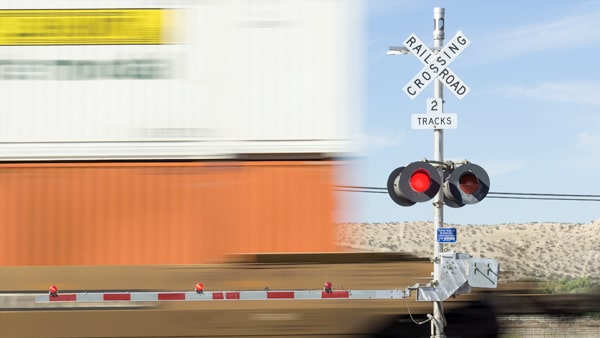
At a crossing with multiple tracks, what should you do after one train passes?

After a train has passed, you should:
  1. A Wait for a green highway signal
  2. B Cross immediately behind the train
  3. C Sound your horn before crossing
  4. D Look again for another train and cross only when safe

Correct answer: D – Look again for another train and cross only when safe

Do not begin crossing immediately after a train clears, especially where multiple tracks are present. Wait until you can see along the tracks and determine that another train is not approaching. Delaware law also prohibits proceeding after a required railroad stop until the crossing can be entered safely.

Source: 21 Del. C. § 4161 – Obedience to signal indicating approach of train or other on-track equipment, drawbridge, or automatic signal system controlling the flow of traffic, Delaware Driver Manual — § 5, “Railroad Crossings”

Question 3

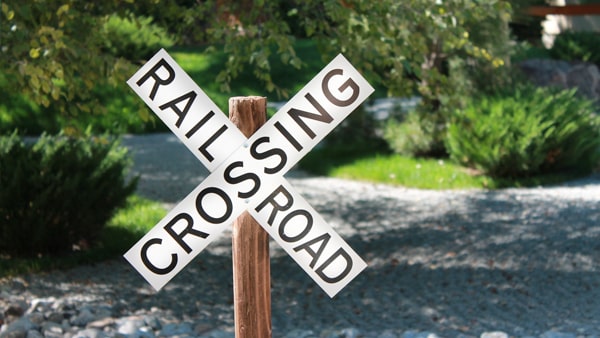
A white X-shaped CROSSBUCK sign identifies a:

This road sign means:
  1. A Stop-controlled intersection
  2. B Three-way intersection
  3. C Crossroad intersection
  4. D Railroad grade crossing

Correct answer: D – Railroad grade crossing

The crossbuck marks a railroad grade crossing. In Delaware, the driver manual explains that it has the same meaning as a yield sign and requires drivers to yield to trains. Approach prepared to slow or stop and cross only when no train or other on-track equipment presents a hazard.

Source: Delaware Driver Manual — § 4, “Railroad Crossings”, 2 DE Admin. Code 2402 – Manual on Uniform Traffic Control Devices (MUTCD), Part 8, § 8B.03, “Crossbuck and Number of Tracks Plaque at Passive Grade Crossings”

Question 4

Which statement about large trucks is correct?

  1. A They generally require more distance to stop than passenger vehicles
  2. B Air brakes allow every truck to stop more quickly than a car
  3. C They can maneuver more easily than passenger vehicles
  4. D They have no areas hidden from the driver’s view

Correct answer: A – They generally require more distance to stop than passenger vehicles

Large trucks generally need more roadway to stop than passenger vehicles traveling at the same speed. They are also less maneuverable and have substantial blind areas around the front, sides, and rear. A truck’s air brakes do not eliminate the need for other drivers to allow adequate following distance.

Source: Delaware Driver Manual — § 5, “Sharing the Road with Trucks”

Question 5

Which driving abilities can alcohol impair?

  1. A The ability to see clearly
  2. B Reaction time
  3. C Judgment of speed and distance
  4. D All of these abilities

Correct answer: D – All of these abilities

Alcohol slows reflexes and reaction time, reduces clear vision, and makes a driver less alert. As alcohol levels increase, judgment and vehicle-control skills deteriorate. A drinking driver may have difficulty judging distances, speeds, and the movement of other vehicles.

Source: Delaware Driver Manual — § 2, “If You Drink, When Can You Drive”

Question 6

If your vehicle has airbags, when must you wear a seat belt under the general rule?

  1. A Only while driving on limited-access highways
  2. B Whenever the vehicle is driven on a street or highway
  3. C Only when driving outside a city or town
  4. D Only at speeds above 35 mph

Correct answer: B – Whenever the vehicle is driven on a street or highway

Delaware generally requires a driver operating a motor vehicle on a street or highway to wear a properly adjusted and fastened seat belt. Airbags do not replace seat belts; the two systems are designed to work together. Section 4802(c) contains limited medical, vehicle, and postal-worker exceptions.

Source: 21 Del. C. § 4802(a), (c) – Driver requirements; exceptions; sales requirements; working condition of system, Delaware Driver Manual — § 5, “Use Safety Belts”