Delaware Practice Permit Test 7

5 out of 5 (60 votes)
80% Passing score
20 Questions
4 Mistakes allowed
Preparing for the Delaware permit test is not just about knowing who has the right-of-way at a four-way stop, although, yes, that still matters. A good Delaware DMV practice permit test should help you get comfortable with the way the actual written test feels: 20 questions, a broad mix of driving laws and safety situations, and a passing score that requires at least 16 correct answers. That gives you some room to miss a few, but not enough room to wander in underprepared and hope the road signs are feeling generous. This Delaware practice permit test is built to cover the kinds of topics new drivers actually need to know, from carrying proof of insurance to handling emergency vehicles, merging safely, and making judgment calls that are not always as tidy as the handbook makes them sound. Whether you are driving through Wilmington traffic, heading around Dover, or eventually dealing with beach-season roads near Lewes and Rehoboth, the point is the same: the Delaware written test is testing practical driving knowledge, not just your ability to memorize a few nice-sounding rules the night before. There is also the paperwork side of getting licensed, which is where people sometimes get tripped up before they even reach the testing part. Delaware DMV license and ID applicants need to bring documents proving identity and legal presence, Social Security number eligibility, and Delaware residency. In most cases, that means a primary identity document such as a certified birth certificate, U.S. passport, naturalization certificate, permanent resident card, or another DMV-accepted lawful presence document. You will also need Social Security proof, such as a Social Security card, W-2, SSA-1099, pay stub showing the full SSN, or another accepted SSA document. For residency, Delaware requires two proofs from separate sources showing your physical Delaware address, not a P.O. box. Utility bills, bank records, rental agreements, insurance policies, voter registration cards, employment records, credit card statements, USPS change-of-address confirmations, and certain recent non-personal mail may all work. Applicants under 18 also need documentation showing a parent or legal guardian, such as a birth certificate or court document. So, yes, the Delaware learners permit practice test helps you sharpen your answers for test day. But just as importantly, it gives you a cleaner sense of the whole process: study the rules, practice the format, check your documents, and avoid the small, irritating surprises that can slow everything down.

FREE DMV Practice Test App
Study for your Delaware permit test or driver’s license with the NextDoorDriving app. 700+ DMV questions and answers, 100% free!
Download on the App Store

Sample Delaware Permit Test Questions

Question 1

After stopping at an intersection, where should you look before proceeding?

  1. A Ahead and left only
  2. B Left and right only
  3. C Left, right, and ahead
  4. D Ahead and right only

Correct answer: C – Left, right, and ahead

Before entering an intersection, scan left, right, and ahead for vehicles, pedestrians, bicyclists, and other hazards. A signal or stop sign does not physically prevent another road user from entering your path. Proceed only after the required stop and when the movement can be made safely.

Source: Delaware Driver Manual — § 5, “Drive Defensively”, 21 Del. C. § 4164(a), (b) – Stop signs and yield signs

Question 2

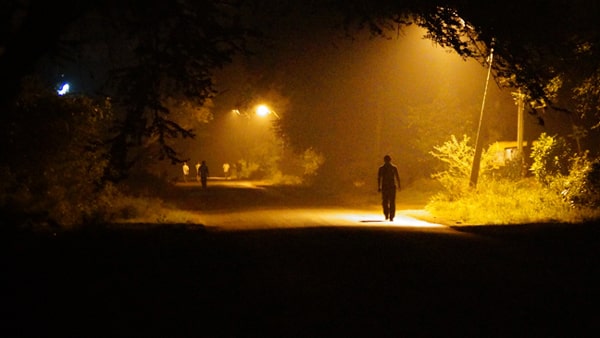
On a dark road at night, how should you choose your speed?

When driving in traffic at night on a dimly lit street, you should:
  1. A Drive slowly enough to stop within the distance illuminated by your headlights
  2. B Use high beams even when following other vehicles closely
  3. C Keep the instrument-panel lights at maximum brightness
  4. D Use hazard lights continuously while moving

Correct answer: A – Drive slowly enough to stop within the distance illuminated by your headlights

Darkness limits how far ahead a driver can identify hazards. Select a speed that allows the vehicle to stop within the visible area illuminated by the headlights. The manual’s sight-distance guidance is intended to prevent drivers from traveling too fast to stop for an object that appears at the edge of their visible range.

Source: Delaware Driver Manual — § 5, “Night Driving”, Delaware Driver Manual — § 5, “Sight Distance Rule”

Question 3

What does a single solid white line between lanes traveling in the same direction indicate?

  1. A Lane changes may be made at any time
  2. B Changing lanes is discouraged
  3. C The line separates opposing traffic
  4. D All vehicles must turn at the next intersection

Correct answer: B – Changing lanes is discouraged

White pavement markings separate traffic moving in the same direction. A dashed white line permits a lane change when it can be made safely, while a single solid white line discourages changing lanes. Double solid white lines prohibit lane changes. Drivers must also obey any accompanying signs or lane-use controls.

Source: Delaware Driver Manual — § 4, “Pavement Markings”

Question 4

When double solid yellow lines separate opposing traffic, which maneuver may be permitted?

  1. A Crossing the lines to turn left into a driveway when it is safe
  2. B Using the left side as an additional travel lane
  3. C Crossing the lines whenever traffic is stopped
  4. D Crossing the lines to pass a slower vehicle

Correct answer: A – Crossing the lines to turn left into a driveway when it is safe

Two solid yellow lines mean that traffic in either direction may not cross them to pass. A driver may cross a solid yellow line to turn into a driveway when the turn can be made safely. Before turning, signal and yield to approaching traffic that is close enough to create an immediate hazard.

Source: 21 Del. C. § 4132 – Vehicle turning left, Delaware Driver Manual — § 4, “Pavement Markings”

Question 5

Which situation calls for especially careful scanning because a person may enter or affect your path?

  1. A Children playing near a residential street
  2. B A driver whose attention is divided by passengers or a device
  3. C A flagger or worker directing traffic in a work zone
  4. D All of the above

Correct answer: D – All of the above

Children may enter a street without recognizing approaching traffic. A driver whose attention is divided may fail to notice a developing conflict. Work-zone flaggers and workers may direct vehicles into altered travel paths. Scan well ahead, reduce speed when conditions require it, and be prepared to respond to each of these situations.

Source: Delaware Driver Manual — § 2, “Distracted Driving”, Delaware Driver Manual — § 4, “Flaggers”, Delaware Driver Manual — § 5, “Adjusting To Traffic”

Question 6

Orange traffic signs normally warn drivers about:

  1. A Hospital and emergency-service routes
  2. B Construction, maintenance, or utility work conditions
  3. C Permanent speed limits
  4. D Reserved high-occupancy lanes

Correct answer: B – Construction, maintenance, or utility work conditions

Most warning signs used in highway and street work areas are orange and diamond shaped, although some are rectangular. They alert drivers to unusual or potentially hazardous conditions involving construction, maintenance, or utility work. Be prepared for workers, flaggers, channelizing devices, closed lanes, and altered traffic patterns.

Source: Delaware Driver Manual — § 4, “Warning Signs”