Delaware DMV Test Evaluation

4.6 out of 5 (172 votes)
80% Passing score
10 Questions
2 Mistakes allowed
Nobody remembers the exact number of pavement-marking questions they studied, but they do remember the DMV question that made them stare at the screen like it had personally betrayed them. That is the point of taking a Delaware DMV practice test before the real thing. The official Class D knowledge test has 32 questions, and you need 26 correct to pass, which gives you a little breathing room, but not enough to treat the exam like a quick errand. This Delaware DMV practice test gives you a practical way to see where you stand before the real knowledge exam. It covers the kind of material Delaware expects new drivers to know: traffic laws, road signs, traffic signals, pavement markings, safe driving habits, and the motor vehicle rules that can start to sound weirdly similar after a while. That is the slightly irritating part of studying, honestly. Some rules feel obvious until the wording changes, or until two answer choices look close enough to make you second-guess yourself. There is also a Delaware-specific rhythm to the test prep. Driving here can mean Wilmington traffic, quiet rural roads, Route 1 on a busy weekend, or beach traffic that makes everyone’s patience thinner than it should be. The practice test helps connect the handbook material to those real driving situations without turning the whole thing into a lecture. When you miss a question, the review gives you a chance to understand the rule behind the answer, which is more useful than just memorizing a letter choice and hoping it appears again. A few licensing details are worth keeping straight as you prepare. Adults 18 and older generally need to pass the vision screening and Class D knowledge exam, receive a learner’s permit, and wait at least 10 days before taking the road skills test. Teen drivers follow Delaware’s Graduated Driver License program, starting with a Level One Learner’s Permit at age 16, along with approved driver education, a sponsor, and supervised driving requirements. And yes, the documents matter. They always do, in the least exciting way possible. So use this Delaware permit practice test as a warm-up while you work on the other requirements. Take it more than once, read the explanations, and pay attention to the details that seem easy to skip. Those details have a habit of becoming test questions.
FREE DMV Practice Test App
Study for your Delaware permit test or driver’s license with the NextDoorDriving app. 700+ DMV questions and answers, 100% free!
Download on the App Store

Sample Delaware Permit Test Questions

Question 1

How should the front wheels be positioned when parking downhill next to a curb?

  1. A Turned toward the curb
  2. B Turned away from the curb
  3. C Kept parallel with the curb
  4. D Any position is acceptable

Correct answer: A – Turned toward the curb

Turn the front wheels toward the curb when parking downhill. The curb can help keep the vehicle from continuing into the traveled roadway if it begins to move. Secure the vehicle by placing the transmission in Park or the appropriate gear and setting the parking brake.

Source: Delaware Driver Manual — Section Four, “General Parking Rules” and “Parking on Hill”

Question 2

What should you do if you become too drowsy to remain alert while driving?

If you are driving and you feel that you cannot stay alert and awake, you:
  1. A Open a window and drink an energy drink
  2. B Turn up the music and talk with passengers
  3. C Stop in a safe place and rest or change drivers
  4. D Use any of these methods

Correct answer: C – Stop in a safe place and rest or change drivers

Fatigue dulls the mind, slows reaction time, and makes driving hazardous. If you become tired while driving, the manual advises resting or changing drivers. Leave the roadway at a safe location before resting, and do not continue until you are sufficiently alert to drive.

Source: Delaware Driver Manual — Section Two, “Drowsy Driving”

Question 3

At a railroad crossing, flashing red warning lights require you to:

  1. A Stop 15 to 50 feet from the nearest rail and proceed only when safe
  2. B Stop only when a train is visible
  3. C Reduce speed and continue across
  4. D Cross if the train still appears far away

Correct answer: A – Stop 15 to 50 feet from the nearest rail and proceed only when safe

In Delaware, flashing railroad-crossing lights require a stop between 15 and 50 feet from the nearest rail. Remain stopped while the warning is active. Proceed only after the warning has ended and you have confirmed that the crossing can be entered safely.

Source: 21 Del. C. § 4161 — Obedience to signal indicating approach of train or other on-track equipment, drawbridge, or automatic signal system controlling the flow of traffic, Delaware Driver Manual — Section Four, “Railroad Crossings”

Question 4

After overtaking another vehicle, what indicates that you have enough clearance to return to your lane?

After passing a car, it is safe to return to your driving lane when:
  1. A Your turn signal has operated for four seconds
  2. B The other driver flashes the vehicle’s lights
  3. C Both headlights of the passed vehicle are visible in your inside rearview mirror
  4. D One headlight appears in your outside mirror

Correct answer: C – Both headlights of the passed vehicle are visible in your inside rearview mirror

Delaware law requires an overtaking driver to return only when safely clear of the passed vehicle. The driver manual recommends waiting until both of that vehicle’s headlights appear in your inside rearview mirror. A courtesy signal from another driver or a partial view in a side mirror does not establish adequate clearance.

Source: 21 Del. C. § 4116(3)c. — Overtaking a vehicle or bicycle on the left, Delaware Driver Manual — Section Five, “Space to Pass”

Question 5

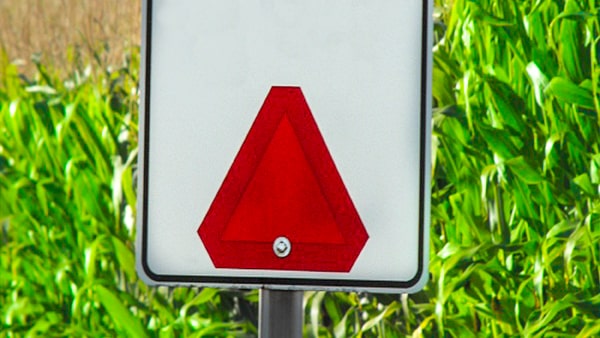
A triangular emblem with an orange center and red border on the rear of a vehicle identifies:

An orange and red sign of this shape always means:
  1. A A vehicle carrying hazardous materials
  2. B A vehicle that always has the right-of-way
  3. C A slow-moving vehicle
  4. D An emergency-response vehicle

Correct answer: C – A slow-moving vehicle

The triangular emblem identifies a slow-moving vehicle, such as certain farm, construction, or maintenance equipment. These vehicles may travel much more slowly than surrounding traffic. Recognizing the emblem early gives an approaching driver time to reduce speed and maintain a safe following distance.

Source: Delaware Driver Manual — Section Five, “Adjusting Speed”, Commercial Driver’s License Manual – Modernized Testing System — Section 2, “Seeing Hazards”

Question 6

When making a right turn, you should enter the new roadway:

  1. A In its far-left lane
  2. B As close as practicable to its right-hand curb or edge
  3. C In any open lane
  4. D In the lane nearest the center line

Correct answer: B – As close as practicable to its right-hand curb or edge

In Delaware, both the approach and the right turn must be made as close as practicable to the right-hand curb or roadway edge. This keeps the vehicle in the proper turning path rather than sweeping across other lanes. Follow a different path only when traffic-control devices at the intersection direct it.

Source: 21 Del. C. § 4152(a)(1), (b) — Required position and method of turning at intersections