Delaware Road Signs Test 2

4.9 out of 5 (46 votes)
80% Passing score
20 Questions
4 Mistakes allowed
Delaware road signs have a sneaky way of looking obvious right up until the DMV asks about them in test form, and the Delaware driver exam can go way beyond the signs everyone recognizes from the grocery-store parking lot. You may be asked to identify highway signs by shape, color, or symbol, and you’re also expected to understand traffic signals and pavement markings. So yes, the little details matter. The DMV did not put all those colors and shapes out there for decoration, unfortunately. This Delaware road signs test gives you 20 multiple-choice questions focused on the signs and signals you’re likely to see on the road and, more importantly for today’s purposes, in the licensing process. It covers the usual cast of characters: stop signs, yield signs, warning signs, regulatory signs, guide signs, no-parking areas, and those color cues that tell you what kind of message you’re dealing with before you’ve even read the words. Red tends to mean something is restricted or flat-out not allowed. Yellow is the road’s way of clearing its throat before something changes. Green points you along. Easy in theory. Less easy when the answer choices start sounding like they were written to test your confidence, not your eyesight. The official Delaware Class D Driver Manual includes road sign knowledge, and it is the study source you should actually trust. On the Class D knowledge test, Delaware gives 32 questions, and you need 26 correct answers to pass, which means you can miss no more than 6. Road sign questions count toward that score. That is the part people sometimes gloss over, and then they get a bit too casual, and then suddenly “I know signs” turns into “why did I miss that one?” Use this DMV road signs practice test before your Delaware permit test, during driver education, or while brushing up for a license renewal. It is not a sketchy cheat sheet dressed up as a shortcut. It is a practical way to see what you know, what you only sort of know, and what deserves another look before you walk into the DMV trying to look relaxed.
FREE DMV Practice Test App
Study for your Delaware permit test or driver’s license with the NextDoorDriving app. 700+ DMV questions and answers, 100% free!
Download on the App Store

Sample Delaware Permit Test Questions

Question 1

When may you move onto the left half of a two-way roadway to pass another vehicle?

On a two-way highway, you are allowed to drive on the left half of the roadway when:
  1. A Whenever the road has a double yellow centerline
  2. B When a solid yellow line is beside your lane
  3. C When passing is permitted and the left side is clear far enough to complete the pass safely
  4. D Whenever you are approaching a curve

Correct answer: C – When passing is permitted and the left side is clear far enough to complete the pass safely

In Delaware, vehicles generally must use the right half of the roadway, with an exception for lawful passing. Before moving left, the passing driver must have a clear view and enough distance to complete the maneuver without interfering with oncoming traffic. No-passing signs and markings must still be obeyed.

Source: 21 Del. C. § 4114(a)(1) – Driving on right side of roadway; exceptions, 21 Del. C. § 4118 – Limitations on overtaking on the left, 21 Del. C. § 4120 – No-passing zones; exceptions
Question 2

A green right-turn arrow changes to a steady yellow arrow as you approach. What does the yellow arrow indicate?

  1. A The green-arrow phase is ending; stop if you can do so safely
  2. B You may turn after yielding without stopping
  3. C Right turns are prohibited until the signal is removed
  4. D You should accelerate to complete the turn

Correct answer: A – The green-arrow phase is ending; stop if you can do so safely

Delaware law states that a yellow arrow warns that the previously displayed green arrow is being terminated. The next indication may be red or green. If you are too close to stop safely when the arrow changes, continue through the intersection carefully; otherwise, stop for the next signal.

Source: 21 Del. C. § 4108(a)(2)b. – Traffic-control signal legend, Delaware Driver Manual — Section Four, “Arrows”

Question 3

While approaching a left turn on a green arrow, the arrow changes to steady yellow. What should you do?

  1. A Speed up to enter before the signal changes
  2. B Stop even if a sudden stop would be unsafe
  3. C Prepare to stop because the green-arrow phase is ending
  4. D Enter without checking the next signal

Correct answer: C – Prepare to stop because the green-arrow phase is ending

Under Delaware law, a steady yellow arrow warns that the green arrow is ending and may be followed by either a red or green indication. Stop if you can do so safely. If you are already too close to stop safely, continue through the intersection with care.

Source: 21 Del. C. § 4108(a)(2)b. – Traffic-control signal legend, Delaware Driver Manual — Section Four, “Arrows”

Question 4

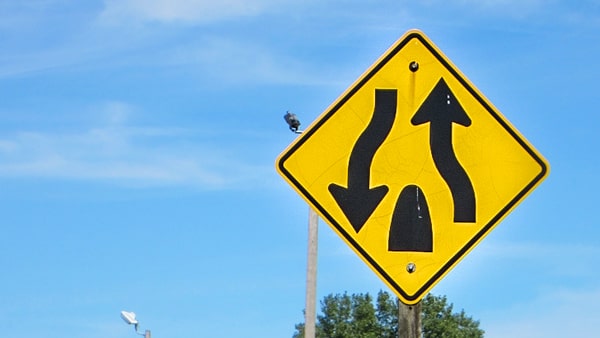
A yellow sign shows opposing arrows separated by a median below the sign but coming together above it. What does it mean?

This sign means:
  1. A Turn at the next intersection
  2. B Divided highway ends ahead
  3. C One-way roadway ahead
  4. D Road closed ahead

Correct answer: B – Divided highway ends ahead

This sign warns that the divided highway ends ahead. The physical median or divider separating opposing traffic will no longer continue. Be prepared for the change in roadway design and continue to follow the lane markings.

Source: Delaware Driver Manual — Section Four, “Warning Signs”

Question 5

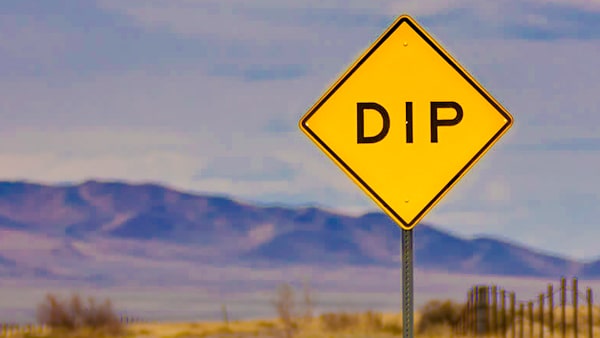
What roadway condition is indicated by a yellow warning sign reading “DIP”?

This sign means:
  1. A A low area in the roadway ahead
  2. B A soft roadway shoulder
  3. C A pedestrian crossing
  4. D A required stop

Correct answer: A – A low area in the roadway ahead

A DIP sign warns that there is a low area in the roadway ahead. Warning signs alert drivers to conditions that may require reduced speed or additional caution. Adjust your driving as needed for the roadway condition.

Source: 2 DE Admin. Code 2402 — Manual on Uniform Traffic Control Devices (MUTCD), Part 2, “Signs”, Delaware Driver Manual — Section Four, “Warning Signs”

Question 6

A yellow diamond sign contains a black arrow that bends to the left. What does it warn about?

This sign is used to warn drivers about:
  1. A An intersection ahead
  2. B A construction zone
  3. C A left curve ahead
  4. D A change in the number of lanes

Correct answer: C – A left curve ahead

The sign warns that the roadway curves to the left ahead. Its arrow shows the direction of the curve. Watch the road alignment and adjust your driving for the approaching curve.

Source: Delaware Driver Manual — Section Four, “Warning Signs”