


Delaware Road Signs Test Simulator

5 out of 5 (46 votes)
80% Passing score
25 Questions
5 Mistakes allowed
Delaware road signs are sneaky in the most ordinary way. They sit there looking familiar, almost too familiar, and then the DMV asks whether you know a sign by its shape, color, symbol, or what it actually means when traffic is not behaving like a neat little diagram in the manual. So yes, this Delaware road signs practice test stays right in that lane: signs, signals, and pavement markings, without wandering off into every other corner of the Delaware DMV test. This Delaware practice permit test gives you 20 road sign questions, and you will need 16 correct answers to pass it. The real Delaware Class D knowledge test is bigger, with 32 questions and a passing score of 26, so this is not pretending to be the whole exam. It is more like the section you should probably stop underestimating. The Delaware Division of Motor Vehicles makes it clear that applicants can be asked to identify highway signs by shape, color, or symbol, and explain the meaning of highway signs, traffic signals, and pavement markings. That sounds simple until two yellow signs start looking suspiciously alike. The questions rotate from a larger database, which is helpful because memorizing one tidy little set of answers is not really studying. It is just rehearsing. And, fine, rehearsing has its place, but the actual Delaware DMV learners permit test is not going to politely serve you the exact same questions in the exact same order because you were nice to it. Here, each session gives you another pass at the material from a slightly different angle, which is where the useful learning usually happens. Use this Delaware DMV practice test if you are getting ready for a learner’s permit, renewing your license, or brushing up because road signs have started blending into roadside wallpaper. It is a low-pressure place to get things wrong, check yourself, and try again without the official-test nerves doing that annoying little tap dance in the background. And compared with “DMV test cheat sheets,” which always seem to arrive with big promises and a faint smell of bad decisions, this instructor-reviewed road sign test is the cleaner bet. Keep the Delaware Class D Driver Manual nearby, since that is still the official study source. Then use this road sign test as focused practice for the stuff you need to recognize quickly, confidently, and preferably before you are already rolling past it.
FREE DMV Practice Test App
Study for your Delaware permit test or driver’s license with the NextDoorDriving app. 700+ DMV questions and answers, 100% free!
Download on the App Store

Sample Delaware Permit Test Questions

Question 1

A steady green arrow displayed with a circular red signal allows you to:

  1. A Proceed straight only
  2. B Proceed only in the direction permitted by the arrow
  3. C Remain stopped until the circular signal turns green
  4. D Proceed in any direction

Correct answer: B – Proceed only in the direction permitted by the arrow

The green arrow permits cautious movement in the arrow’s direction, while the circular red signal prohibits movements not otherwise authorized. You must use the lane and make only the movement controlled by the arrow. You must also yield to pedestrians and traffic lawfully within the intersection.

Source: 21 Del. C. § 4108(a)(3)–(4) – Traffic-control signal legend, Delaware Driver Manual — § 4, “Arrows”

Question 2

A protected left-turn arrow ends, but a circular green signal remains. What may you do?

  1. A Turn left after yielding to oncoming traffic and pedestrians
  2. B Proceed straight because left turns are no longer permitted
  3. C Turn left without yielding because the turn remains protected
  4. D Stop and wait for the next green arrow

Correct answer: A – Turn left after yielding to oncoming traffic and pedestrians

When the arrow ends and only a circular green remains, the protected phase has ended. Delaware law generally permits a left turn on green unless a traffic-control device prohibits it. The turning driver must yield to approaching traffic that presents an immediate hazard and to pedestrians or other traffic lawfully within the intersection or adjacent crosswalk.

Source: 21 Del. C. § 4108(a)(1) – Traffic-control signal legend, 21 Del. C. § 4132 – Vehicle turning left

Question 3

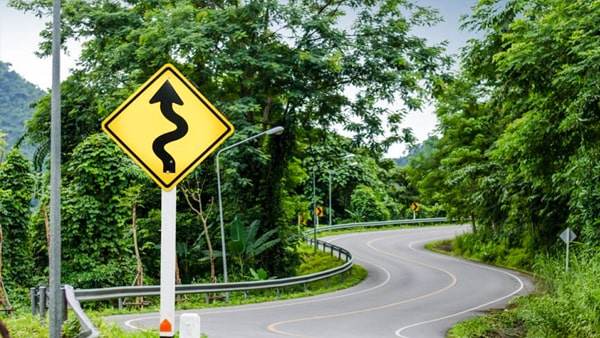
A yellow diamond sign displaying a winding arrow warns of:

This sign tells you that:
  1. A A prohibition against turning
  2. B A roadway that becomes narrower
  3. C A series of curves ahead
  4. D A surface that is slippery when wet

Correct answer: C – A series of curves ahead

The winding-road sign warns that a series of curves is ahead. Drivers should adjust their speed before reaching the curves and maintain control through each change in direction. It is different from a single-curve or slippery-road warning sign.

Source: Delaware Driver Manual — § 4, “Other Warning Signs”, 2 DE Admin. Code 2402 – Manual on Uniform Traffic Control Devices (MUTCD), Part 2, W1-5, “Winding Road”

Question 4

At a two-way intersection, what may a driver do after stopping at a steady circular red signal?

  1. A Proceed straight when no traffic is visible
  2. B Turn left when the roadway is clear
  3. C Cautiously turn right unless a traffic-control device prohibits it
  4. D Make any movement when the intersection appears clear

Correct answer: C – Cautiously turn right unless a traffic-control device prohibits it

In Delaware, a driver facing a circular red signal must stop at the stop line, crosswalk, or intersection as applicable. After stopping, the driver may cautiously turn right unless a sign or other traffic-control device prohibits the turn. A left turn on red is permitted only from a one-way roadway onto another one-way roadway.

Source: 21 Del. C. § 4108(a)(3) – Traffic-control signal legend

Question 5

An orange diamond sign showing a person using a shovel warns that:

This sign means that:
  1. A A volunteer cleanup group is nearby
  2. B Workers may be in or near the roadway ahead
  3. C A playground is ahead
  4. D A pedestrian crossing is ahead

Correct answer: B – Workers may be in or near the roadway ahead

The worker symbol warns road users that workers may be in or near the roadway. The sign is used in temporary traffic-control areas and calls for close attention to changing road conditions. Drivers must obey applicable signs and directions from authorized flaggers or traffic-control personnel.

Source: 2 DE Admin. Code 2402 – Manual on Uniform Traffic Control Devices (MUTCD), Part 6, § 6F.33, “Workers Signs (W21-1, W21-1a)”, Delaware Driver Manual — § 4, “Highway Work Zones”

Question 6

A diamond-shaped traffic sign is generally used for:

  1. A A warning about roadway conditions or hazards
  2. B An interstate route number
  3. C A school-zone designation
  4. D A posted speed limit

Correct answer: A – A warning about roadway conditions or hazards

The diamond shape is assigned to the warning-sign series. These signs alert drivers to roadway alignments, intersections, merging traffic, surface conditions, and other situations that may require attention. Route, school, and speed-limit signs use different standard shapes.

Source: 2 DE Admin. Code 2402 – Manual on Uniform Traffic Control Devices (MUTCD), Part 2, § 2A.09, “Shapes”, Delaware Driver Manual — § 4, “Warning Signs”