


Washington DC General Knowledge CDL Prep Test (DC) 4

5 out of 5 (47 votes)
80% Passing score
20 Questions
4 Mistakes allowed
As a resident of Washington DC preparing for the Commercial Driver's License (CDL) exam, you've already shown dedication and commitment. Our fourth CDL practice test, designed specifically for 2026, offers an invaluable resource in your preparation. This Washington DC CDL practice test comprises 20 questions, mirroring the content of the DMV's actual examination. To pass, you need to correctly answer at least 16 of these questions. Our practice test stands out because it provides a diverse range of questions. This means every time you revisit the test, you're exposed to different scenarios and questions, enhancing your knowledge and readiness for the real CDL general knowledge test in DC. This variety is crucial in ensuring you're not just memorizing answers, but truly understanding the material. Another significant advantage of our Washington DC CDL practice test is its current and relevant content. We regularly update the test to reflect the latest guidelines and regulations, ensuring that you are studying the most current information for 2026. This up-to-date approach is essential for your success in the CDL exam. What's more, this quality resource comes to you at no cost. While other platforms might charge for similar services, we believe in providing accessible education. Our free Washington DC general knowledge CDL practice test offers the same level of comprehensiveness and effectiveness as any paid version. This commitment to free and quality education is part of our dedication to helping Washingtonians succeed in their CDL exams. In conclusion, our fourth CDL practice test is a thorough, constantly updated, and free resource for anyone preparing for their CDL exam. It's an essential tool in your study arsenal, ensuring you walk into the DMV confident and well-prepared in 2026.
FREE CDL Practice Test App
Pass your Washington DC CDL General Knowledge test with the NextDoorDriving app. Real questions and answers—100% free and ad-free.
Download on the App Store

Sample Washington DC CDL Test Questions - General Knowledge

Question 1

When is a roadway often especially slippery during rainfall?

  1. A Just after rain begins following a dry period
  2. B Only during a heavy downpour
  3. C After several hours of steady rain
  4. D Only when standing water becomes deep

Correct answer: A – Just after rain begins following a dry period

The District of Columbia CDL manual explains that a roadway can become very slippery just after rain begins. Water mixes with oil left on the pavement by vehicles, reducing available traction. Continued rain may eventually wash much of that oil away, but drivers should reduce speed whenever rain affects traction or visibility.

Source: DC DMV Commercial Driver License Manual — § 2.6.2, “Matching Speed to the Road Surface”
Question 2

When fighting a vehicle fire, you should aim the extinguisher at the top of the flames.

  1. A True
  2. B False

Correct answer: B – False

Aim the extinguisher at the source or base of the fire, not at the upper flames. Directing the extinguishing agent at the base attacks the burning material. Stay as far from the fire as practical and use an extinguisher appropriate for the type of fire.

Source: DC DMV Commercial Driver License Manual — § 2.21.3, “Fire Fighting”

Question 3

When a commercial vehicle is stopped on a one-way or divided highway, where should the three reflective triangles be placed?

  1. A 10 feet, 100 feet, and 200 feet toward approaching traffic
  2. B 25 feet, 100 feet, and 250 feet toward approaching traffic
  3. C 50 feet, 100 feet, and 300 feet toward approaching traffic
  4. D 75 feet, 100 feet, and 400 feet toward approaching traffic

Correct answer: A – 10 feet, 100 feet, and 200 feet toward approaching traffic

The District of Columbia CDL manual specifies distances of 10, 100, and 200 feet toward approaching traffic. The nearest triangle goes on the traffic side within 10 feet of the rear of the vehicle. Under 49 CFR § 392.22, the devices must be placed as soon as possible and within 10 minutes of stopping, unless an exception applies.

Source: DC DMV Commercial Driver License Manual — § 2.5.2, “Communicating Your Presence”, 49 CFR § 392.22(b)(2)(v) – Emergency signals; stopped commercial motor vehicles

Question 4

A tank vehicle may be used to carry liquid or gas while its cargo tank is leaking.

  1. A TRUE
  2. B FALSE

Correct answer: B – FALSE

The District of Columbia CDL manual directs drivers not to carry liquids or gases in a leaking tank. A leaking tank can release cargo and make the vehicle unsafe to operate. Under 49 CFR § 396.7, an unsafe vehicle generally cannot be operated; limited movement to the nearest repair location is allowed only when that movement is less hazardous than leaving the vehicle where it is.

Source: DC DMV Commercial Driver License Manual — § 8.1, “Inspecting Tank Vehicles”, 49 CFR § 396.7 – Unsafe operations forbidden

Question 5

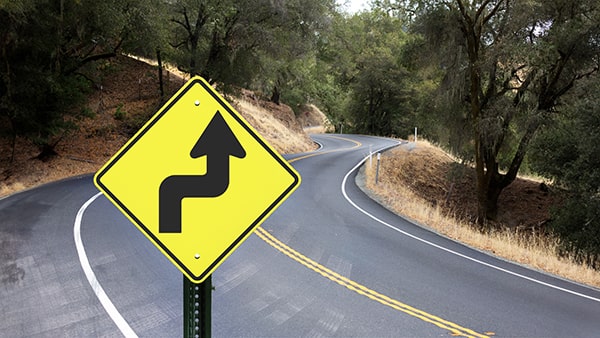
A yellow warning sign shows a sharp right turn followed by a sharp left turn. What does it indicate?

This sign warns drivers to  _____________.
  1. A A gradual curve to the right and then left
  2. B One sharp right turn
  3. C One sharp left turn
  4. D Two sharp turns, first right and then left

Correct answer: D – Two sharp turns, first right and then left

This is a right Reverse Turn warning sign. It is used when two sharp changes in roadway alignment occur in opposite directions, with the first turn to the right. Drivers should reduce speed as necessary before entering the first turn and remain prepared for the immediate turn in the opposite direction.

Source: Manual on Uniform Traffic Control Devices for Streets and Highways, 11th Edition — § 2C.07, “Horizontal Alignment Signs”

Question 6

Which is the cautious and lawful way to use a mobile telephone in a commercial motor vehicle?

  1. A Send texts whenever the vehicle is moving below 35 mph
  2. B Use a compliant hands-free setup, or pull safely off the highway and stop before using a hand-held phone
  3. C Hold the phone in the left hand so the right hand remains near the controls
  4. D Either A or B

Correct answer: B – Use a compliant hands-free setup, or pull safely off the highway and stop before using a hand-held phone

The District of Columbia CDL manual permits a properly positioned hands-free phone that can be operated without holding it or leaving the seated, belted driving position. Under 49 CFR §§ 392.80 and 392.82, texting and hand-held phone use are prohibited while driving a CMV. A driver who moves safely off the highway and stops where the vehicle can remain stationary is no longer considered to be driving for these provisions.

Source: DC DMV Commercial Driver License Manual — § 2.9.4, “Cell/Mobile Phones”, 49 CFR § 392.80 – Prohibition against texting, 49 CFR § 392.82 – Using a hand-held mobile telephone