


Washington DC CDL General Knowledge Test (DC) 5

5 out of 5 (45 votes)
80% Passing score
50 Questions
10 Mistakes allowed
As a Washingtonian ready to take on the challenge of obtaining your CDL (Commercial Driver's License), we're here to offer you a crucial tool in your preparation arsenal: our Washington DC CDL General Knowledge Practice Test. This fifth installment in our series of CDL practice tests is a reliable and effective way to gauge your readiness for the real deal. Crafted with careful attention to the demands of the CDL exam, this DMV practice test features 50 questions mirroring the content and format you'll encounter at the DMV. Each question is designed to test your knowledge and understanding of the necessary general knowledge needed for a CDL. To pass, you must correctly answer at least 40 out of these 50 questions, a standard that aligns with the DMV's expectations. What sets our Washington DC CDL practice test apart is its unbeatable accessibility and cost-effectiveness. Unlike other resources that can put a dent in your wallet, our DC DMV CDL practice test is completely free. We believe in providing equal opportunities for all aspiring commercial drivers in Washington DC, regardless of their financial circumstances. Plus, you can access this general knowledge practice test across multiple platforms - be it on your desktop, laptop, or through mobile apps. This flexibility ensures that you can practice anytime and anywhere, fitting study time into your busy schedule. Our CDL practice test adopts a multiple-choice and true/false format, identical to what you'll face in the actual DMV written test. This approach not only aids in knowledge retention but also hones your skills in identifying the correct answer amidst plausible alternatives. By repeatedly practicing this format, you'll become adept at navigating the kind of questions that the DMV will throw your way. In conclusion, our Washington DC CDL General Knowledge Practice Test is more than just a study tool; it's a strategic companion in your path to becoming a certified commercial driver. It's time to test your knowledge and edge closer to achieving your goal in 2026!
FREE CDL Practice Test App
Pass your Washington DC CDL General Knowledge test with the NextDoorDriving app. Real questions and answers—100% free and ad-free.
Download on the App Store

Sample Washington DC CDL Test Questions - General Knowledge

Question 1

The same loading and unloading procedure may be used for every hazardous material.

  1. A. TRUE
  2. B. FALSE

Correct answer: B. – FALSE

Hazardous materials require procedures appropriate to their classifications and properties. For example, explosives, corrosives, compressed gases, and radioactive materials have different loading precautions. Some materials must also be separated because 49 CFR § 177.848 prohibits certain hazardous materials from being loaded, transported, or stored together according to its segregation requirements.

Source: DC DMV Commercial Driver License Manual — § 9.4, “Loading and Unloading”, 49 CFR § 177.848 – Segregation of hazardous materials

Question 2

Which items are included in a commercial vehicle pre-trip inspection?

  1. A. The condition and securement of the cargo
  2. B. Whether exterior lights are clean and operating
  3. C. Both A and B
  4. D. Neither A nor B

Correct answer: C. – Both A and B

The District of Columbia CDL manual includes both items in its inspection procedures. Cargo should be properly blocked, braced, tied, chained, or otherwise secured. The driver must also inspect exterior lights and reflective equipment for cleanliness and proper operation because these devices make the vehicle visible and communicate its movements to other road users.

Source: DC DMV Commercial Driver License Manual — § 2.1.5, “Seven-Step Inspection Method”

Question 3

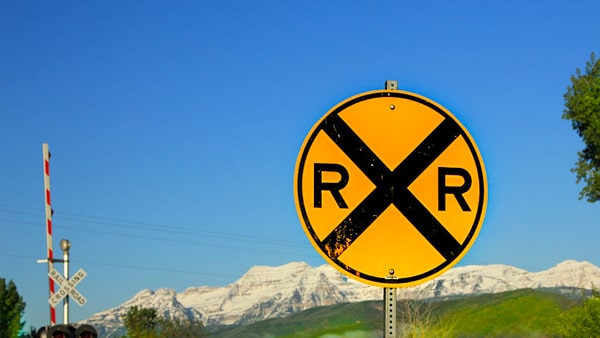
What does a round yellow sign displaying a black X and the letters “RR” warn of?

This sign warns drivers to _____________.
  1. A. A rural road intersection
  2. B. A location where every vehicle must always stop
  3. C. A pedestrian crosswalk
  4. D. A highway-rail grade crossing ahead

Correct answer: D. – A highway-rail grade crossing ahead

The round yellow W10-1 sign provides advance warning of a highway-rail grade crossing. It gives drivers time to reduce speed, look and listen for trains, and prepare to stop if required. The sign is different from the crossbuck placed at the crossing itself and does not by itself require every approaching vehicle to stop.

Source: Manual on Uniform Traffic Control Devices for Streets and Highways, 11th Edition — Part 8, “Grade Crossing Advance Warning Signs (W10 Series)”

Question 4

What is the purpose of a highway escape ramp?

  1. A. To provide an exit when a driver cannot change lanes
  2. B. To serve as an ordinary highway exit
  3. C. To provide a lane for passing slow vehicles
  4. D. To slow and stop a runaway vehicle on a steep downgrade

Correct answer: D. – To slow and stop a runaway vehicle on a steep downgrade

An escape ramp is designed to stop a runaway vehicle safely on a steep downgrade. Many use a long bed of loose, soft material that creates rolling resistance, sometimes combined with an uphill grade. Drivers should know where escape ramps are located along their route and use one when brake failure or severe brake fade prevents a controlled stop.

Source: DC DMV Commercial Driver License Manual — § 2.16.5, “Escape Ramps”

Question 5

According to the District of Columbia CDL manual, what is the leading cause of injury and death in roadway work zones?

  1. A. Speeding traffic
  2. B. Wet pavement
  3. C. Poorly adjusted brakes
  4. D. Limited nighttime visibility

Correct answer: A. – Speeding traffic

The CDL manual identifies speeding traffic as the number-one cause of injury and death in roadway work zones. Drivers must obey posted limits while approaching and traveling through these areas and should not allow speed to increase gradually. Additional speed reduction is appropriate when weather or roadway conditions are poor or workers are close to traffic.

Source: DC DMV Commercial Driver License Manual — § 2.6.7, “Roadway Work Zones”

Question 6

A yellow diamond sign shows a short road joining the main roadway from the right. What does it warn of?

This sign warns drivers to _____________.
  1. A. A one-way street beginning to the right
  2. B. Traffic approaching only from the left
  3. C. A side-road intersection on the right
  4. D. A reverse turn beginning to the right

Correct answer: C. – A side-road intersection on the right

The Side Road warning sign identifies an intersection where another roadway enters from the indicated side. A branch on the right warns of a side road ahead on the right. Drivers should watch for vehicles that may be turning into or entering from that roadway and adjust their speed and following distance when conditions require it.

Source: Manual on Uniform Traffic Control Devices for Streets and Highways, 11th Edition — Part 2, “Intersection Warning Signs and Plaques”