


Washington DC CDL Permit Test (DC) Online Simulator

5 out of 5 (36 votes)
80% Passing score
50 Questions
10 Mistakes allowed
If you're aiming to ace your Washington DC CDL Permit Test, you've come to the right place. Our unique online CDL Permit Test Simulator is not just another practice test; it's a comprehensive tool that challenges and enhances your knowledge for the real deal. With over 700 questions in our database, the simulator ensures you're well-versed in every aspect of the test. Every attempt at this simulator presents a fresh set of 50 DC CDL test questions, drawn randomly from our extensive pool. This format is pivotal in providing a real test experience, making sure you don't just memorize the sequence but understand the material thoroughly. The questions, a mix of multiple-choice and true or false, cover everything you need to know for CDL licenses classes A and B. Unlike many CDL practice tests, our simulator isn't timed. This allows you to delve into each question, understand the nitty-gritty, and build a solid foundation of knowledge. Remember, while the actual CDL test will be timed, here you have the liberty to take your time, a feature we believe is essential for deep learning. The simulator is structured to reflect the real DC CDL test conditions: you'll need to correctly answer at least 40 out of 50 questions to pass. We encourage you to aim higher, ensuring that when it's time for the actual test, you're more than ready. By repeatedly taking this simulator, you're not just practicing; you're adapting to the test format, learning time management, and most importantly, building the confidence to succeed. Get ready to tackle your Washington DC CDL permit test in 2026 with the assurance that you've prepared in the most effective and realistic way possible.
FREE CDL Practice Test App
Pass your Washington DC CDL General Knowledge test with the NextDoorDriving app. Real questions and answers—100% free and ad-free.
Download on the App Store

Sample Washington DC CDL Test Questions - General Knowledge

Question 1

Why is backing toward the driver's side preferred when a choice is available?

  1. A Traffic law always requires it
  2. B It guarantees that the maneuver will take less time
  3. C It gives the driver a better view of the vehicle's path
  4. D It eliminates the need to check both mirrors

Correct answer: C – It gives the driver a better view of the vehicle's path

Driver-side backing provides better visibility than backing toward the right. When turning toward the driver's side, the driver can watch the rear of the vehicle through the side window while continuing to check the mirrors. Back slowly and use a helper when one is available because blind spots still remain.

Source: DC DMV Commercial Driver License Manual — Section 2, § 2.2.2, “Backing Safely”
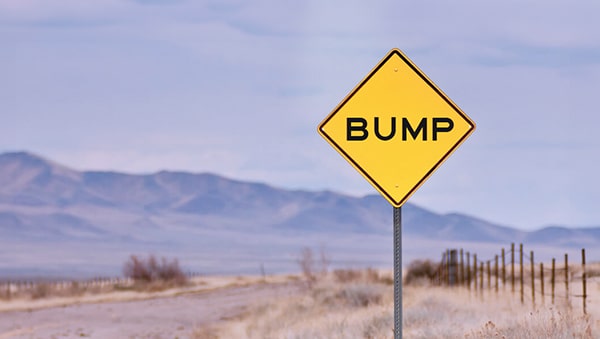
Question 2

A yellow BUMP warning sign indicates that the roadway ahead has:

This sign warns drivers to _____________.
  1. A A depression in the road profile
  2. B A sharp rise in the road profile
  3. C A higher minimum speed
  4. D A lane ending ahead

Correct answer: B – A sharp rise in the road profile

The BUMP sign provides advance warning of a sharp rise in the roadway profile. The similar DIP sign is used for a depression in the road. Drivers should recognize the distinction and adjust their operation for the roadway condition indicated by the warning sign.

Source: Manual on Uniform Traffic Control Devices, 11th ed., rev. 1 — § 2C.26, “BUMP and DIP Signs (W8-1 and W8-2)”

Question 3

An unblocked cargo article on a flatbed is 8 feet long. What is the minimum number of tiedowns required?

  1. A 1
  2. B 2
  3. C 3
  4. D 4

Correct answer: B – 2

Federal cargo-securement rules require at least two tiedowns for an unblocked article that is longer than 5 feet but no longer than 10 feet, regardless of its weight. An article is considered unblocked here when a headerboard, bulkhead, other cargo, or another appropriate device does not prevent its forward movement.

Source: 49 CFR § 393.110(a), (b)(2)(ii) — Additional Requirements for Determining the Minimum Number of Tiedowns

Question 4

Before backing with a helper, which hand signal is most important for both people to establish?

  1. A Stop
  2. B Accelerate
  3. C Turn left
  4. D Turn right

Correct answer: A – Stop

The District of Columbia CDL manual instructs the driver and helper to agree on a set of hand signals before backing. The stop signal is especially important because it must be recognized immediately when a hazard or clearance problem develops. The helper should remain near the rear where the driver can see the signals.

Source: DC DMV Commercial Driver License Manual — Section 2, § 2.2.2, “Backing Safely”

Question 5

An unblocked cargo article is 4 feet long and weighs 1,500 pounds. How many tiedowns are required at minimum?

  1. A 1
  2. B 2
  3. C 3
  4. D 4

Correct answer: B – 2

Federal rules require at least two tiedowns when an unblocked article is 5 feet or shorter and weighs more than 1,100 pounds. One tiedown is sufficient under this particular length-and-weight rule only when the article is no longer than 5 feet and weighs 1,100 pounds or less. Other cargo-securement requirements still apply.

Source: 49 CFR § 393.110(a), (b)(1), (b)(2)(i) — Additional Requirements for Determining the Minimum Number of Tiedowns

Question 6

On District of Columbia roadways, a brown guide sign generally identifies:

  1. A A recreational or cultural-interest destination
  2. B A general roadway hazard
  3. C A traffic regulation that drivers must obey
  4. D An emergency evacuation route

Correct answer: A – A recreational or cultural-interest destination

Brown guide signs are associated with recreational and cultural-interest areas, facilities, and activities. Examples include parks, campgrounds, museums, historic sites, and outdoor recreation. Warning and regulatory signs use different standardized designs and colors, making those choices incorrect.

Source: Manual on Uniform Traffic Control Devices, 11th ed., rev. 1 — Ch. 2M, “Recreational and Cultural Interest Area Signs”