


Washington DC DMV Practice Test 2

4.9 out of 5 (281 votes)
80% Passing score
20 Questions
4 Mistakes allowed
A good DC DMV practice test should do more than toss a few road signs at you and call it preparation. The real knowledge test sits inside a bigger licensing process, and in DC that process has its own rhythm, especially for younger drivers. This Washington DC learners permit practice test gives you 20 multiple-choice questions focused on road rules, safe driving habits, traffic laws, and the kinds of judgment calls that show up when DMV wording gets a little too tidy for real life. That matters because earning a learner permit in DC is not just a quick box to check. Applicants can start at age 16, but they still need to pass the vision screening and knowledge test first. For drivers under 21, getting that permit also places them in DC’s Graduated License Program, usually called GRAD. The name sounds more ceremonial than it is. Really, it is a staged system: first supervised practice, then a provisional license, then a full license with certain conditions depending on age and driving history. This DC DMV permit practice test is built to help with the first big step, the written knowledge test, while also keeping the surrounding rules in view. As you move through the questions, you get immediate feedback and explanations, which is where the studying actually becomes useful. A wrong answer is not just marked wrong and left there sulking on the screen. You can see why the rule works the way it does, whether it involves right-of-way, seat belt use, safe following distance, or another rule that seems obvious until the answer choices start looking strangely similar. Some questions also include visual aids, which helps with traffic situations that are easier to understand when you can actually see what is happening. The GRAD details are worth knowing early, too. A DC learner permit generally allows driving only from 6:00 a.m. to 9:00 p.m. To move from a learner permit to a provisional license, a driver under 21 must usually hold the permit for at least 6 months, complete 40 hours of supervised driving practice, keep the required clean record, and pass the road skills test. Later, a full license with conditions brings in additional requirements, including night-driving practice. Adults 21 and older follow a more direct path, without the same GRAD holding periods or certification steps. Use this free DMV written test practice as a practical study tool before the official exam. It will not replace official DC DMV materials or driver education where recommended, but it does help turn the rules into something you can recognize, remember, and use when it counts.
FREE DMV Practice Test App
Study for your Washington DC permit test or driver’s license with the NextDoorDriving app. 700+ DMV questions and answers, 100% free!
Download on the App Store

Sample Washington DC Permit Test Questions

Question 1

A yellow diamond-shaped sign containing a black cross warns of what?

This sign shows one type of:
  1. A A crossroad intersection ahead
  2. B A winding road ahead
  3. C A mandatory right turn
  4. D A lane ending ahead

Correct answer: A – A crossroad intersection ahead

The crossroad warning sign indicates that another roadway crosses ahead. It alerts you to watch for vehicles entering from either side and for traffic controls near the intersection. Adjust your speed as conditions require and be prepared to yield or stop.

Source: DC DMV Automobile Driver Manual — “Traffic Signs”
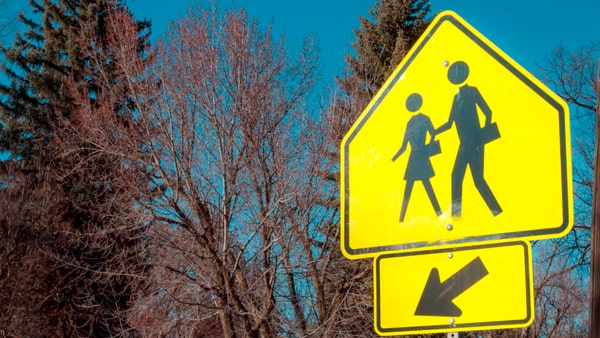
Question 2

A five-sided yellow or fluorescent yellow-green sign showing pedestrians identifies what?

This road sign means:
  1. A A school area or school crossing
  2. B A business district
  3. C A sidewalk-only route
  4. D A place where pedestrian crossing is prohibited

Correct answer: A – A school area or school crossing

Five-sided warning signs identify school areas and school crossings. Reduce speed as required by posted controls and watch carefully for children entering or crossing the roadway. Obey traffic signals, signs, and directions from an authorized crossing guard.

Source: DC DMV Automobile Driver Manual — “Traffic Signs”, 18 DCMR § 2000.2, .4 — Obedience to Traffic Regulations

Question 3

At a District location marked NO PARKING—but not NO STANDING or NO STOPPING—what is generally allowed?

  1. A Leaving the vehicle unattended for a short errand
  2. B Stopping temporarily while actively loading or unloading passengers or merchandise
  3. C Remaining parked as long as the driver stays inside
  4. D Parking for five minutes without loading or unloading

Correct answer: B – Stopping temporarily while actively loading or unloading passengers or merchandise

Parking is defined as standing a vehicle other than while temporarily and actively loading or unloading passengers or merchandise. A NO PARKING restriction therefore generally permits that limited activity unless another sign or rule prohibits standing or stopping. Simply remaining in the vehicle or leaving it briefly does not make ordinary parking lawful.

Source: 18 DCMR § 9901 — Definitions

Question 4

Which technique helps prevent a skid on a slippery roadway?

  1. A Brake sharply whenever the vehicle begins slowing
  2. B Make smooth speed and steering changes and avoid sudden stops
  3. C Follow closely in another vehicle's tire tracks
  4. D Steer toward standing water or low areas

Correct answer: B – Make smooth speed and steering changes and avoid sudden stops

Reduce speed and operate the accelerator, brakes, and steering smoothly on a slippery surface. Sudden braking or steering can cause the tires to lose traction and begin sliding. Leave additional space so you can slow gradually instead of making an abrupt stop.

Source: DC DMV Automobile Driver Manual — “Slippery Roads”, DC Commercial Driver License Manual — § 2.17, “Skid Control and Recovery”

Question 5

Which action demonstrates defensive driving?

  1. A Using a fixed one-car-length following distance at every speed
  2. B Staring continuously at the vehicle directly ahead
  3. C Keeping your eyes moving and searching for developing hazards
  4. D Assuming surrounding drivers will always follow the rules

Correct answer: C – Keeping your eyes moving and searching for developing hazards

A defensive driver scans ahead, to the sides, and through the mirrors for possible hazards. Staring at one vehicle narrows awareness and can hide conditions developing farther ahead or beside the roadway. Following distance should account for speed, traffic, and road conditions rather than using one fixed car-length rule.

Source: DC DMV Automobile Driver Manual — “Defensive Driving”, 18 DCMR § 2201.9 — Driving on the Right Side of the Roadway: Proper Use of the Roadway

Question 6

Which statement correctly describes a District child-restraint requirement?

  1. A A child under age 2 who weighs less than 40 pounds or is shorter than 40 inches must use a rear-facing child restraint
  2. B A child under age 8 may use an adult belt without a child safety seat
  3. C Children are exempt whenever the driver travels slowly
  4. D Only front-seat passengers under age 16 must be restrained

Correct answer: A – A child under age 2 who weighs less than 40 pounds or is shorter than 40 inches must use a rear-facing child restraint

A child younger than 2 who weighs under 40 pounds or measures under 40 inches must be properly secured in a rear-facing child restraint seat. Children under age 8 must use an appropriate installed infant, convertible, or booster seat according to its instructions. Children under age 16 must be secured in an approved child-restraint system or seat belt.

Source: D.C. Code § 50-1703(a)–(b) — Requirements