


Washington DC DMV Practice Test 3

4.9 out of 5 (222 votes)
80% Passing score
20 Questions
4 Mistakes allowed
Studying for the DC DMV permit test sounds simple until you remember you are studying for DC driving, which is its own little civic obstacle course. One minute it is a normal road sign question, the next you are thinking about pedestrians in crosswalks, bus lanes, odd intersections, distracted driving rules, and whether that pavement marking was trying to help you or quietly ruin your day. This Washington DC DMV practice test gives you a way to work through the rules before the real knowledge test starts asking them in that very official, very unforgiving DMV tone. The actual DC DMV knowledge test is based on the DC DMV Automobile Driver Manual, so that is the world this practice test lives in too. Expect the usual suspects: District traffic laws, road signs, rules of the road, parking rules, signals, pavement markings, safe driving habits, and driver responsibility. Not thrilling material, exactly, but important. Also, the passing score is 80%, which sounds friendly until you do the math. GRAD applicants ages 16 through 20 get 30 questions and need 24 correct answers. Adult applicants 21 and older get 25 questions and need 20 correct. So yes, you can miss a few. You just cannot wander through the test guessing like you are picking a lunch spot on H Street. This free DMV practice test keeps the focus on the material you are likely to see on the real DC DMV permit test, but it does not just toss questions at you and shrug. If you get stuck, hints can point you in the right direction without handing you the answer outright. If you miss something, the explanation does the useful part: it slows the rule down, shows why the correct answer works, and, ideally, keeps that mistake from following you into the actual exam room. DC also gives applicants a few ways to test. Knowledge testing is available at DC DMV service centers on a first-come, first-served basis, while virtual testing and local Test Proctoring Center testing require appointments. One small catch, because of course there is one: if you pass the virtual test, you still need to visit a DC DMV service center within 14 business days with the required documents, or the result will not count. Use this learners permit practice test to get sharper, not just more hopeful. Hope is nice. Correct answers are better.
FREE DMV Practice Test App
Study for your Washington DC permit test or driver’s license with the NextDoorDriving app. 700+ DMV questions and answers, 100% free!
Download on the App Store

Sample Washington DC Permit Test Questions

Question 1

Where a U-turn is permitted on a roadway with several lanes in your direction, from which lane should you begin?

  1. A The shoulder
  2. B The far-left travel lane
  3. C An unpaved median
  4. D Any available lane

Correct answer: B – The far-left travel lane

Begin a permitted U-turn from the far-left travel lane unless signs or pavement markings direct another method. In the District of Columbia, U-turns must be safe and must not interfere with other traffic; posted prohibitions must be obeyed. U-turns are also prohibited across bicycle lanes and generally at intersections controlled by traffic lights or police unless specifically authorized.

Source: 18 DCMR § 2204.6–.10 – Turning Requirements and Restrictions, DC DMV Automobile Driver Manual — Driving Rules, “U-Turns”
Question 2

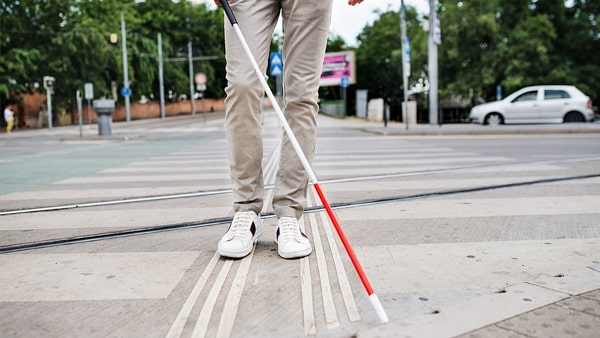
When approaching a pedestrian using a white cane or guide dog, what should a driver do?

When driving near a blind pedestrian who is carrying a white cane or using a guide dog, you should:
  1. A Slow down, yield, and be prepared to stop
  2. B Take the right-of-way before the pedestrian enters the road
  3. C Maintain speed and proceed normally
  4. D Accelerate past the pedestrian

Correct answer: A – Slow down, yield, and be prepared to stop

District of Columbia law requires a driver approaching a blind pedestrian using a predominantly white or metallic cane, or a blind or deaf pedestrian using a guide dog, to take all necessary precautions to avoid injury. The driver manual instructs motorists to yield and use extra care around pedestrians with disabilities. Slow down and be prepared to stop.

Source: D.C. Code § 7-1004 – Safety Standards for Drivers of Motor Vehicles, DC DMV Automobile Driver Manual — Driver Information, “Individuals with Disabilities”

Question 3

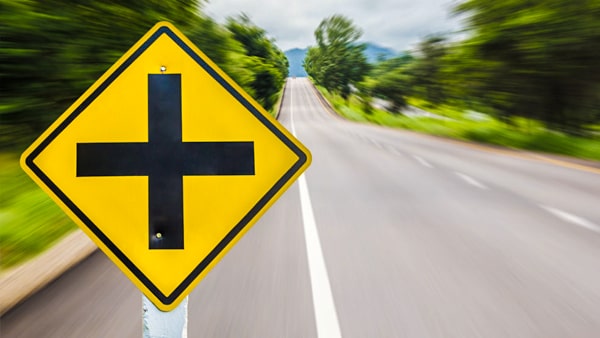
A yellow diamond sign contains one vertical line crossed by a horizontal line. What does it indicate?

This sign means:
  1. A A church is nearby
  2. B A first-aid station is nearby
  3. C A crossroad is ahead
  4. D A railroad crossing is ahead

Correct answer: C – A crossroad is ahead

The crossroad warning sign indicates that another roadway crosses the road ahead. Watch for vehicles that may enter or cross your path at the upcoming intersection. Reduce speed as conditions require and observe any signs or signals controlling the junction.

Source: DC DMV Automobile Driver Manual — Signals, Signs and Markings, “Warning Signs”

Question 4

How should you check an area beside your vehicle that is not visible in the mirrors?

  1. A Look only in the inside rearview mirror
  2. B Look only in the side mirror
  3. C Briefly glance over the appropriate shoulder
  4. D Continue looking straight ahead

Correct answer: C – Briefly glance over the appropriate shoulder

Blind spots are areas beside and slightly behind a vehicle that may not appear in the rearview or side mirrors. Before changing lanes or moving sideways, briefly glance over the shoulder in the direction you intend to move. Keep the check brief so your attention returns promptly to the road ahead.

Source: DC DMV Automobile Driver Manual — Driver Information, “Blind Spots”

Question 5

Under District traffic regulations, what is a safety zone or loading platform?

  1. A A shoulder reserved for disabled vehicles
  2. B A marked or protected roadway space reserved for pedestrians
  3. C The center divider of a multilane street
  4. D An open area maintained around a moving vehicle

Correct answer: B – A marked or protected roadway space reserved for pedestrians

A safety zone is an officially designated area within a roadway for the exclusive use of pedestrians. It must be protected or marked so that it is plainly visible. Drivers may pass alongside one cautiously, but they may not drive through or within the safety zone.

Source: 18 DCMR § 9901 — Definitions, 18 DCMR § 2211.5–.6 — Streetcars, Railroad Trains, and Safety Zones

Question 6

When parking downhill on a two-way road without a curb, how should you turn the front wheels?

  1. A Left, toward the center of the road
  2. B Right, toward the roadway edge
  3. C Straight ahead
  4. D In either direction

Correct answer: B – Right, toward the roadway edge

Turn the wheels right, toward the side of the roadway. On a two-way road, this directs a rolling vehicle away from the center and moving traffic. District regulations also require the front wheels of an unattended vehicle on a grade to be turned toward the curb or side of the highway and the parking brake to be set.

Source: 18 DCMR § 2418.1–.2 — Miscellaneous Non-Moving Violations, DC DMV Automobile Driver Manual — “Parking on Hills”