Washington DC DMV Permit Practice Test 6

4.8 out of 5 (135 votes)
80% Passing score
20 Questions
4 Mistakes allowed
The DC DMV written test is not trying to trick you, exactly, but it does expect you to know the rules well enough that you are not guessing your way through basic traffic decisions. This DC DMV practice test gives you 20 questions based on the DC Driver’s Manual, with extra attention on turn signals, which sounds simple until you remember how much driving in the District depends on making your next move obvious before you actually make it. Lane changes, turns, pulling from the curb, dealing with bikes, buses, crosswalks, and that one driver who seems personally offended by your existence. It helps to know that signaling is not for decoration. That's where this practice test comes in.   You’ll need 16 correct answers to pass this Washington DC DMV permit practice test. Work through the questions, use a hint when your brain stalls for a second, and when you miss something, read the explanation instead of just clicking onward in mild irritation. That is where the useful studying happens. At the end, the test gives you a summary of what you missed, so your next round is not just “try harder,” which is vague and unhelpful, but a more focused review of the rules that actually gave you trouble. This DMV practice permit test is a good fit if you are studying for your first learner permit, renewing your license, or just trying to clean up rusty knowledge before the real DMV written test. And because this is DC, the test itself is only one part of the larger licensing picture. Teen drivers in the GRAD program may need the official 40-hour supervised driving certification before a provisional license, then the 10-hour night driving certification before a full license with conditions. DC also offers Limited Purpose learner permits and driver licenses for residents who do not have, and are not eligible for, a Social Security number, although those applicants still have to prove identity, age, DC residency, six-month residency, and other eligibility details. A couple of administrative details matter more than people expect. If you pass the virtual knowledge test, DC requires you to finish the in-person document and credential step at a DMV service center within 14 business days. Outstanding District debts or unpaid moving violation fines from other jurisdictions can also block a REAL ID or Limited Purpose learner permit. And in some cases, DC DMV may require a Medical/Eye Report if a condition could affect safe driving. So yes, use this DC permit practice test to study turn signals and road rules. But also use it to get comfortable with the process around the test, because in DC, the small print has a way of becoming the main event.
FREE DMV Practice Test App
Study for your Washington DC permit test or driver’s license with the NextDoorDriving app. 700+ DMV questions and answers, 100% free!
Download on the App Store

Sample Washington DC Permit Test Questions

Question 1

How should you approach a railroad crossing that has no gates or flashing signals?

  1. A Stop every time, even when no train is approaching
  2. B Reduce speed, look and listen, and be prepared to stop
  3. C Continue normally because every active track has signals
  4. D Accelerate to spend less time on the tracks

Correct answer: B – Reduce speed, look and listen, and be prepared to stop

A passive railroad crossing may not have gates or flashing lights. Reduce speed as you approach, look and listen for a train, and be prepared to stop. A stop between 15 and 50 feet from the nearest rail is required when a train, crossing signal, lowered gate, or flagger presents one of the conditions specified by District regulations.

Source: 18 DCMR § 2200.5 – Speed Restrictions, 18 DCMR § 2216.1-.2 – Railroad Crossings
Question 2

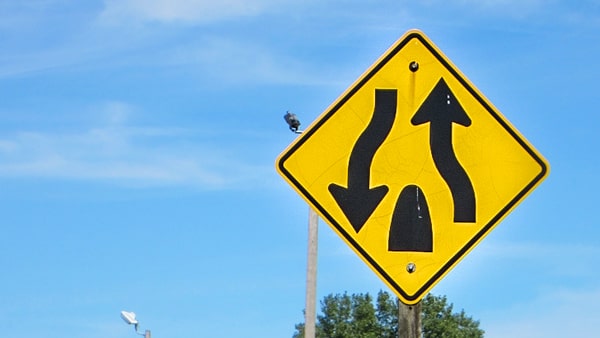
A yellow diamond sign shows opposite-direction arrows separated by a divider at the bottom, with the divider disappearing at the top. What does it mean?

This sign means:
  1. A A turn is required at the next intersection
  2. B The divided highway ends ahead
  3. C A one-way street begins ahead
  4. D The road is closed ahead

Correct answer: B – The divided highway ends ahead

This warning sign indicates that the median or other divider separating opposing traffic ends ahead. Drivers will soon enter an undivided roadway carrying traffic in both directions. Be prepared for oncoming vehicles and remain on the right side of the roadway after the divided section ends.

Source: DC DMV Automobile Driver Manual — “Warning Signs”

Question 3

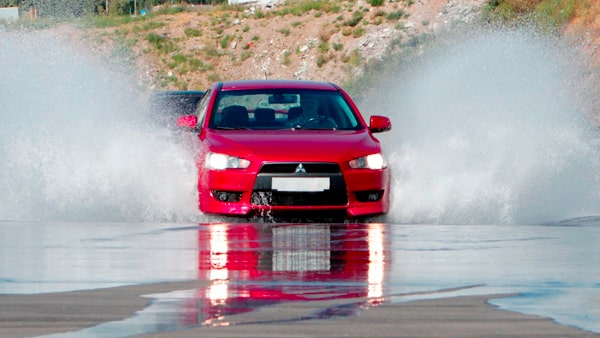
If your vehicle begins hydroplaning on a wet roadway, what should you do first?

If the roadway is wet and your car starts to skid, you should:
  1. A Ease off the accelerator and steer steadily in your intended direction
  2. B Shift immediately into a lower gear
  3. C Pump the brakes firmly and rapidly
  4. D Shift into neutral and turn sharply

Correct answer: A – Ease off the accelerator and steer steadily in your intended direction

Hydroplaning occurs when the tires ride on a layer of water and lose firm contact with the pavement. Braking, accelerating, and steering become less effective. Ease off the accelerator, hold the steering wheel firmly in the direction you want to travel, and allow the vehicle to slow until control returns.

Source: DC DMV Driver Manual — Driving Rules, “Driving in Rain”

Question 4

On a steep, narrow road, an uphill vehicle and a downhill vehicle meet with no room to pass. Which vehicle should back to a wider place?

  1. A The vehicle traveling uphill
  2. B The vehicle facing downhill
  3. C Neither vehicle under any circumstances
  4. D Whichever vehicle is smaller

Correct answer: B – The vehicle facing downhill

The vehicle facing downhill should back to a location where the uphill vehicle can pass. Backing uphill generally provides better control than requiring the uphill-facing vehicle to reverse downhill. Before backing, the driver should look behind the vehicle, move slowly, and check for approaching traffic and pedestrians.

Source: DC DMV Driver Manual — Traffic Rules, “Right-of-Way”, DC DMV Driver Manual — Driving Rules, “Backing”

Question 5

An oncoming driver turns left across your path, making a collision likely. What should you do?

  1. A Maintain speed because you have the right-of-way
  2. B Slow down or stop as needed to avoid the collision
  3. C Sound the horn while continuing at the same speed
  4. D Accelerate through the conflict area

Correct answer: B – Slow down or stop as needed to avoid the collision

Right-of-way rules do not justify continuing into an avoidable collision. The DC manual instructs drivers to base decisions on the action involving the least risk and not to place right-of-way ahead of safety. Reduce speed or stop when necessary, while maintaining control and watching surrounding traffic.

Source: DC DMV Driver Manual — Driver Information, “Four Major Components of Driving”, DC DMV Driver Manual — Traffic Rules, “Right-of-Way”

Question 6

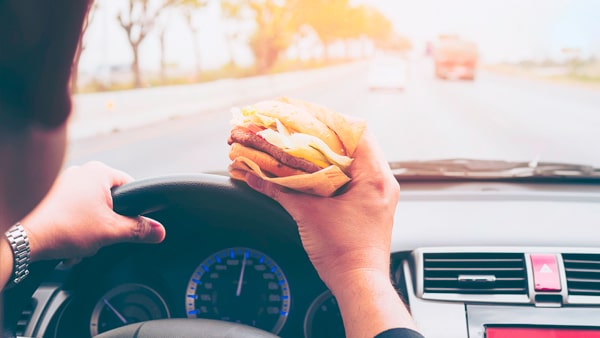
How can eating or drinking while driving affect a motorist?

Drivers who eat and drink while driving:
  1. A It eliminates ordinary driving mistakes
  2. B It improves awareness during long trips
  3. C It makes lane positioning more accurate
  4. D It diverts attention from the driving task

Correct answer: D – It diverts attention from the driving task

Eating and drinking are identified as forms of distracted driving. These activities may take a driver's attention away from traffic and can require handling objects instead of concentrating fully on vehicle operation. Drivers should remain focused on the roadway and avoid activities that interfere with the primary task of driving.

Source: DC DMV Driver Manual — Vision Zero, “Distracted Driving”