


Washington DC DMV Permit Practice Test 7

4.9 out of 5 (127 votes)
80% Passing score
20 Questions
4 Mistakes allowed
Driving in DC rewards people who actually know the rules, not just people who have learned to survive traffic circles through sheer nerve. The District has its own rhythm: pedestrians who expect drivers to pay attention, school zones that are easy to miss until they are not, tight streets, odd intersections, and a DMV knowledge test that pulls from more than just common sense. This DC DMV practice test is meant to get you ready for that real test with 20 focused multiple-choice questions, written around the laws, signs, and driving habits that matter here. The official DC DMV knowledge test is based on the DC DMV Automobile Driver Manual, which is the document applicants are expected to study. It covers District traffic laws, road signs, signals, pavement markings, parking and traffic rules, safe operation, and driver responsibility. That last part sounds broad, because it is. It includes the everyday stuff, yes, but also the details people tend to half-read, such as financial responsibility requirements, proof of insurance, pedestrian rules, and what DC expects from someone sitting behind the wheel of a car in a crowded city. This DC permit practice test gives you a cleaner way to work through that material before you walk into the official exam. You answer the questions online, review what you missed, and get explanations and hints that help the rules stick a little better than simply rereading the manual and hoping your brain behaves. It is available 24/7, so you can fit it in after work, between classes, or during that weird spare half hour when you are technically “studying” but also not really studying unless something is right in front of you. The official test format depends on your age. GRAD applicants, ages 16 through 20, take a 30-question test and need 24 correct answers to pass. Adults 21 and older take a 25-question test and need 20 correct answers. Either way, the required score is 80%, which is fair, but not especially forgiving if you are guessing through signs or DC-specific rules. And one more thing worth knowing before you treat the test casually: if you fail the official knowledge test, DC DMV requires a 3-full-calendar-day wait before you can try again. So this DMV practice permit test is not just extra review. It is a quieter, lower-stakes place to find the gaps before the District finds them for you.
FREE DMV Practice Test App
Study for your Washington DC permit test or driver’s license with the NextDoorDriving app. 700+ DMV questions and answers, 100% free!
Download on the App Store

Sample Washington DC Permit Test Questions

Question 1

When merging onto a freeway, how should you check the lane you intend to enter?
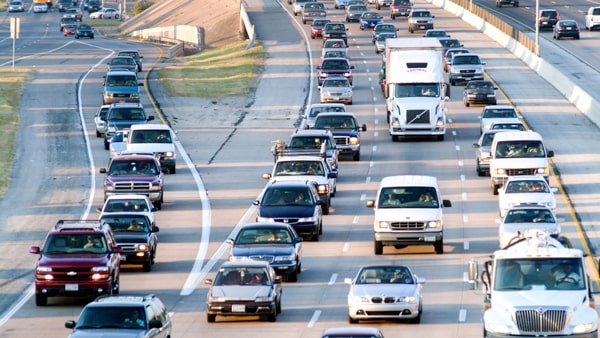
When you enter a freeway, you should check traffic by using:
  1. A Use the inside mirror only
  2. B Use both side mirrors without turning your head
  3. C Check all mirrors and briefly look over your shoulder
  4. D Check only the left side-view mirror

Correct answer: C – Check all mirrors and briefly look over your shoulder

Mirrors do not show every area alongside your vehicle. Check all mirrors, then briefly look over your shoulder to verify that the blind spot is clear before merging. In the District of Columbia, a driver entering a freeway from an access ramp must yield to traffic already on the freeway.

Source: 18 DCMR § 2208.8 – Right-of-Way: Intersections; DC DMV Automobile Driver Manual — “Entering a Freeway” acceptance.

Question 2

What is the purpose of a striped access aisle beside an accessible parking space?

  1. A To provide room for people to enter or leave a vehicle
  2. B To provide short-term loading parking
  3. C To provide parking for motorcycles
  4. D To provide an additional compact-car space

Correct answer: A – To provide room for people to enter or leave a vehicle

The striped or crosshatched area is an access aisle associated with an accessible parking space. It provides maneuvering room for people using wheelchairs, lifts, ramps, or other mobility devices. The aisle is not an additional parking space and must be kept unobstructed.

Source: DC DMV Automobile Driver Manual — “Parking for Persons with Disabilities”

Question 3

When traffic is moving lawfully at a normal pace, what is true about driving much more slowly?

  1. A It is permitted because it forces everyone to slow down
  2. B It may unlawfully impede or block normal traffic
  3. C It is always safer than matching the traffic flow
  4. D It is permitted in any lane if you remain below the speed limit

Correct answer: B – It may unlawfully impede or block normal traffic

Driving below the speed limit is not automatically safe or lawful. District rules prohibit driving so slowly that you impede normal and reasonable traffic, unless the reduced speed is necessary for safety or legal compliance. A slower vehicle generally must use the available right-hand lane unless passing or preparing for a left turn.

Source: 18 DCMR § 2200.10 – Speed Restrictions, 18 DCMR § 2201.2 – Driving on the Right Side of the Roadway: Proper Use of the Roadway

Question 4

Which actions help a driver communicate with other road users?

  1. A Using turn signals and brake lights to show intended movements
  2. B Using the horn when necessary to warn of danger
  3. C Using hazard lights or emergency warning devices when needed
  4. D All of these actions

Correct answer: D – All of these actions

Clear communication helps other road users recognize your location and intended movement. Use required signals before turning, changing direction, slowing, or stopping. A horn can warn of danger, while hazard lights and other emergency warning devices can identify a disabled vehicle or another urgent situation.

Source: 18 DCMR § 2205.1-.2 – Proper Signals for Turning and Stopping, DC DMV Automobile Driver Manual — “Communicating with Other Drivers”

Question 5

Which statement about seat belts is correct?

  1. A They are useful only during high-speed driving
  2. B Being thrown from a vehicle usually improves survival chances
  3. C They create a greater risk whenever a vehicle enters water
  4. D They improve the chance of surviving most types of crashes

Correct answer: D – They improve the chance of surviving most types of crashes

A properly fastened lap and shoulder belt restrains an occupant during a crash. It reduces the risk of striking the vehicle interior or being ejected. Seat belts should be worn correctly on every trip, regardless of the vehicle's speed or the distance being traveled.

Source: DC DMV Automobile Driver Manual — “Seat Belts”

Question 6

A vehicle ahead has stopped at a crosswalk for a pedestrian. What must you do?

  1. A Stop behind it and proceed only after the crosswalk is clear
  2. B Change lanes and pass after checking for traffic
  3. C Slow down and pass if you cannot see a pedestrian
  4. D Move onto the shoulder and stop beside the vehicle

Correct answer: A – Stop behind it and proceed only after the crosswalk is clear

Do not pass a vehicle that has stopped at a marked or unmarked crosswalk to let a pedestrian cross. The vehicle may block your view of the pedestrian. District regulations expressly prohibit a driver approaching from behind from overtaking and passing in this situation.

Source: 18 DCMR § 2221.5 – Miscellaneous Moving Violations