Washington DC Road Signs Test

4.9 out of 5 (159 votes)
80% Passing score
10 Questions
2 Mistakes allowed
In DC, where traffic can go from calm to mildly ridiculous in half a block, knowing what a sign is telling you is not just test material. It is basic survival, legally speaking and, well, practically speaking too. This DC road signs test gives you 20 multiple-choice questions focused on the signs and signals that show up in the official DC driver’s manual. That includes regulatory signs, warning signs, traffic direction signs, pavement markings, traffic signals, and the color-and-shape clues that help you recognize a sign before you are close enough to read every word on it. The test is meant to feel familiar to anyone preparing for the DC DMV permit test, not because it copies the exam, but because it sticks to the same source material the DMV uses. A small but important detail: DC does not list a separate road-sign-only test, so these questions are folded into the regular DC DMV driver knowledge test, along with traffic laws and safe driving rules. For GRAD applicants, those questions are part of the 30-question knowledge test. For standard adult applicants, they appear within the 25-question knowledge test. So while this is a DC road signs practice test, the real exam treats sign knowledge as one piece of the larger driving picture. To pass this practice test, you will need at least 16 correct answers out of 20. That is a useful benchmark, especially if you have already read the manual and want to see whether the sign section actually stuck. And if it did not, fine. Better to find that out here, on a practice screen, than while sitting through the real DC learners permit test trying to remember whether a sign’s shape was supposed to be helpful or just decorative.
FREE DMV Practice Test App
Study for your Washington DC permit test or driver’s license with the NextDoorDriving app. 700+ DMV questions and answers, 100% free!
Download on the App Store

Sample Washington DC Permit Test Questions

Question 1

A rectangular sign showing two one-way roadways separated by a median warns that:
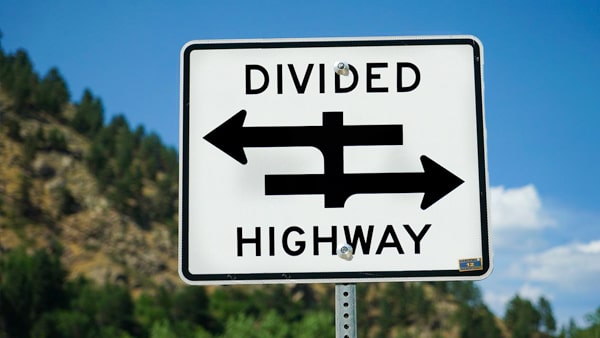
This sign means:
  1. A Traffic must turn left or right
  2. B A T-intersection is ahead
  3. C Your road intersects a divided highway
  4. D Your road passes over a divided highway

Correct answer: C – Your road intersects a divided highway

In the District, the Divided Highway Crossing sign advises drivers that their road is approaching an intersection with a divided highway. The divided highway’s opposing directions use separate roadways divided by a median. Drivers must observe the directional signs and controls governing each portion of the crossing.

Source: 18 DCMR § 2100.2 – Standards for Placement of Traffic Control Devices, Signs, and Pavement Markings, Manual on Uniform Traffic Control Devices, 11th ed. — § 2B.50, “Divided Highway Crossing Signs (R6-3 and R6-3a)”
Question 2

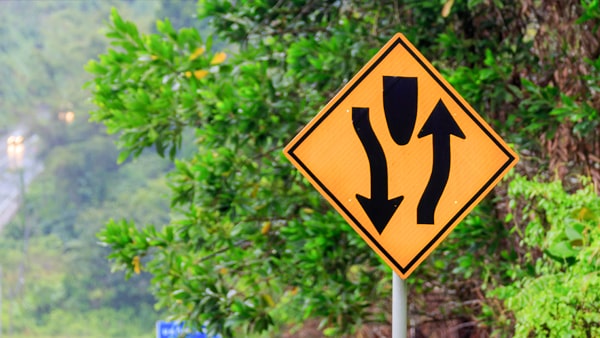
A yellow diamond sign showing opposing traffic arrows separating around a median means:

This sign means:
  1. A The divided highway ends ahead
  2. B A one-way street begins
  3. C A one-way street ends
  4. D A divided highway begins ahead

Correct answer: D – A divided highway begins ahead

The Divided Highway sign warns that the roadway ahead will separate opposing traffic flows with a median or another physical barrier. It is used before the beginning of the divided section, not at an intersection with a divided highway. Drivers should follow the roadway that carries traffic in their direction.

Source: 18 DCMR § 2100.2 – Standards for Placement of Traffic Control Devices, Signs, and Pavement Markings, Manual on Uniform Traffic Control Devices, 11th ed. — § 2C.20, “Divided Highway Sign (W6-1)”

Question 3

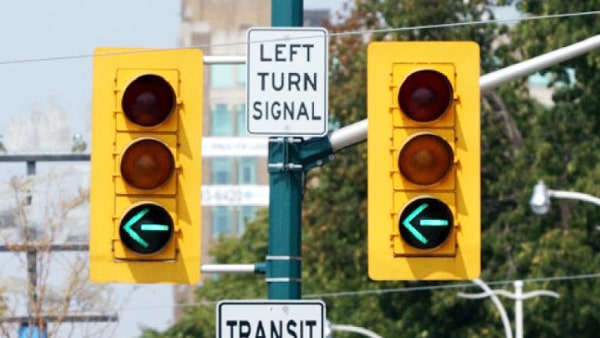
A steady green arrow pointing left authorizes you to:

A green arrow pointing to the left on a traffic light means you may:
  1. A Turn left or proceed straight
  2. B Turn left only after first stopping
  3. C Proceed left after yielding to lawful users already in the intersection
  4. D Turn without regard for pedestrians or other traffic

Correct answer: C – Proceed left after yielding to lawful users already in the intersection

In the District, traffic facing a green arrow may cautiously enter the intersection only to make the movement shown by the arrow. Drivers must still yield to pedestrians lawfully in a crosswalk and other traffic lawfully using the intersection. A green arrow does not authorize proceeding straight unless another signal permits that movement.

Source: 18 DCMR § 2103.4 – Traffic Control Signals: Vehicles

Question 4

After stopping at a stop line, your view of cross traffic is blocked. What should you do?

  1. A Wait five seconds and then enter
  2. B Sound the horn before moving
  3. C Listen for vehicles and proceed without looking
  4. D Edge forward cautiously, check again, and enter only when safe

Correct answer: D – Edge forward cautiously, check again, and enter only when safe

In the District, first make the required complete stop at the marked stop line. If the line is too far back for a clear view, cautiously move forward only as needed to observe cross traffic and pedestrians. Before entering, yield to pedestrians and to traffic that is in the intersection or close enough to be an immediate hazard.

Source: 18 DCMR § 2208.3-.4 – Right-of-Way: Intersections, DC DMV Automobile Driver Manual — “Stop Signs”

Question 5

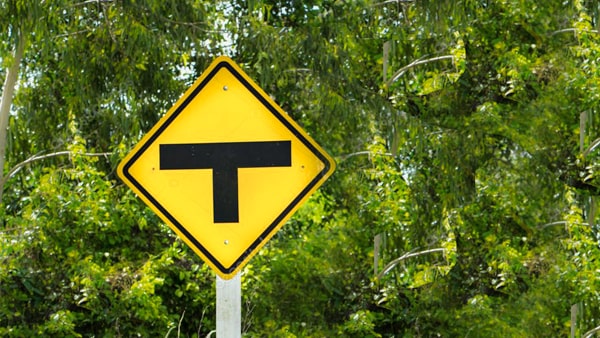
A yellow diamond sign displaying a black T-shaped symbol warns of:

This sign shows one type of:
  1. A A mandatory right turn
  2. B An intersection
  3. C A lane shift
  4. D A series of curves

Correct answer: B – An intersection

The T-Intersection warning sign indicates that the road ahead meets another roadway in a T-shaped configuration. It alerts drivers to the presence of an intersection and the possibility of turning or entering traffic. Watch for any stop, yield, or other traffic-control device at the intersection.

Source: 18 DCMR § 2100.2 – Standards for Placement of Traffic Control Devices, Signs, and Pavement Markings, Manual on Uniform Traffic Control Devices, 11th ed. — § 2C.41, “Intersection Warning Signs (W2-1 through W2-8)”

Question 6

How must a driver respond to a flashing red traffic signal?

If you are approaching an intersection with a red flashing light, what should you do?
  1. A Continue through without slowing
  2. B Slow down and yield without stopping
  3. C Remain stopped until a green signal appears
  4. D Stop, then proceed when the applicable right-of-way rules allow

Correct answer: D – Stop, then proceed when the applicable right-of-way rules allow

In the District, a flashing red signal requires a stop at the marked limit line or before the nearest crosswalk, as applicable. After stopping, the driver must follow the same right-of-way rules that apply at a stop sign. Yield to pedestrians and to traffic that presents an immediate hazard before proceeding.

Source: 18 DCMR § 2104.2 – Flashing Red and Yellow Signals: Vehicles, 18 DCMR § 2208.3-.4 – Right-of-Way: Intersections