


Florida General Knowledge CDL Prep Test (FL) 4

5 out of 5 (125 votes)
80% Passing score
20 Questions
4 Mistakes allowed
If you're gearing up for your CDL in Florida, our fourth CDL practice test is a resource you can't miss out on. This Florida general knowledge CDL practice test is a crucial step in preparing for the real deal in 2026. With 20 well-crafted questions, it reflects the unique aspects of Florida's driving regulations, ensuring you're not just learning, but learning what's relevant for the Sunshine State. Each time you tackle our test, you'll be faced with a rearranged set of questions. This means you get to cover a broader range of topics and scenarios, making your prep more comprehensive. Unlike some CDL practice tests that keep the question order the same, ours mixes it up. This way, you're not just remembering the order of questions; you're actually understanding and retaining the material. The best part? It's completely free. We believe quality preparation should be accessible to everyone. That's why we offer a Florida CDL practice test that rivals any paid versions in terms of content and learning experience, without the price tag. Our general knowledge test requires you to correctly answer at least 16 out of 20 questions. While this might sound daunting, it's a realistic simulation of the challenge you'll face on the actual Florida CDL permit test in 2026. By setting this benchmark, we ensure you're not just passing, but excelling. This Florida CDL general knowledge DMV practice test is more than just a study tool; it's a confidence builder. The more you practice, the more familiar you become with the types of questions you'll see, the better you'll perform under the real test conditions. So, take advantage of this opportunity to reinforce your knowledge, familiarize yourself with Florida-specific driving laws, and get one step closer to acing your Florida CDL test in 2026.
FREE CDL Practice Test App
Pass your Florida CDL General Knowledge test with the NextDoorDriving app. Real questions and answers—100% free and ad-free.
Download on the App Store

Sample Florida CDL Test Questions - General Knowledge

Question 1

In the general stopping-distance formula, which three distances are added together?

  1. A Perception distance, reaction distance, and braking distance
  2. B Observation distance, reaction distance, and slowing distance
  3. C Perception distance, response distance, and reaction distance
  4. D Road-condition distance, speed distance, and perception distance

Correct answer: A – Perception distance, reaction distance, and braking distance

The general formula is perception distance plus reaction distance plus braking distance. Perception distance is traveled while recognizing the hazard, reaction distance while responding and reaching the brake, and braking distance after the brakes are applied. Air-brake vehicles also have brake-lag distance, which is addressed separately in the air-brake section.

Source: Florida Commercial Driver’s License Manual — §§ 2.6.1 and 5.4.4, “Stopping Distance”
Question 2

Under the general cargo-securement rule, an unblocked article is longer than 5 feet but no longer than 10 feet. What is the minimum number of tiedowns required?

  1. A 1
  2. B 2
  3. C 3
  4. D 4

Correct answer: B – 2

Federal cargo-securement rules require at least two tiedowns for an unblocked article longer than 5 feet but no longer than 10 feet, regardless of weight. An article 5 feet or shorter and weighing no more than 1,100 pounds can require only one. Special-purpose vehicles and commodity-specific cargo may be subject to different securement provisions.

Source: Florida Commercial Driver’s License Manual — § 3.3.2, “Cargo Tie-down”, 49 CFR § 393.110(b) – Additional Requirements for Determining the Minimum Number of Tiedowns

Question 3

A Florida school bus driver should routinely back the bus whenever doing so saves time.

  1. A TRUE
  2. B FALSE

Correct answer: B – FALSE

Backing a school bus is strongly discouraged because it increases the risk of a collision. The bus should be backed only when no other safe way to move it is available, and never while students are outside the bus. If backing is unavoidable, the driver should post a lookout, check the mirrors and rear windows, and move slowly and smoothly.

Source: Florida Commercial Driver’s License Manual — § 10.7.3, “Backing” alterations reviewed and applied for localization.

Question 4

Which description best defines controlled braking?

  1. A A technique used only when a vehicle has no antilock brakes
  2. B Applying the brakes firmly without locking the wheels
  3. C Locking the wheels, releasing the brakes, and then repeating
  4. D Keeping the wheels locked until the vehicle stops

Correct answer: B – Applying the brakes firmly without locking the wheels

Controlled braking means applying the brakes as hard as possible without locking the wheels. Steering movements should remain small during the stop. If the wheels lock or a larger steering adjustment becomes necessary, release the brakes and reapply them as soon as possible.

Source: Florida Commercial Driver’s License Manual — § 2.17.2, “How to Stop Quickly and Safely” alterations reviewed and applied for localization.

Question 5

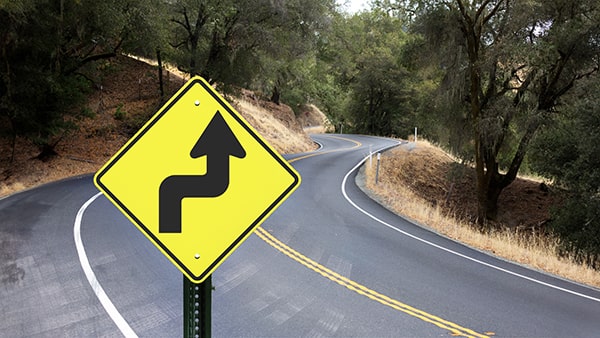
On a Florida road, a yellow diamond sign shows two turns, first to the right and then to the left. What does it warn of?

This sign warns drivers to  _____________.
  1. A A gradual right curve followed by a left curve
  2. B A single right turn
  3. C A single left turn
  4. D Two turns ahead, first right and then left

Correct answer: D – Two turns ahead, first right and then left

This is a Reverse Turn warning sign with the first turn shown to the right. It warns of two changes in roadway alignment in opposite directions within a short distance. The driver should recognize that the second turn follows soon after the first.

Source: Fla. Admin. Code R. 14-15.010 – Manual on Uniform Traffic Control Devices, Manual on Uniform Traffic Control Devices, 11th Edition — § 2C.07, “Horizontal Alignment Signs (W1-1 through W1-5, W1-11, and W1-15)”

Question 6

Which three distances combine to make total stopping distance?

  1. A Stopping, reaction, and perception distances
  2. B Vehicle, stopping, and reaction distances
  3. C Braking, obstacle, and stopping distances
  4. D Perception, reaction, and braking distances

Correct answer: D – Perception, reaction, and braking distances

Total stopping distance has three parts. Perception distance is traveled while recognizing the hazard, reaction distance is traveled before physically applying the brakes, and braking distance is traveled while braking. Adding these three distances gives the total stopping distance.

Source: Florida Commercial Driver’s License Manual — § 2.6.1, “Stopping Distance” alterations reviewed and applied for localization.