Florida Class E Knowledge Exam Practice 9

4.7 out of 5 (2199 votes)
80% Passing score
20 Questions
4 Mistakes allowed
Florida’s school bus laws are not the part of driving most people expect to trip over. And yet, somehow, they do. A bus stops, the lights start flashing, traffic is split by lanes or a median or just general confusion, and suddenly a simple rule feels a little less simple than it did in the handbook. This Florida permit practice test is built for exactly that kind of moment, with a focused set of school bus and school zone questions that help you understand the rule before you are staring at it in real traffic. The official Florida learner permit test is the Class E Knowledge Exam, and it is based on the Official Florida Driver License Handbook. It covers traffic laws, safe driving practices, road signs, and traffic controls, all in a multiple-choice format. The real exam has 50 questions, and you need 40 correct answers to pass. That is an 80% score, which also means you can miss no more than 10. Simple math, slightly less simple pressure when you are actually taking it. This Florida DMV practice test gives you 20 detailed questions on school buses, school zones, and the driving decisions that tend to create hesitation. To pass this practice round, you need 16 correct answers, matching the same 80% benchmark used on the actual Florida Class E Knowledge Exam. The point is not just to memorize that “red lights mean stop,” because, well, yes. The point is to know what Florida expects when a school bus is stopped on a two-way street, when there is a divided highway, when children are crossing, and when everyone around you seems to be making up their own version of the law. The test also changes things up with a larger pool of possible questions, so you are not just coasting through the same sequence by memory. When a question gives you trouble, hints can nudge you in the right direction, and explanations after missed answers help pin down the rule without making you dig back through the handbook for one sentence you swear you just read. Use this Florida Class E practice test as a focused study tool before the full permit knowledge test. It keeps school bus safety in its own lane, so to speak, while still reinforcing the handbook-based thinking you will need for the Florida learner’s license exam.
FREE DMV Practice Test App
Study for your Florida permit test or driver’s license with the NextDoorDriving app. 700+ DMV questions and answers, 100% free!
Download on the App Store

Sample Florida Permit Test Questions

Question 1

You face a circular green signal and intend to turn left. What must you do before completing the turn?

  1. A Yield to oncoming traffic that presents an immediate hazard and to pedestrians lawfully in the intersection
  2. B Turn first because the green signal gives left turns priority
  3. C Wait for the oncoming driver to flash the headlights
  4. D Sound the horn and turn before oncoming traffic arrives

Correct answer: A – Yield to oncoming traffic that presents an immediate hazard and to pedestrians lawfully in the intersection

In Florida, a circular green signal permits a left turn but does not give the turning driver priority over hazardous oncoming traffic. A left-turning driver must yield to an approaching vehicle that is within the intersection or close enough to be an immediate hazard. The driver must also yield to pedestrians lawfully within the intersection or adjacent crosswalk.

Source: Fla. Stat. § 316.075(1)(a)1. – Traffic control signal devices, Fla. Stat. § 316.122 – Vehicle turning left

Question 2

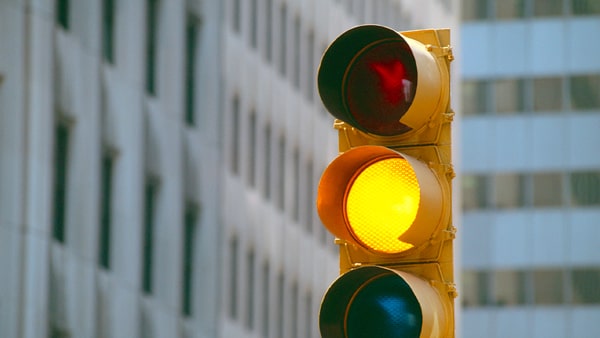
A traffic signal changes from green to steady yellow as you approach. What should you prepare to do?

As you near an intersection, the traffic light changes from green to yellow. Your best action would be to:
  1. A Accelerate to enter before the red signal
  2. B Brake sharply regardless of surrounding traffic
  3. C Stop in the middle of the intersection
  4. D Stop before the intersection if you can do so safely

Correct answer: D – Stop before the intersection if you can do so safely

A steady yellow signal warns that the green movement is ending and a red indication will appear immediately afterward. Stop before entering the intersection if you can do so safely. If you are too close to stop safely, continue cautiously rather than braking abruptly or stopping within the intersection.

Source: Fla. Stat. § 316.075(1)(b) – Traffic control signal devices, The Official Florida Driver License Handbook — Ch. 6, “Traffic Signal Lights”

Question 3

A vehicle behind you disappears from your mirrors as you prepare to change lanes. Before moving over, you should:

  1. A Signal and begin moving over slowly
  2. B Quickly look over your shoulder to check the blind spot
  3. C Sound your horn and enter the next lane
  4. D Accelerate before checking the lane

Correct answer: B – Quickly look over your shoulder to check the blind spot

Mirrors do not reveal every area beside and behind a vehicle. A vehicle that disappears from view may have entered a rear-corner blind spot, so turn your head briefly to verify that the lane is clear. A lane change may begin only after you determine it can be completed safely without interfering with another vehicle.

Source: Fla. Stat. § 316.085(2) – Limitations on overtaking, passing, changing lanes and changing course, The Official Florida Driver License Handbook — “Blind Spots”

Question 4

When following a motorcycle in Florida, what space must you allow the rider?

If you are driving behind a motorcycle, you must:
  1. A Full use of the traffic lane
  2. B Only the left half of the lane
  3. C Only enough room to avoid touching the motorcycle
  4. D Part of the lane so you can pass beside the motorcycle

Correct answer: A – Full use of the traffic lane

Florida law entitles a motorcycle to full use of a traffic lane, and another motor vehicle may not deprive it of that use. A limited exception permits motorcycles to operate two abreast in one lane. A driver following a motorcycle should remain in a separate lane rather than attempting to share the rider’s lane.

Source: Fla. Stat. § 316.209(1), (4) – Operating motorcycles on roadways laned for traffic

Question 5

Which seat-belt practice provides protection for everyone in a passenger vehicle?

Seat belts can be most effective as injury preventive devices when they are worn by:
  1. A Only the driver buckles up
  2. B Passengers buckle up only for long trips
  3. C Everyone buckles up only on expressways
  4. D The driver and all passengers buckle up on every trip

Correct answer: D – The driver and all passengers buckle up on every trip

A seat belt can protect an occupant only when it is properly adjusted and fastened. Having every occupant buckle up before every trip provides protection throughout the ride, rather than only on long trips or expressways. The driver should also ensure that children and other passengers covered by restraint laws are properly secured.

Source: Fla. Stat. § 316.614(3)(c), (4)–(5) – Safety belt usage, The Official Florida Driver License Handbook — “Safety Belts and Child Restraints”

Question 6

Which area is considered a vehicle’s blind spot?

  1. A An area visible through the windshield
  2. B An area clearly shown in the rearview mirror
  3. C An area clearly shown in a side mirror
  4. D An area you must turn your head to see

Correct answer: D – An area you must turn your head to see

Blind spots are areas near the left and right rear corners that are not visible in the mirrors or through peripheral vision. A driver must turn their head briefly to check these areas. This check is important before changing lanes, passing, or making certain turns.

Source: The Official Florida Driver License Handbook — “Blind Spots”