


Florida Road Signs Test

4.8 out of 5 (1518 votes)
80% Passing score
10 Questions
2 Mistakes allowed
Florida road signs are one of those things drivers tend to recognize by instinct, right up until the test asks what a color, shape, or symbol actually means. That distinction matters. In Florida, road sign knowledge is part of the Class E licensing process, not a side topic tucked somewhere in the handbook. The learner’s license requirements include road rules, road signs, vision, and hearing, and the Class E Knowledge Exam itself has 50 multiple-choice questions covering traffic laws and traffic signs. So, yes, the signs count. The exam requires 40 correct answers to pass, which gives you room to miss 10 questions total. That sounds comfortable until you remember the road rules questions are in the same pool, and a few careless guesses on signs can eat into that margin faster than expected. This Florida road signs test gives you a focused way to practice that part of the Florida permit test without wandering through every licensing requirement at once. It includes 20 multiple-choice questions built around sign shape, color, symbols, and meaning—the details Florida drivers are expected to know before they get behind the wheel on their own. Some questions use sign images, which is helpful because road signs are visual by nature, and, awkwardly enough, reading about a sign is not always the same as recognizing it when it shows up in front of you. The Florida DMV does not release its exact test questions, so this Florida DMV practice test is not pretending to be a leaked copy of the real thing. Better to be clear about that. What it does do is mirror the general format and subject matter of the DMV written permit test, giving you practice with the kind of multiple-choice thinking the exam requires. You learn to slow down, compare answer choices, and notice the small details that separate one sign from another. To pass this permit test road signs practice, you need at least 16 correct answers out of 20. Use it as a warm-up before the Florida learner’s license exam, as a quick check after studying, or as a reality check if you feel a little too confident. Florida driving throws plenty at you—tourists, tight intersections, fast-moving highways, random weather, the usual mess. Knowing the signs is one piece of staying ahead of it.
FREE DMV Practice Test App
Study for your Florida permit test or driver’s license with the NextDoorDriving app. 700+ DMV questions and answers, 100% free!
Download on the App Store

Sample Florida Permit Test Questions

Question 1

What condition does this warning sign identify?
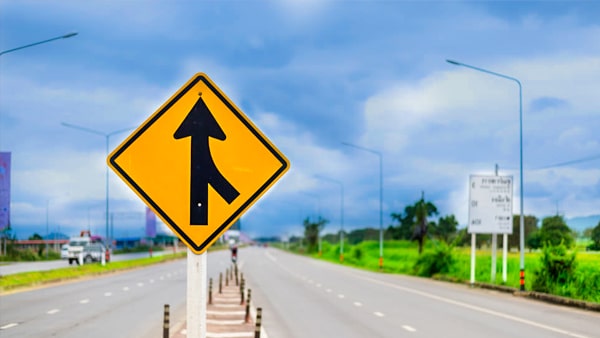
This sign means:
  1. A Two-way traffic begins ahead
  2. B The roadway becomes narrower on both sides
  3. C Traffic will enter and merge with your lane
  4. D A divided highway begins ahead

Correct answer: C – Traffic will enter and merge with your lane

On Florida roads, a Merge sign warns that traffic from another roadway will join the traffic stream ahead. Watch the entering roadway and maintain awareness of vehicles beside you. Change speed or lanes only after verifying that the movement can be made safely.

Source: Fla. Stat. § 316.089(1) – Driving on roadways laned for traffic, The Official Florida Driver License Handbook — Ch. 6, “Traffic Signs”

Question 2

On a Florida road, what do double solid yellow centerlines mean?

  1. A Cross them only to enter a private driveway
  2. B Do not cross them to pass; cross only for a permitted left turn when safe
  3. C Use the area as a two-way left-turn lane
  4. D Treat the lines as a reversible-lane boundary

Correct answer: B – Do not cross them to pass; cross only for a permitted left turn when safe

Double solid yellow lines separate opposing traffic and prohibit vehicles traveling in either direction from crossing them to pass. They may be crossed when making a permitted left turn and the movement can be completed safely. They do not designate a center turn lane or reversible lane.

Source: The Official Florida Driver License Handbook — Ch. 6, “Pavement Markings”

Question 3

Your light turns green, but traffic still blocks the intersection and there is no room beyond it. What should you do?

  1. A Enter the intersection and wait for an opening
  2. B Enter if you can steer around the stopped vehicles
  3. C Wait outside the intersection until there is enough space
  4. D Enter because the green light gives you priority

Correct answer: C – Wait outside the intersection until there is enough space

Florida law prohibits entering an intersection unless there is enough space on the other side for your vehicle without obstructing traffic or pedestrians. This rule applies even when a signal indicates that you may proceed. Wait behind the intersection until the vehicles ahead move and sufficient space is available.

Source: Fla. Stat. § 316.2061 – Stop when traffic obstructed, The Official Florida Driver License Handbook — Ch. 6, “Traffic Signals”

Question 4

What colors are normally used for highway and expressway guide signs?

  1. A Orange with black lettering
  2. B Green with white lettering
  3. C Yellow with black lettering
  4. D Red with white lettering

Correct answer: B – Green with white lettering

Green guide signs use white lettering or symbols to provide directional and distance information. They help drivers identify routes, destinations, and exits. Yellow signs provide general warnings, while orange signs identify construction and maintenance conditions.

Source: The Official Florida Driver License Handbook — Ch. 6, “Informational Signs”

Question 5

When may you use an oncoming-traffic lane to pass another vehicle on a two-way highway?

On a two-way highway, you are allowed to drive on the left half of the roadway when:
  1. A Whenever the centerline is double yellow
  2. B When a solid yellow line is beside your lane
  3. C Only when passing is permitted and the entire maneuver can be completed safely
  4. D Whenever you are approaching an intersection where you plan to turn left

Correct answer: C – Only when passing is permitted and the entire maneuver can be completed safely

Florida law allows travel left of center to overtake another vehicle only under the rules governing passing. The left side must be clearly visible and free of oncoming traffic for enough distance to complete the pass without interference. The passing vehicle must return to an authorized lane before coming within 200 feet of an approaching vehicle.

Source: Fla. Stat. § 316.081(1)(a) – Driving on right side of roadway; exceptions, Fla. Stat. § 316.085(1) – Limitations on overtaking, passing, changing lanes and changing course

Question 6

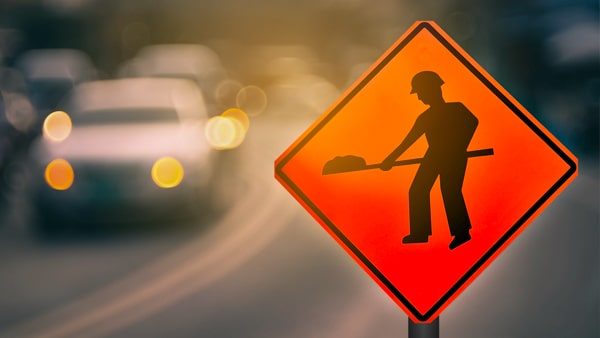
What does this work-zone sign warn drivers about?

This sign means that:
  1. A A volunteer group is collecting litter
  2. B Workers are on or close to the roadway ahead
  3. C Children may be playing beside the road
  4. D A pedestrian crosswalk is ahead

Correct answer: B – Workers are on or close to the roadway ahead

Florida’s handbook identifies orange signs as construction and maintenance warnings. The worker symbol indicates that personnel may be working on or very near the roadway. Reduce speed as conditions require, stay alert, and obey temporary signs, flaggers, and authorized traffic directions.

Source: The Official Florida Driver License Handbook — Ch. 6, “Construction/Maintenance Signs & Signals”