


Florida Road Signs Test 2

4.9 out of 5 (792 votes)
80% Passing score
20 Questions
4 Mistakes allowed
Florida road signs are not something drivers can ignore. On the road, you are expected to read them quickly, react correctly, and keep moving without turning every intersection into a little guessing exercise. A sign flashes by near a school zone, a lane shifts in a construction area, traffic is stacking up near a tourist corridor, and suddenly the color, shape, and message of that sign matter more than they did when you were casually studying at home. This free Florida road signs test is built to help with that exact kind of recognition. It gives you 20 multiple-choice questions covering the signs and traffic controls Florida drivers need to understand, including regulatory signs, warning signs, guide signs, work-zone signs, school-zone signs, and the color-coded system that makes road signs readable before you are close enough to overthink them. Red usually means stop, yield, or do not enter. Yellow warns you. Green guides you. Orange means road work is about to make your day slightly more complicated. Simple enough, until it is not. The practice test also fits neatly into Florida’s larger licensing structure. The official Florida Class E Knowledge Exam has 50 multiple-choice questions on traffic laws, safe driving practices, road signs, and traffic controls. You need 40 correct answers to pass, which is 80%. So while this Florida DMV practice test is shorter and more focused, it uses the same passing benchmark: aim for at least 16 out of 20. That is a useful target whether you are studying for a learner’s permit, preparing for a DMV renewal, or just doing the responsible-driver thing nobody brags about but everyone benefits from. Many questions include images, which helps because road signs are visual by design. You can read a description of a sign all day and still hesitate when you see it in traffic, half-blocked by a truck or sitting beside three other signs competing for your attention. After you finish, you will get a performance summary with explanations for missed answers, so you are not just told what was wrong. You can see why it was wrong, fix the gap, and move on with a little more confidence than you had five minutes earlier.
FREE DMV Practice Test App
Study for your Florida permit test or driver’s license with the NextDoorDriving app. 700+ DMV questions and answers, 100% free!
Download on the App Store

Sample Florida Permit Test Questions

Question 1

When may a driver cross double solid yellow centerlines marking a no-passing zone?

  1. A To pass a slower vehicle
  2. B Only during daylight hours
  3. C Whenever no traffic is visible
  4. D To make a safe left turn into or from a driveway or private road

Correct answer: D – To make a safe left turn into or from a driveway or private road

Florida law prohibits driving left of pavement striping that marks a no-passing zone. A driver may cross safely and briefly when necessary to turn left into or from an alley, private road, or driveway. The turning driver must still yield to approaching traffic that is close enough to create an immediate hazard.

Source: Fla. Stat. § 316.0875(2), (3)(b) – No-passing zones, Fla. Stat. § 316.122 – Vehicle turning left
Question 2

At a stop sign with a marked crosswalk but no stop line, where must you stop?

  1. A Before entering the crosswalk
  2. B Fifty feet before the intersection
  3. C At the location where a stop line would normally appear
  4. D With the front wheels inside the crosswalk

Correct answer: A – Before entering the crosswalk

At a stop sign, first stop at a clearly marked stop line. If there is no stop line, stop before entering the crosswalk on the near side of the intersection. If neither marking exists, stop at the nearest point where you can see approaching traffic before entering the intersection.

Source: Fla. Stat. § 316.123(2)(a) – Vehicle entering stop or yield intersection

Question 3

Which description identifies a KEEP RIGHT sign?

  1. A A yellow diamond showing that a divided highway ends
  2. B A white sign with a black arrow directing traffic to the right of an obstruction
  3. C A yellow diamond displaying a sharp left-turn arrow
  4. D A yellow diamond showing that the right lane ends

Correct answer: B – A white sign with a black arrow directing traffic to the right of an obstruction

A KEEP RIGHT sign directs drivers to travel to the right of a traffic island, median, or other obstruction. It is a regulatory sign and must be obeyed. It should not be confused with warning signs that announce curves, lane reductions, or the end of a divided roadway.

Source: The Official Florida Driver License Handbook — Ch. 6, “Traffic Signs”

Question 4

After stopping at a marked stop line, your view of cross traffic is blocked. What must you verify before entering the intersection?

  1. A That at least five seconds have passed
  2. B That your horn can be heard by approaching drivers
  3. C That no vehicle is immediately behind you
  4. D That you can proceed without conflicting with approaching traffic or pedestrians

Correct answer: D – That you can proceed without conflicting with approaching traffic or pedestrians

In Florida, the required first stop must be made at the marked stop line. After stopping, the driver must yield to vehicles already in the intersection and to traffic approaching closely enough to be an immediate hazard. When the view is blocked, do not enter until you can check the intersection and verify that proceeding is safe.

Source: Fla. Stat. § 316.123(2)(a) – Vehicle entering stop or yield intersection, The Official Florida Driver License Handbook — Ch. 6, “Regulatory Signs”

Question 5

At an intersection of two-way roads in Florida, what may you generally do after making a complete stop at a steady red light?

  1. A Proceed straight if the intersection appears clear
  2. B Turn left if no vehicle is approaching
  3. C Turn right after yielding, unless a sign prohibits it
  4. D Make any of these movements

Correct answer: C – Turn right after yielding, unless a sign prohibits it

After stopping at the proper location, a driver may generally turn right on red unless a visible sign prohibits the turn. The driver must yield to pedestrians and other traffic proceeding as directed by the signal. A left turn on red is permitted only from a one-way street onto another one-way street carrying traffic to the left.

Source: Fla. Stat. § 316.075(1)(c)1.a.–b. – Traffic control signal devices

Question 6

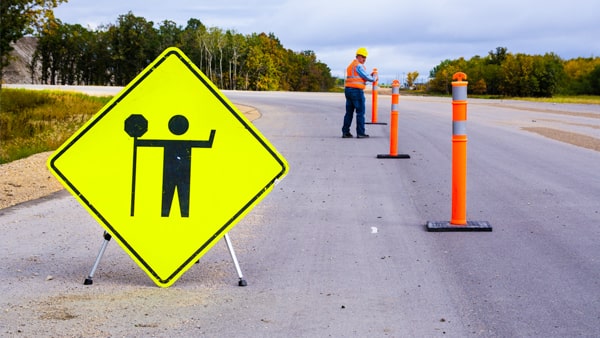
An orange diamond sign showing a person holding a flag warns that:

This sign means:
  1. A A pedestrian crossing is ahead
  2. B The work zone is ending
  3. C A school crossing is ahead
  4. D A flagger is directing traffic ahead

Correct answer: D – A flagger is directing traffic ahead

This sign warns that a flagger is ahead in a road construction or maintenance area. Flaggers use red flags or signs to stop, slow, or guide traffic safely through the work site. Be prepared to reduce speed and follow the flagger’s directions.

Source: The Official Florida Driver License Handbook — Ch. 6, “Construction/Maintenance Signs & Signals”