


Florida Road Signs Test Simulator

4.9 out of 5 (840 votes)
80% Passing score
25 Questions
5 Mistakes allowed
Florida road signs deserve more attention than most people give them, so this practice test will help you get ready for the ones you might see on the real permit test. The official Florida permit test has 50 multiple-choice questions on traffic laws, safe driving practices, traffic controls, and signs, and you need 40 correct answers to pass. So the signs count. They count in the scoring, and more importantly, they count once you are actually out on Florida roads with everyone else trying to merge, turn, hesitate, speed up, and pretend they saw that yield sign. This Florida permit practice test keeps the focus on road signs, including warning signs, lane-use signs, railroad signs, school-zone signs, and, of course, the humble Stop sign. All the similar shapes and symbols can start running together once you are staring at them in test format. Each practice session gives you 20 questions pulled from a larger road-sign database, so the test does not feel like the same stale quiz every time you open it. New attempt, new mix, new chance to catch the stuff you only sort of knew. The passing score is 16 out of 20, which follows the same 80% standard used on the real Florida DMV knowledge test. It is shorter than the official exam, obviously, but the point is not to replace the full test. It is to drill one important part of it until the signs feel less like a guessing game and more like something you can answer without squinting at the screen and negotiating with yourself. After each test, you get a results summary showing what you missed and what the correct answers were. That part is worth slowing down for. The missed questions are usually where the useful studying is hiding, even if it is slightly irritating to admit. The questions are built around practical road-sign knowledge and reviewed with real driving instruction in mind, with visual aids included where they help. Whether you are preparing for a Florida learner’s permit, reviewing before the DMV permit test, or brushing up because road signs have become a blur of yellow diamonds and regulatory rectangles, this Florida DMV practice test gives you focused practice that really helps.
FREE DMV Practice Test App
Study for your Florida permit test or driver’s license with the NextDoorDriving app. 700+ DMV questions and answers, 100% free!
Download on the App Store

Sample Florida Permit Test Questions

Question 1

When is it improper to cross a single broken white or yellow line?

  1. A When the movement cannot be completed safely without interfering with traffic
  2. B When changing lanes after signaling and checking that the lane is clear
  3. C When passing across a broken yellow line with a clear opposite lane
  4. D When changing lanes on a one-way street after checking for traffic

Correct answer: A – When the movement cannot be completed safely without interfering with traffic

A broken line may permit a lane change or, when yellow, a pass across the centerline. The driver must first determine that the movement can be completed safely and without interfering with another vehicle. Traffic, visibility, signs, and other passing restrictions may still prohibit the maneuver.

Source: Fla. Stat. § 316.085(1), (2) – Limitations on overtaking, passing, changing lanes and changing course, Fla. Stat. § 316.089(1) – Driving on roadways laned for traffic, The Official Florida Driver License Handbook — Ch. 6, “Pavement Markings”
Question 2

A solid white edge line on your right tapers toward the center of the roadway. What change does it outline?

  1. A An intersection begins ahead
  2. B A work zone begins ahead
  3. C Traffic must turn left ahead
  4. D The usable roadway becomes narrower

Correct answer: D – The usable roadway becomes narrower

A solid white edge line delineates the right edge of the roadway. When that line tapers inward, it outlines a pavement-width transition where less roadway width is available ahead. Maintain your position within the marked roadway and adjust for the narrower area.

Source: Fla. Admin. Code R. 14-15.010 – Manual on Uniform Traffic Control Devices, Manual on Uniform Traffic Control Devices, 11th ed. — § 3B.09, “Edge Line Pavement Markings”, The Official Florida Driver License Handbook — Ch. 6, “Pavement Markings”

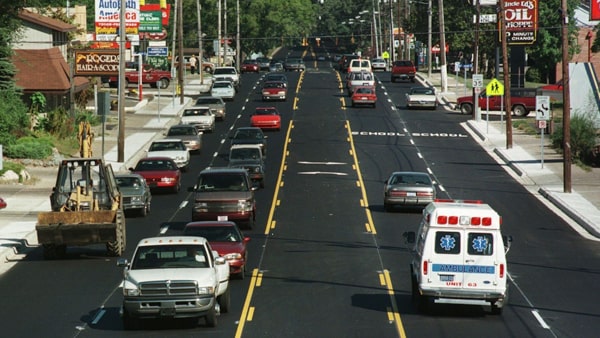
Question 3

A center lane marked with left-turn arrows for traffic in both directions is intended for:

The center lane in the illustration is used for:
  1. A Normal through travel
  2. B Left turns from either direction
  3. C Passing slower vehicles
  4. D Emergency vehicles only

Correct answer: B – Left turns from either direction

In Florida, a center turn lane is shared by traffic traveling in opposite directions and is used to prepare for left turns. It is not a regular travel lane or a passing lane. Drivers entering the lane must watch for vehicles approaching from the opposite direction that may also be preparing to turn.

Source: The Official Florida Driver License Handbook — Ch. 6, “Pavement Markings”

Question 4

Yellow centerline markings generally separate:

  1. A Traffic moving in opposite directions
  2. B Lanes moving in the same direction
  3. C A travel lane from the right shoulder
  4. D A roadway from a railroad crossing

Correct answer: A – Traffic moving in opposite directions

Yellow lines generally divide traffic traveling in opposite directions. White lines ordinarily separate lanes moving in the same direction. Whether a driver may cross a yellow line depends on whether the line is broken or solid and on the maneuver being made.

Source: The Official Florida Driver License Handbook — Ch. 6, “Pavement Markings”

Question 5

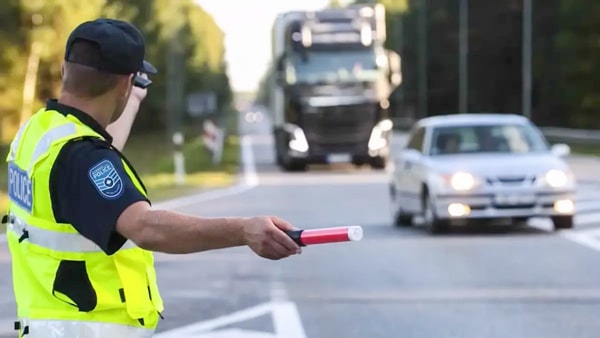
A law enforcement officer directs you through an intersection while the signal is red. What should you do?

A traffic light is red, but a police officer is telling you to go ahead anyway. What should you do?
  1. A Remain stopped until the signal turns green
  2. B Change lanes before entering the intersection
  3. C Follow the officer’s lawful direction
  4. D Wait for the officer to approach your window

Correct answer: C – Follow the officer’s lawful direction

Florida drivers must comply with lawful orders or directions given by authorized law enforcement officials. Follow the officer’s direction even when it differs from the displayed traffic signal. Willfully refusing is a second-degree misdemeanor, punishable by up to 60 days in jail and a fine of up to $500.

Source: Fla. Stat. § 316.072(3) – Obedience to and effect of traffic laws, Fla. Stat. § 775.082(4)(b) – Penalties; applicability of sentencing structures; mandatory minimum sentences for certain reoffenders previously released from prison, Fla. Stat. § 775.083(1)(e) – Fines

Question 6

A single broken white line between travel lanes indicates that:

A broken white center line on the roadway means:
  1. A Turns are prohibited
  2. B Drivers must reduce speed
  3. C Passing and lane changes are prohibited
  4. D Drivers may change lanes when it is safe

Correct answer: D – Drivers may change lanes when it is safe

A broken white line separates lanes of traffic moving in the same direction. A driver may cross it to change lanes when the movement is permitted and can be completed safely. Before leaving a lane, the driver must first verify that the lane change will not interfere with other traffic.

Source: Fla. Stat. § 316.089(1) – Driving on roadways laned for traffic, The Official Florida Driver License Handbook — Ch. 6, “Pavement Markings”