Georgia DDS Practice Test 2

4.7 out of 5 (303 votes)
80% Passing score
20 Questions
4 Mistakes allowed
A Georgia DDS practice test works best when it feels close enough to the real thing that your mistakes actually mean something. This GA practice permit test gives you 20 multiple-choice questions drawn from the same world as the official Georgia Drivers Manual: road rules, road signs, traffic signals, pavement markings, right-of-way decisions, seat belt rules, and the everyday driver responsibilities that tend to sound obvious until they are phrased like a DDS question. The real Georgia knowledge exam is not a random collection of useless topics. It is split into two separate 20-question sections: the Road Rules Test and the Road Signs Test. You need at least 15 correct answers on each section to pass, so a strong score on signs will not cover for a shaky understanding of traffic laws, and knowing the rules will not save you if signs and markings are where you drift. That is a small technical detail, sure, but it changes how you should study. You are not just trying to “do pretty well.” You are trying to be steady in both lanes, so to speak. This Georgia DDS practice test helps with that because it keeps the material tied to what the DDS actually tests. No random driving folklore, no overstuffed trivia pretending to be useful, just the parts of the manual that applicants are expected to know before getting a learner’s permit or moving further through the licensing process. And, a little awkwardly but importantly, the logistics matter too. You do not need an appointment for the non-commercial knowledge exam, but you do need to be on the testing computer at least 30 minutes before the Customer Service Center closes. The Class CP learner’s permit fee is $10, paid before the test begins, and if you fail any part, that fee is not refunded. Retakes are not complicated, but they are not exactly pleasant. After a first knowledge test failure, you wait 1 day. After a second failure, you wait 7 days, and each attempt means paying again. So taking this Georgia DMV practice test a few times is not busywork. It is a practical way to find the weak spots, go back to the manual with a sharper eye, and walk into the DDS with fewer surprises waiting for you.
FREE DMV Practice Test App
Study for your Georgia permit test or driver’s license with the NextDoorDriving app. 700+ DMV questions and answers, 100% free!
Download on the App Store

Sample Georgia Permit Test Questions

Question 1

A yellow warning sign showing two opposing roadways separated by a median means:
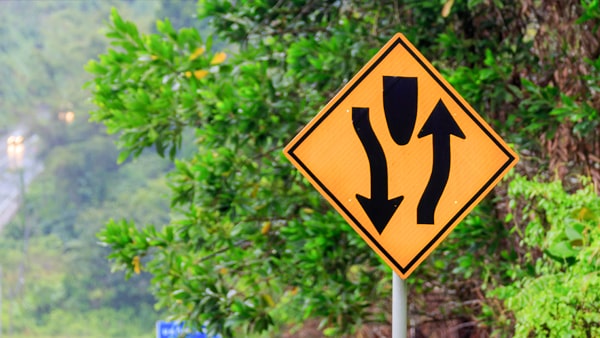
This sign means:
  1. A. The divided highway ends ahead
  2. B. A one-way street begins ahead
  3. C. Two-way traffic ends ahead
  4. D. A divided highway begins ahead

Correct answer: D. – A divided highway begins ahead

The DIVIDED HIGHWAY sign warns that a median or other divider begins ahead. Opposing traffic will travel on separate roadways. Be prepared to adjust your lane position as you enter the divided section.

Source: Georgia Department of Driver Services Drivers’ Manual — § 7, “Divided Highway Sign”

Question 2

Before passing in the opposing lane of a two-lane road, what must you evaluate?

When passing in the oncoming traffic lane of a two-lane road, you should consider:
  1. A. The time and clear space needed to complete the pass
  2. B. The distance and movement of oncoming traffic
  3. C. The passing zone, intersections, visibility, and other hazards ahead
  4. D. All of the above

Correct answer: D. – All of the above

On a Georgia two-lane road, look ahead to determine the length of the passing zone and whether oncoming traffic is present. You must have enough time and space to pass and return completely to the right lane before the passing zone ends, before entering an intersection, and before oncoming traffic comes within 200 feet. Hills, curves, and other hazards can also make passing unsafe.

Source: Georgia Department of Driver Services Drivers’ Manual — § 5, “How To Pass On A Two-Lane Road”

Question 3

Which behavior demonstrates defensive observation while driving?

  1. A. Keeping exactly one car length behind every vehicle
  2. B. Watching only the vehicle directly ahead
  3. C. Moving your eyes, checking mirrors, and looking ahead for hazards
  4. D. All of the above

Correct answer: C. – Moving your eyes, checking mirrors, and looking ahead for hazards

Defensive observation requires awareness of conditions ahead, behind, and beside your vehicle. Keep your eyes moving, look ahead for trouble spots, and check the rearview and side mirrors frequently. Focusing on only one vehicle or one part of the roadway can prevent you from noticing a developing hazard.

Source: Georgia Department of Driver Services Drivers’ Manual — § 8, “Tips For Expressway Driving”

Question 4

A train is approaching tracks that you intend to turn across. What must you do?

  1. A. Complete the turn before the warning devices fully activate
  2. B. Follow the vehicle ahead closely across the tracks
  3. C. Wait until the train has passed and the crossing can be entered safely
  4. D. Sound your horn and turn across if the train appears slow

Correct answer: C. – Wait until the train has passed and the crossing can be entered safely

The Georgia driver’s manual requires a driver to stop when railroad warning signals indicate that a train is approaching. Do not enter until the train has fully passed and the crossing is safe. Before proceeding, check that another train is not approaching on a second track.

Source: Georgia Department of Driver Services Drivers’ Manual — § 5, “Railroad Crossings”; § 7, “Railroad Crossings”

Question 5

Before changing lanes, how should you check an area that may not be visible in your mirrors?

  1. A. Look only through the rearview mirror
  2. B. Move closer to the vehicle ahead
  3. C. Rely on the side mirror after signaling
  4. D. Turn your head and look into the blind spot

Correct answer: D. – Turn your head and look into the blind spot

Before leaving your lane, check the rearview and side mirrors and then turn your head to inspect the blind spot. A vehicle can be positioned outside the areas shown by your mirrors. The visual check helps verify that no one is passing or occupying the lane you intend to enter.

Source: Georgia Department of Driver Services Drivers’ Manual — § 5, “How To Pass On A Two-Lane Road”

Question 6

In Georgia, a pedestrian carrying a white cane should be recognized as:

You need to use extra caution when driving near a pedestrian using a white cane because:
  1. A. A pedestrian who is deaf
  2. B. A pedestrian directing traffic
  3. C. A pedestrian who is blind
  4. D. A pedestrian who must use a wheelchair

Correct answer: C. – A pedestrian who is blind

A white cane, including one tipped with red, identifies a blind pedestrian. Drivers must yield the right-of-way to a blind pedestrian carrying such a cane or accompanied by a guide dog. Approach cautiously and be prepared to stop to allow the pedestrian to cross safely.

Source: O.C.G.A. § 40-6-94 – Right of Way of Blind Pedestrian