Georgia DDS Permit Practice Test 9

4.9 out of 5 (99 votes)
80% Passing score
20 Questions
4 Mistakes allowed
Georgia school bus rules deserve more attention than most new drivers give them, mostly because they are not just “stop when the bus stops” and call it a day. That would be convenient. The DDS expects you to understand the details: flashing lights, divided highways, traffic moving in both directions, children loading or unloading, and those moments when the correct move is to wait even though another driver is acting like patience was recently outlawed. This Georgia DMV practice permit test gives you 20 focused questions on school bus safety and related road-rule judgment, using the same general style you will see on the real Georgia DDS permit test. Multiple choice and true-or-false questions may sound harmless, but the answer choices can get particular. That is the point. A good GA DDS practice test should make you slow down, notice the wording, and get used to eliminating the almost-right answers before the official test does it for you. The full Georgia permit knowledge exam is administered by the Department of Driver Services and is based on the Georgia Drivers Manual. First-time applicants must pass two separate sections: a 20-question Road Rules Test and a 20-question Road Signs Test. You need at least 15 correct answers on each section, which means school bus rules, traffic laws, signals, signs, pavement markings, and general driver responsibility all matter. Not equally every minute, no, but enough that skipping one category is a bad little strategy. And the school bus topic is not some isolated exam trick. In Atlanta or Savannah traffic, you may have multiple lanes, impatient drivers, and a stopped bus creating a situation that feels messier than the handbook paragraph made it sound. On rural roads, the danger shifts: less traffic, maybe, but also curves, lower visibility, and fewer cues that a bus is about to stop. Same law, different kind of pressure. So, yes, this GA DDS practice test helps you prepare for school bus questions. But more than that, it gives you a cleaner read on the kind of driver Georgia expects you to become: alert, patient when it matters, and not easily bullied by bad guesses or honking strangers. This also fits into the bigger licensing picture for teens. For a Georgia Class CP Learner’s Permit, you must be at least 15, and the permit may be valid for up to 2 years. Once permitted, you drive only with a qualified supervising driver who is at least 21, licensed for a Class C vehicle, able to take control, and seated beside you. A Class D Provisional License comes later, at age 16 or older, after holding the permit for at least 1 year and 1 day. New drivers over 18 have their own process.  But no matter where you are in it, getting ready for the road starts with knowing the rules, and that's where this test comes in.

FREE DMV Practice Test App
Study for your Georgia permit test or driver’s license with the NextDoorDriving app. 700+ DMV questions and answers, 100% free!
Download on the App Store

Sample Georgia Permit Test Questions

Question 1

A posted regulatory speed limit indicates:

The posted speed limits show:
  1. A. The slowest lawful speed on the road
  2. B. The speed every driver must maintain
  3. C. The highest lawful speed when conditions permit
  4. D. A speed that is safe under every condition

Correct answer: C. – The highest lawful speed when conditions permit

A regulatory speed limit states the maximum speed permitted for that roadway. It does not guarantee that the posted speed is safe during rain, heavy traffic, limited visibility, or other hazards. Georgia’s basic speed rule requires drivers to travel at a reasonable and prudent speed for existing conditions, even when that speed is below the posted limit.

Source: O.C.G.A. § 40-6-180 — Basic rules, Georgia Department of Driver Services Drivers Manual — Section 5, “Speed Limits”

Question 2

The limit is 55 mph, but the pavement is wet. What should you do?

  1. A. Immediately slow to exactly 25 mph
  2. B. Reduce speed to a level that is safe for the conditions
  3. C. Continue at 55 mph because it is the posted limit

Correct answer: B. – Reduce speed to a level that is safe for the conditions

Wet pavement reduces tire traction and can lead to hydroplaning, especially as speed increases. There is no single fixed reduction that is appropriate for every wet road. Slow to a reasonable speed based on the amount of water, visibility, traffic, tires, and other conditions.

Source: O.C.G.A. § 40-6-180 — Basic rules, Georgia Department of Driver Services Drivers Manual — Section 8, “Hydroplaning”

Question 3

Which combination may result from a first Georgia DUI conviction?

  1. A. A possible jail sentence
  2. B. A required fine
  3. C. Suspension of driving privileges
  4. D. All of these consequences

Correct answer: D. – All of these consequences

For a first DUI conviction within the statutory ten-year lookback period, the law provides for a $300 to $1,000 fine and imprisonment ranging from 10 days to 12 months, subject to its probation and suspension provisions. Community service and completion of a DUI risk-reduction program are also required. A qualifying first conviction generally produces a 12-month license suspension under the licensing statute.

Source: O.C.G.A. § 40-6-391(c)(1) — Driving under the influence of alcohol, drugs, or other intoxicating substances; penalties; publication of notice of conviction for persons convicted for second time; endangering a child, O.C.G.A. § 40-5-63(a)(1) — Periods of suspension for certain convictions of Code Section 40-5-54 or 40-6-391; conditions to return of license

Question 4

Why does backing a vehicle require special care?

Backing up your vehicle is:
  1. A. A helper removes every risk
  2. B. The driver cannot see everything behind the vehicle
  3. C. Only large vehicles have restricted rear visibility
  4. D. Backing is prohibited on every roadway

Correct answer: B. – The driver cannot see everything behind the vehicle

A driver’s view is limited while moving in reverse. Before backing, check every side of the vehicle and verify that the path is clear. Turn your head and look over your right shoulder while backing instead of depending only on the mirrors.

Source: Georgia Department of Driver Services Drivers Manual — Section 5, “Backing Up”

Question 5

Under Georgia rules, when must a driver use headlights?

When should you use your headlights while driving?
  1. A. Only after complete darkness
  2. B. When it is raining or visibility is limited
  3. C. Beginning 30 minutes before sunset
  4. D. Only when another driver flashes headlights

Correct answer: B. – When it is raining or visibility is limited

Headlights must be used when it is raining or visibility is limited. They are also required from one-half hour after sunset until one-half hour before sunrise. Drivers should use low beams in rain, fog, snow, or smoke to limit glare.

Source: O.C.G.A. § 40-8-20 — When lighted headlights and other lights required, Georgia Department of Driver Services Drivers Manual — Section 5, “Use Headlights Properly”

Question 6

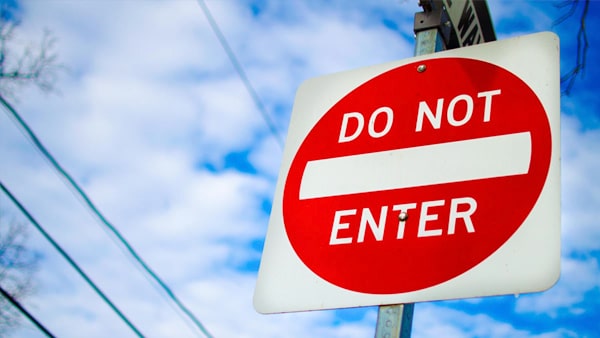
What does a red-and-white DO NOT ENTER sign mean?

This sign means:
  1. A. Come to a complete stop, then continue
  2. B. U-turns are prohibited
  3. C. Yield to vehicles already on the roadway
  4. D. Do not enter the roadway from this direction

Correct answer: D. – Do not enter the roadway from this direction

A DO NOT ENTER sign prohibits traffic from entering at that location or from that direction. It is commonly used where an entrance would place a driver against the lawful flow of traffic, such as at certain one-way roads or ramps. Choose another lawful route rather than passing the sign.

Source: Georgia Department of Driver Services Drivers Manual — Section 7, “Regulatory Signs—Do Not Enter Sign”